

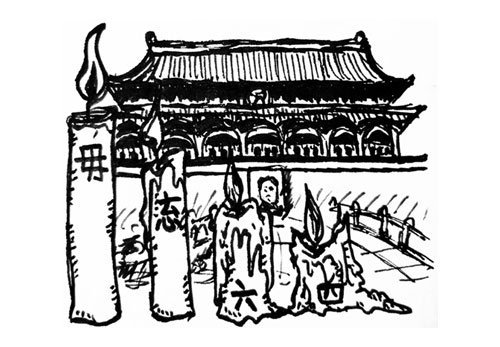
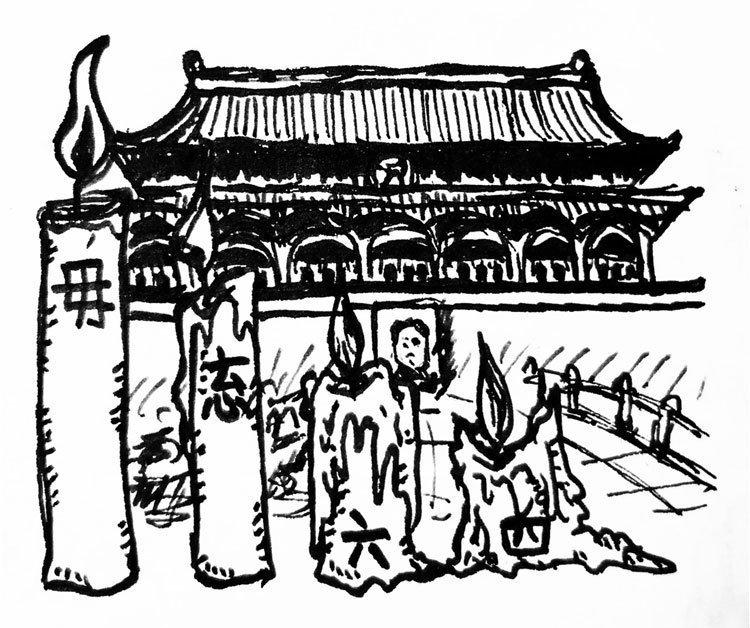
You can count on several things happening like clockwork this time of year relating to the dramatic and tragic events that took place in Beijing 32 years ago.
In places far from Beijing, the iconic image of a lone man standing in front of a line of tanks will make many appearances. And people will hold events to honour the martyrs and reflect on the meaning of the 1989 massacre that in English is usually associated with a place name, Tiananmen, and in Chinese with a date, 4 June.
Inside of Beijing, meanwhile, the lead up to the anniversary will see a tightening of controls on means of expression. There will be no displays of the Tank Man photograph that was taken on 5 June 1989. There will be no panels or group gatherings associated with last hours of 3 June and first hours of 4 June 1989, during which soldiers killed hundreds or perhaps thousands—there has never been a complete count—of people in the heart of the capital of the People’s Republic of China
Personally, there are also predictable aspects of this time of year.
I always think about the dramatic wave of protests that brought large crowds to the central plazas of cities across China in April and May of 1989. I think about the Big Lie that the Chinese Communist Party (CCP) cleaves to about those protests and the crackdown that ended them, which included not just the massacre in Beijing but also a smaller one in Chengdu, the definitive account of which appears in Louisa Lim’s The People’s Republic of Amnesia: Tiananmen Revisited. How long, I wonder, will the CCP deny that 1989 saw largely peaceful expressions of concern for the country and brutal acts of state violence? How long will the CCP insist that it is best to keep silent about the events of that spring—or present them as events that pit a small set of troublemakers spurred on by nefarious outsiders and intent to create ‘chaos’ against soldiers who exercised great restraint while restoring ‘order’ and in some cases lost their lives while doing so?
Each year at this time, I also find myself thinking about—and sometimes bringing up in print or at panels—recurring mistakes that mar some foreign commentaries on 1989. It is problematic to gloss over the fact that some soldiers lost their lives in Beijing that June. It is also problematic to present the massacre as one in which tanks rolled over students in Tiananmen Square, since the main killing fields were on a street near that plaza, not in the plaza itself. Since defenders of the Big Lie make the most of small mistakes, it is important to get the details right. One should acknowledge that a few soldiers were killed by crowds, but stress that this happened after the blood of unarmed civilians had started to flow. It is worth noting that students were among the martyrs but also pointing out that so were workers, retirees and members of still other social groups.
At this time of year, I also always find myself thinking about an award-winning film directed by Carma Hinton and Richard Gordon: The Gate of Heavenly Peace. I was among the film’s consultants—though one who did far less to shape it than did two other historians, Gail Hershatter and above all Geremie Barmé—so I am not completely objective about it, but I consider it the best documentary ever made on Tiananmen and one of the best made about the PRC. One of its strengths is that it shows clearly how wrong the Big Lie is while avoiding the mistakes mentioned above. It even shows an armoured vehicle going up in flames.
The film also, to its credit I continue to feel, presents the movement sympathetically but not hagiographically. Some Tiananmen activists and sympathisers wish it paid less attention to flaws within groups that were clearly on the right side of history, but it is notable that the film has always been banned on the mainland. And that it has fans in Beijing. Some of these fans came to admire it by seeing it circulating surreptitiously on the mainland, and will tell you, in private, that it was a shock to have it reveal the Big Lie for what it is. Others first saw the film while abroad or in Hong Kong, where it was shown while the city was a British colony and after it became a Special Administrative Region (SAR) of the PRC on 1 July 1997.
These predictable patterns do not mean that each June Fourth anniversary is the same—either for others or for me. There have always been and continue to be variations, sometimes from decade to decade, sometimes from year to year.
Far from Beijing, for example, in milestone anniversary years, there tends to be an uptick in the number of publications associated with China’s 1989 that appear and larger than usual turnouts for commemorative events. An unusually large number of Tiananmen op-eds were published in the international press in 2009, for example, and Lim’s book was published in 2014 just before the 25th anniversary. 2009 and 2014 were also two years when especially large numbers of people gathered in Hong Kong’s Victoria Park for its celebrated June Fourth vigil.
Inside Beijing, there have been changes over time relating to even what at first seems a key constant: the meaning of the Tank Man photograph. Both Lim’s book and Margaret Hillenbrand’s Negative Exposures: Knowing What Not to Know in Contemporary China, published last year, detail the extraordinary steps the CCP has taken to prevent that powerful image from circulating on the mainland for decades. In the immediate wake of the June Fourth massacre, however, as The Gate of Heavenly Peace shows, the authorities used footage of the lead vehicle failing to run over the Tank Man as ‘evidence’ that there had been no crackdown. Only later did the CCP realise that this interpretation of the imagery was unconvincing and instead tried to blot out all memory of soldiers and armoured vehicles having been on the streets of the capital in June of 1989. There were many in Beijing at the time of the first June Fourth anniversary who, if shown the photograph, would have thought of it not as a providing a novel sight or an image that was taboo, but as a still frame version of footage that had aired on state television.
As for me, one year stands out from all the rest when it comes to the anniversary: 2019.
This is because, while I had long wanted to attend the Victoria Park Vigil, I did not find a way to be in Hong Kong on 4 June until the 30th anniversary of the massacre. It turned out to be a very special vigil to attend. Its highlights included impassioned speeches, boisterous songs, and a magical moment when all fell silent and the more than one hundred thousand participants in the event held up candles. That moment changed forever the meaning to me of the idea that Hong Kong is a city of lights.
What made the 2019 vigil most significant of all, however, turned out to be the way it ended. Speakers closed the event on a forward-facing note, calling on the crowd’s members to return to the same spot in five days to take part in a protest against a new extradition bill that was seen by many as a direct assault on local freedoms and the city’s rule of law tradition. By 9 June, I had left Hong Kong, but many of the others who had help up candles at Victoria Park did what the speakers called on them to do and returned. So did hundreds of thousands of others. That demonstration drew a crowd estimated by some as a million strong. It is often described as launching the epochal protest surge of 2019.
What about anniversaries since then? What made last year’s June Fourth season distinctive and what is different about this year’s?
There was a major departure from all previous anniversaries last year because, for the first time, it was not legal for people to gather to commemorate the massacre in Hong Kong. Vigils were also banned, as they never had been before, in Macau. That former Portuguese colony had regularly been the site of significant commemorative gathering as well, albeit ones much smaller than those in the former British colony that stands near to it in the Pearl River Delta.
This was a break with tradition freighted with symbolic meaning. The fact that June Fourth gatherings were still legal in Hong Kong after it became an SAR in 1997 and in Macau after it became an SAR in 1999, when its time under Portuguese control ended, was treated as one sign that there was meaning to the ‘One country, two systems’ formulation. This was based on the idea that the two cities, while becoming part of the PRC in some senses, would remain places where residents could enjoy distinctive liberties and a distinctive way of life. The authorities in Hong Kong and Macau claimed last year that denying permission to hold the annual June Fourth commemorations was not motivated by political concerns but only public health ones. In the time of COVID-19, they said, gatherings were not safe. It was not, they insisted, a sign that the ‘One country, two systems’ framework had lost its meaning.
This year’s ban on the holding of vigils in Hong Kong and Macau needs to be seen as a repetition but one with a difference. This year, the authorities are again citing public health reasons, but at a time when some weeks go by without any new local cases of Covid-19 and when large crowds are being allowed to gather for other reasons. In Hong Kong, for example, stadiums have recently been crammed with fans during sporting events.
There are other differences worth noting relating to Hong Kong and Macau this year. In Macau in the past, photography exhibits that included showing of the Tank Man image were allowed, but this year a request to hold one was denied. In Hong Kong, this is the first time the anniversary will arrive with some local activists being punished for taking part in a June Fourth vigil. They are being prosecuted for defying last year’s ban and gathering in socially distanced groups to light candles in Victoria Park in 2020. In addition, the authorities have made it clear that to go to Victoria Park this year, or even simply to urge others to do so, will be treated as a serious offence, acts that could result in five-year prison sentences.
There was also a novel feature of the 2020 June Fourth commemorations held outside of the PRC that will be repeated but have added meaning in 2021. In these commemorations, one group that has always played a role is Tiananmen exiles, including some who escaped from the PRC in 1989 to Hong Kong. Last year, those Tiananmen veterans were joined at commemorative events for the first time by a small number of exiles from Hong Kong who had left the city they love to avoid being persecuted for their role in the 2019 events.
How exactly the anniversary day will pass in Hong Kong this year is unknown, but there have been calls by some organisers of past commemorations for people to take a new approach. Instead of gathering in one place to light candles for the martyrs of 1989, they are urged to do this in their neighbourhoods, so that, as one making the call put it, vigils will ‘blossom’ everywhere. If this happens, it will add still another layer of meaning to the idea that Hong Kong is a very special kind of city of lights.

More from Mekong Review
-

Beijing is determined to crush the protests
-
China crushes dissent in Hong Kong
-
An activist’s detention marks the start of 4 June
