

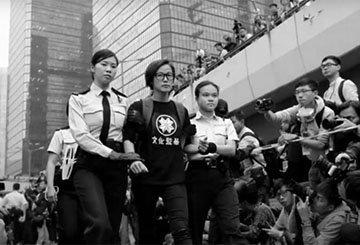
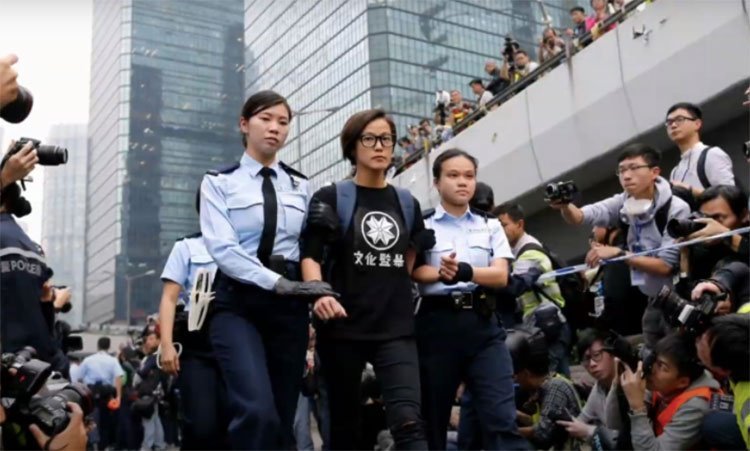
Denise Ho: Becoming the Song
Sue Williams (Director)
Aquarian Works and Ambrica Productions: 2020
.
Sue Williams’ new film about Cantopop singer-turned-activist Denise Ho is, at base, a love story. Since 1989, Williams has been directing documentaries about China’s past and present, including films that cover its century of revolution with dramatic narrative and historical detail. Denise Ho: Becoming the Song is also a revolutionary tale, one that weaves Ho’s career trajectory with the history of Hong Kong since her childhood, a period in which the former British colony became a Chinese special administrative region.
In the film’s opening sequence, Denise Ho—also known as Ho Wan-See or HOCC to her fans—remarks that, although her songs always played on ‘themes of freedom and liberation’, it is only recently that she has come to inhabit such lyrics. Tracing Ho’s career from Canadian childhood to Hong Kong rising star, from coming out publicly to support gay rights in Hong Kong to involvement in the 2014 Umbrella Movement, from being banned in China to becoming a pro-democracy activist, Becoming the Song is a love story in two ways: it is about Denise Ho becoming herself, and about Ho’s love for the city of her birth.
For newcomers to Hong Kong history and politics, the film is an accessible and engaging primer on the 2014 Umbrella Movement, the anti-extradition bill protests of 2019 and what is at stake with the 1 July National Security Law. The first concert we witness is an October 2019 performance in New York entitled ‘Free Hong Kong’, which depicts Ho bringing Hong Kong’s pro-democracy cause to the world stage, one that includes the US Congress and the United Nations Human Rights Council. In addition to insightful interviews with Ho, her family, and her staff, the film features commentary from former members of the Hong Kong government, scholars, musicians and ordinary fans. Former member of Hong Kong’s Legislative Council Margaret Ng is particularly eloquent, explaining the average Hongkonger’s participation in protest movements: ‘This is your only home’. Film footage not only includes historic and contemporary news coverage of political events, but it also splices in scenes of everyday life in Hong Kong, a reminder that the protests are about both politics and culture, both power and a way of life. As Ho sings in her 2015 ‘Dear Friend’ concert, it is about seeing ‘who the real heroes are’.
For long-time China-watchers, Becoming the Song is a reminder of the role that music—and art writ large—can play in political change. In this way Denise Ho serves as an allegory for Hong Kong society. She claims that as a young rising star, she was not interested in politics. But her idol-turned-mentor, the legendary Anita Mui, also used her stardom in the service of activism, including a benefit concert for protesters in Beijing in 1989. So too does Ho, as she turns thirty, begin to contemplate what ‘more there could be to a music career’.
In a similar way, the protests of 2014 and then in 2019 shocked the world: a Hong Kong society thought to be politically complacent took to the streets in the millions. Both protests became known for their creativity, from a proliferation of street art to the composition and popularisation of protest music, including 2014’s ‘Raise the Umbrella’ and a new anthem in 2019, ‘Glory to Hong Kong’.
Indeed, the power of music in revolution is part of Chinese history. China’s national anthem, ‘The March of the Volunteers’, was originally a film song that was sung, sometimes en masse, all over China and around the world. Similarly, Tiananmen Square in 1989 had its own unofficial anthem, Cui Jian’s ‘Nothing to My Name’. And music, especially Denise Ho’s Cantopop tradition, had the potential to cross borders even when it was banned. Despite the ban on pop music at the height of the Maoist era in the 1960s—a time when loudspeakers at the border played ‘Socialism is Great!’—radio waves carried broadcasts from Hong Kong and Macau into China. Officials on the China side reported with consternation that so-called ‘yellow music’ could be heard in the streets, its lyrics scrawled onto the walls.
But while Hong Kong bordered China, it also was a way station to the rest of the world. Denise Ho: Becoming the Song reminds us of the power of place, of a Hong Kong identity that is at once intensely local and cosmopolitan. Ho’s journey is one that is planted in Hong Kong but watered by her experience as a teenager growing up in Montreal. We follow her on a return trip to her childhood home, where she tells us that—true to her parents’ wishes—her Canadian upbringing allowed her to pursue creativity and music.
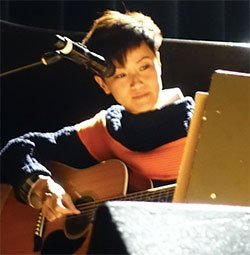
‘Canada,’ says Ho, ‘changed me completely … everything came from the education that I got in Canada.’ Yet it is back in the city of her birth that Ho finds her voice and makes her name, a place that crowdfunds a final stadium concert in 2016, after her political turn strips her of access to record labels and even performance venues. Beyond Hong Kong, her reception among the diaspora highlights its deep affinities and its own activism as it witnesses new threats to a place called home. If Denise Ho belongs to the world, so does Hong Kong.

More from Mekong Review
-
China crushes dissent in Hong Kong
-

An activist’s detention marks the start of 4 June
-
Why the world should stand up to China’s assault on Hong Kong
- Tags: Denise Ho, Denise Y. Ho, Free to read, Hong Kong, Notebook, Sue Williams
