

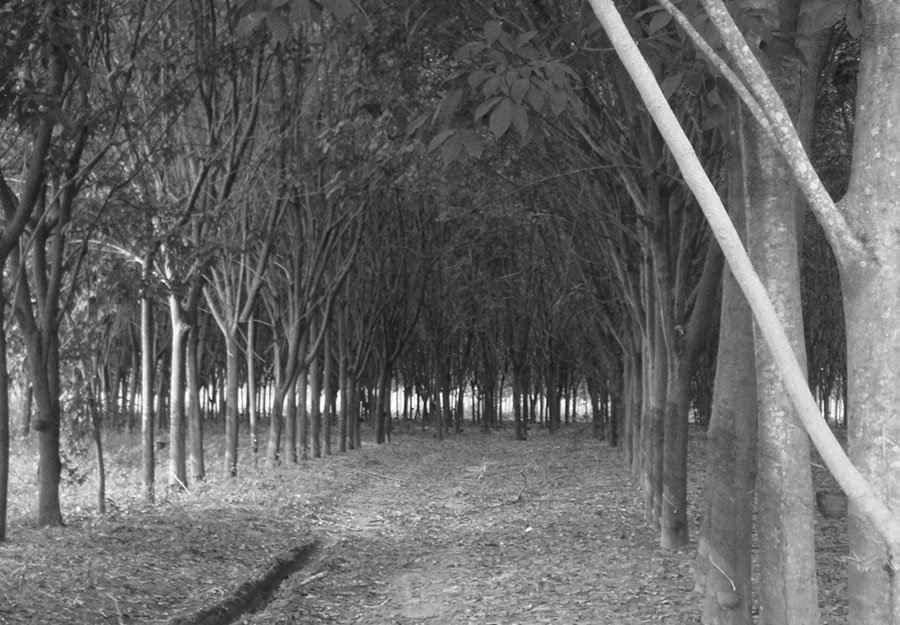
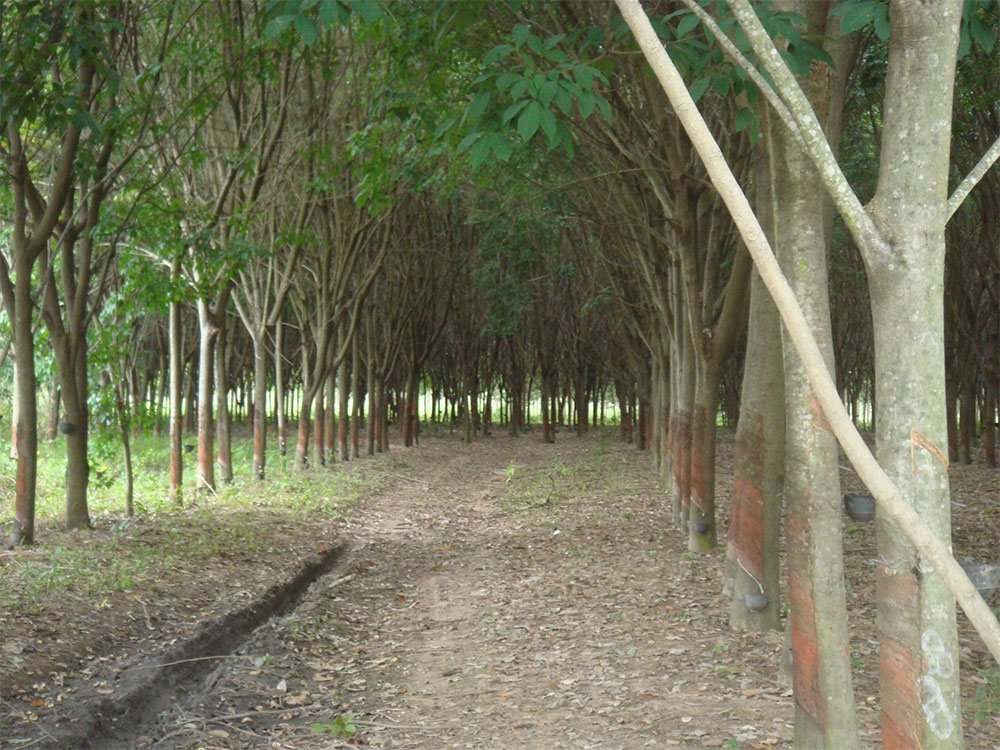
Past midnight, my companion and I were walking along an unmarked two-lane road in the south of Thailand, north of Phang Nga town, on our way back to Bangkok. An hour ago there was a suggestion of a village in this direction, but now we were lost among endless, near-identical trees. The trees were in careful rows, row upon row barely illuminated by my headlamp. We debated what they were. Eventually, roaming a bit off the road (now just dirt) we saw a V-shaped spout wedged into a trunk and a viscous white liquid dripping into a hanging bucket. Rubber plantations … The sight of gridded jungle from the plane, days before, came back with a stark realism. Of course, every tree was part of a large monoculture, and we were right in the stomach of it.
This was an ecology of southern Thailand I’d heard about. I had no reason to be surprised; I had read articles about the industry’s hundred-year-old beginnings and the myth of how a wealthy provincial ruler smuggled the first trees from Indonesia. Yet the experience arrived sidelong and unexpected. It was unfamiliar and immense, and sat oddly in my being—how do you feel the loss of something you never knew personally: outside your country, your ecology, your lifespan and your language? These monocultures will eventually strip the soil, eventually erode into themselves.
More from Mekong Review
-
Lockdown is forcing us to discover our own hometown
-
If you grew up in Bangkok, you’re unlikely to notice its bounty of sensory pleasures
-

Poetry from Maw Shein Win
- Tags: Conner Bouchard-Roberts, Issue 19, Thailand