

Mr [Vu Khac] Ngoc further elaborated that AirVisual’s data and rankings “have affected” Vietnam’s tourism, calling on Vietnamese people to review the app negatively. — VOA
Dear potential tourist
Come and discover the charm of Hanoi, Vietnam’s 1,000-year-old capital. As a twenty-first-century visitor, you’ll also experience Hanoi as a city of the future — one that portends our environmental fate. No special bookings or accommodation are needed: in Hanoi, all forms of tourism are ecotourism. It’s not the romanticised green sort you might expect; instead, it’s the leading edge of apocalyptic urbanisation. Politically correct, Hanoi ecotourism is no Orientalist adventure, but rather a journey into Hanoians’ everyday realities.
Hanoi is the most polluted city in Southeast Asia and, according to pollution monitoring company AirVisual, recently became the city with the world’s worst air. Hopefully, when you’re here, Hanoi’s air pollution will continue to top out, beating that of its main rival, New Delhi. Regardless, the air will be dense enough with particulate matter that you’ll sense the pollution with each breath. The best way to do so is to take a motorbike ride through the city. You’ll fill your lungs with unregulated fumes from other vehicles. Plus, it’ll be a good chance to experience the city’s legendary, snarled traffic. If you want a real Hanoi high, inhale deeply to induce a headache that feels like spikes needling your sinuses. Forego air masks for an authentic experience of our atmospheric future. Then again, if you want to look like a stylish Hanoian, mask yourself.
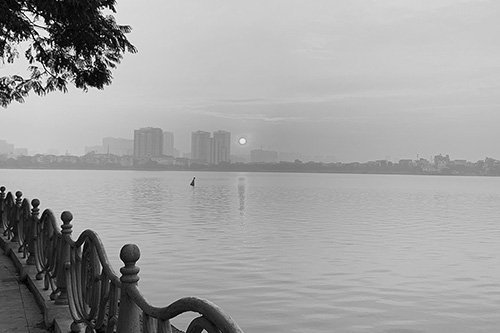
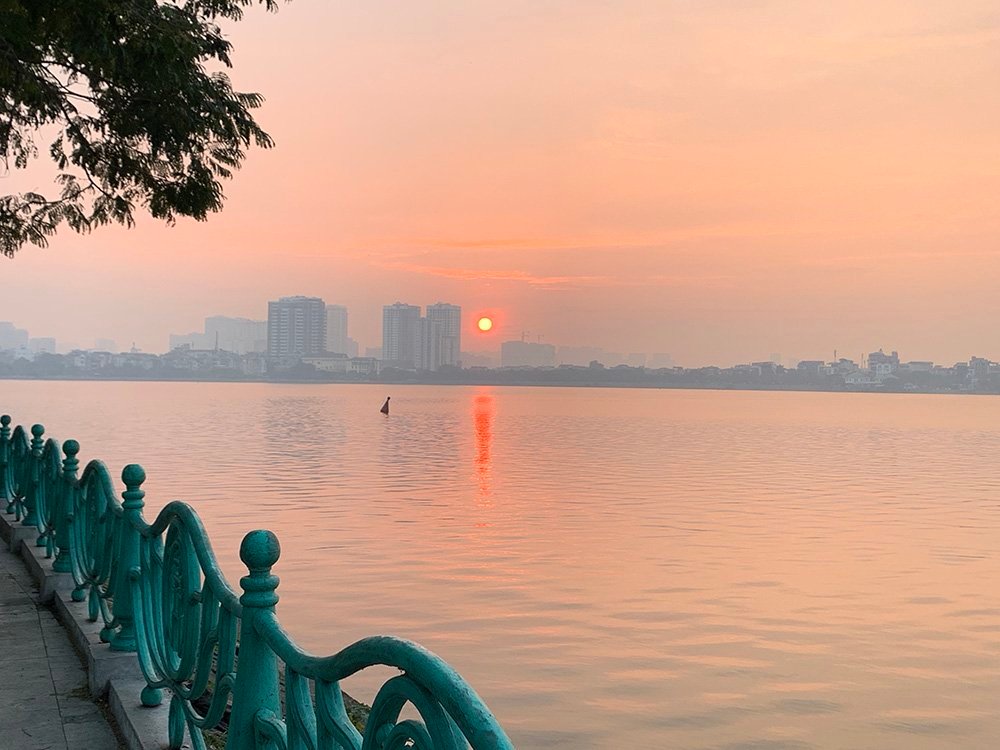
Hanoi is a city of lakes that are often blanketed by layers of fog. This scenic and tranquil milieu has inspired countless poems and paintings in Hanoi’s rich cultural history. These days, fog takes the form of smog, stubbornly squatting on the lakes and refusing to roll out. It gives an even more picturesque, romantic feel to the city —very Instagrammable. The smog is quite convincing. You’ll see plenty of locals out exercising around Hoan Kiem Lake and the larger Ho Tay (West Lake), particularly in the early mornings. Hoan Kiem Lake is closed to cars on the weekends, and a lovely road rings West Lake. There’s plenty of exercise equipment installed around West Lake, too, free for anyone to use. The really brave can even go swimming. West Lake’s fish died by the tonne a couple of summers ago, and it’s probably still toxic. Just wash off the water with other water afterwards. Be guided by the local swimmers, who congregate on the various staircases leading down to the lake.
Besides taking photos and swimming, drink the tap water. It wouldn’t be a true Hanoi experience otherwise. Truckloads of oil, buildings’ worth of human waste, and God knows what else are dumped into the city’s water sources. Bruce Lee might’ve said, “Be like water.” But more seriously, how are you going to be without water? You think you can solve the problem with bottled and filtered water? But where does bottled water come from? How does it get bottled? Why is it so cheap? Don’t trust plastic packaging so much. Yes, you ought to be a diligent Hanoi tourist and eat a proper bowl of pho or try an egg coffee. There’s no need to ask if the water has been filtered. Most likely it hasn’t — just believe in the pseudoscience that boiling water purifies it, even of heavy metals. Starbucks just closed seven Hanoi stores, citing no reliable water source and, in effect, acknowledging its inability to filter water. Imagine if every pho and coffee joint closed because of the water: What would you eat and drink? What would be left of Hanoi? Don’t be a quitter — drink and eat on. Hanoi’s waters have always been bountiful. And, like its pho and coffee, Hanoi wouldn’t be the same without its freshwater fish and snails. It’s not about tasting Hanoi’s flavours; it’s about ingesting some of Hanoi itself and letting it dissipate inside you at its own half-life.
There’s more to eating like a Hanoian. There’s plenty of enticing, legendary street food, enjoyed by the likes of President Obama and Anthony Bourdain. From skewered meats to pastries, from rice crepes to desserts, it’ll pop out at you on every street corner and in every nook. It’ll come to you on bikes, even delivered via apps. But be smart, which means be selective. Yes, the short-term effects might include an upset stomach, a painful episode in a strange bathroom, but this too shall pass. The potential long-term effects are more serious: a spectrum of chemicals is used as preservatives. The most notorious case involved using formaldehyde to prolong “fresh” pho noodles. Vegetables survive for weeks. Decaying meat can be regenerated with injections. So find establishments buzzing with Vietnamese folks. A restaurant’s crowd inevitably includes returning customers who haven’t suffered short- or long-term effects. Follow your willing predecessors, those still healthy enough to stand in line, still alive to eat. Don’t buy fruit or vegetables in open-air markets. Many Vietnamese trust supermarket chains for produce. It’s dystopian when a socialist country depends on food companies to self-regulate food safety, but that’s the only realistic hope of oversight right now. Don’t worry — linger around any school during dismissal and you’ll see smart vendors targeting those voracious appetites. Hopefully, vendors feeding Vietnam’s youth source their food ethically. It’s not guaranteed, but there’s a greater probability of food safety. No local will confuse you for Humbert Humbert. This is an accepted eating strategy.
The particulate matter in the air and the chemically laced foods are Hanoi’s constants. But look out for greater catastrophes. Something will happen while you’re here. Not too long ago, a lightbulb plant lit up the Hanoi sky, as an exploding incandescent-production plant should. The blaze was an all-consuming spectacle for anyone outside. With all the rubbernecking, it took the city a while to realise that quicksilver was escaping into the ground and the air. You could snap that unnaturally coloured fire brightening the city’s night sky. Then you might quickly figure out you’re being poisoned. If you’re unsure, you’ll go into a state of panicked, ignorant helplessness. You’ll have to consult the internet about the symptoms of mercury poisoning. How does unleashed mercury vaporise and leak? The company will first deny any use of the chemical in question and later confess otherwise. Officials will issue and rescind safety warnings and evacuations. Your embassy will have no idea what’s going on. You’ll have to figure out if any of your food or water comes from the contaminated area, if the wind bearing mercury blew your way. Stop worrying; such concerns are foolish and impossible to resolve. Soon it’ll be declared that all is safe and clean. It’s fine that everyone’s lying to you — you don’t have a choice. Come to peace with your helplessness and you will have fulfilled whatever Asian spiritual quest you paid for.
For more information on such events, you’ll have to comb the news yourself. You’re a tourist in a neoliberal world, where everyone is on their own when it comes to information. Learn Vietnamese — the local media has more coverage, including conspiracy theories that might add some colour and context to such inexplicable events.
Is Hanoi good for young children? Just bring them. They’ll hate walking on the tiring obstacle courses that are supposed to be footpaths. They might complain about the smells and the rubbish. One of them might even get dengue fever, but just think of the first bout with the virus as a mulligan. Traffic accidents are common but not necessarily fatal. Probability and luck are in your favour: your children most likely won’t die. The whole point is to sharpen your sense of guilt. Immerse your progeny in the conditions you’ve put them in. Then you’ll have to question your decisions, your inability or unwillingness to do something. You may begin to scream with as much urgency about your kids’ environment as you do at their sporting events. In the same way you’re really barking at your own inadequacies as an athlete, reliving your sports days vicariously, you should empathise with your children and yell at your younger self for quitting and pouting. You’ll understand better why teenagers have had to take charge and save the planet.
You could say that clean air and water are among the most basic necessities, the earth’s last democratically available resources. Daily sustenance shouldn’t be deleterious. Yet even when all the fundamental aspects of human life are compromised, the Vietnamese government continues to maintain social order and stability. Hanoi is no Hong Kong. Your flights won’t be disrupted; your shopping won’t be unimpeded; your tour bus won’t lose its barrelling right of way. Environmental stuff aside, Hanoi remains one of the safest travel destinations, with low crime levels and no terror threats. If you’re still worried, buy a return ticket: the exit date will be a psychological security blanket. Stay long enough, though, and you’ll think of pollution like jetlag: after a while you’ll adjust to local rhythms.
If you need proof, visit the West Lake peninsula, where you can see expats who have not only acclimated to the pollution but have become cynical about it. They’ll tell you to buck up, as they have done; they’re still enjoying their privileges, kicking back and partying. As for Vietnamese Hanoians, be assured that Vietnam has been poisoned for half a century now by the United States’ relentless aerial blitzkriegs of artillery and chemicals during the Vietnam War. It’ll seem as though everyone’s getting on with their lives, as they always have. “Don’t cry before your own funeral,” they’ll tell you. Everything will be OK. Come spend your money.

More from Mekong Review
-

Vietnam as seen from above and below
-

Be wary of Vietnam’s hybrid economic model
-
The lockdown order Da Nang has been dreading
- Tags: Ben Tran, Free to read, tourism, Vietnam
