

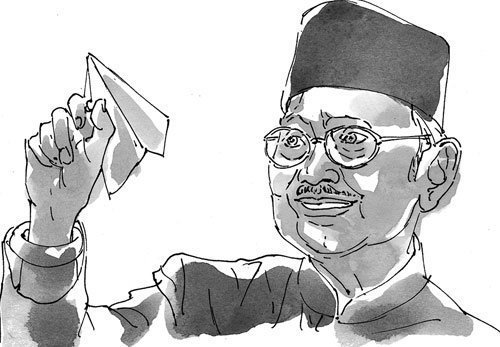

Walking into Minister Bacharuddin Jusuf Habibie’s office as a new reporter in Indonesia in September 1993 meant trying to reconcile conflicting mental images of the man: manic scientist or insidious courtier. It was only six months since the senior member of the authoritarian Suharto regime had unsettled the economic establishment with unusually frank public comments about tensions within the government over its direction.
After three ministerial terms as an idiosyncratic aviation engineer calling for massive investment in technology, Habibie, as a source of advice for Suharto, had emerged as an influential alternative to the ex-generals and Western-trained economists who tended to fill most cabinet jobs. His bid to be nominated vice-president earlier that year had failed, but several of his associates who had come up through his personally crafted Ministry of Research and Technology (and its associated agencies) were now themselves ministers, while some of the long-serving economist-technocrats had not been reappointed.
As a business reporter in the sway of the mainstream economic rationalism favoured by technocrats, I would have absorbed the latest excoriation of Habibie in the pages of the latest Bulletin of Indonesian Economic Studies (BIES). From the rarefied atmosphere of the Australian National University, in Canberra, BIES has been the self-styled voice of rational economic policy in Indonesia for half a century, and from the 1980s Habibie was a particular bête noire. “All eyes recently have been on the Minister for Research and Technology and his vision of ‘technological leapfrogging’ as the preferred development path for Indonesia to follow,” the lead article warned about the latest turn in normally opaque Indonesian politics. “To Habibie, however, ‘development’ seems not to be about incomes but about the physical appearance of the economy: it consists in the proliferation of enterprises which make heavy use of technology — seemingly regardless of the impact this might have on national income.”
More from Mekong Review
-

Two poems by Rory Harris
-

Magical realism meets gritty realism
-
Indonesia in the 1960s, through the prism of post-colonialism