

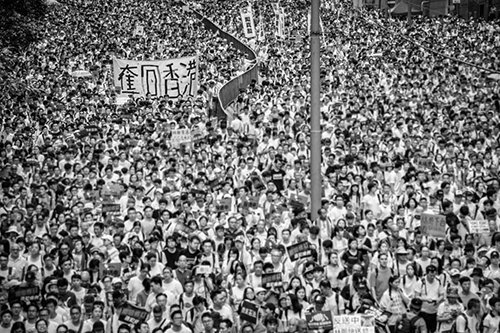
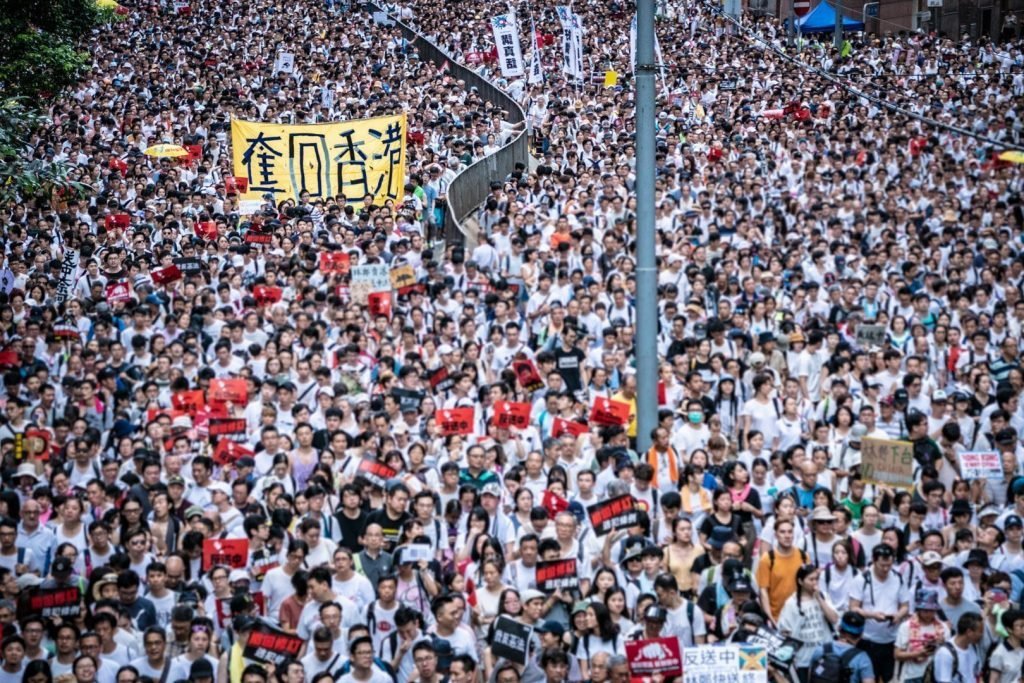
Gwong Fuk Heung Gong! Si Doi Gark Ming!” If you understand this slogan, chances are you’re a Hongkonger of the post-80s or post-90s. The “language” is a form of loose Cantonese romanisation (a feature of the wider linguistic phenomenon Chinglish/Kongish) that recently surged from niche exchanges to widespread societal use in political activism, via the online platform LIHKG.
What is loose Cantonese romanisation?
Loose Cantonese romanisation exists apart from standardised forms of Cantonese romanisation such as Jyutping and Yale, and is believed to have come into existence in the late 2000s. It arose organically as the use of instant messaging applications (such as the now defunct MSN Messenger) increased among post-90s who were unfamiliar with the Chinese input systems of Cangjie or Zhuyin. The widespread use of personal mobile phones and texting in the early 2010s also contributed to the development of loose Cantonese romanisation; texters did not always change to the available Chinese input methods from the default English keyboard when expressing Cantonese messages, choosing instead to romanise Cantonese words via the English alphabet.
Why did loose Cantonese romanisation arise despite the existence of standardised systems of Cantonese romanisation?
The answer probably lies in the lack of use of Jyutping (developed in 1993), Yale (1958) and Cantonese pinyin (1971) outside professional and academic contexts. Most of the post-90s generation are not literate in these romanisation systems, which were not taught in schools — unlike Hanyu Pinyin in China and Zhuyin in Taiwan — and the elements of International Phonetic Alphabet enunciations and characters in these systems make them inaccessible and unintuitive to the layperson.
Romanising Cantonese according to the rules of English phonics requires the romaniser to be familiar with both the phonics of written English and the phonology of spoken Cantonese. The Hong Kong Education Bureau’s “trilingual and biliterate” language education policy since the 1997 handover has greatly increased English-language standards among students, and thus the average post-90 is much more likely to be familiar with English phonics than with Jyutping or Yale, and also when compared with the previous generation of Hongkongers. This policy, coupled with the aforementioned technological developments, laid the framework of necessary linguistic conditions for a new form of Cantonese romanisation to arise organically among the post-90s generation.
Why use loose Cantonese romanisation?
The main purpose of loose Cantonese romanisation is efficient communication. Owing to the widespread use of code-mixing among the younger generation of post-80s and post-90s, interlocutors found it troublesome to switch between the Chinese and English keyboards or input methods (particularly with earlier models of mobile phones) to code-mix an English admixture into Cantonese texts, and would thus choose to transcribe the message in loosely romanised Cantonese instead. Even if the interlocutor uses a Chinese input method, the preferred method of much of the younger generation (who were not taught Cangjie or Zhuyin) is handwriting, and many interlocutors would not be familiar with the written characters of frequently used words owing to their obscurity and complexity, despite their familiarity with them in spoken Cantonese. A good example is the pronoun 佢 (he/she/it), loosely romanised to kui, which in Jyutping is keoi5 but in Yale is kéui.
Does loose Cantonese romanisation follow any rules?
Despite developing organically, loose Cantonese romanisation is not without its rules. The word 邋遢 (dirty/untidy), for example, is loosely romanised as laat taat, which in Jyutping is coincidentally also laat6 taat3, and in Yale is laaht taat. This suggests that despite having no tones, loose Cantonese romanisation follows (certain) similar rules to standard forms of romanisation, which are likely to be the ones widely applicable to romanisation in general (of any language). Owing to the highly tonal quality of Cantonese — it has six to nine tones, depending on how you’re counting — the lack of tones in loose Cantonese romanisation results in a large number of homographs, which could alter the entire meaning of a sentence. Ngo seung hui lah, for example, means either “I want to go now” (and I previously did not want to go) (我想去啦) or “I’m going up” (我上去啦), depending on whether the word morpheme seung is interpreted as soeng2 (想) or soeng5 (上). Thus the elucidation of homographs in loosely romanised Cantonese relies largely on context. The lack of tones also constrains loose Cantonese romanisation by reverting “lazy sounds” (merged phoneme pairs) to standard Cantonese pronunciation, most notably the morphemes for “me” (我) and “you” (你): 我 is transcribed as ngo as in the Jyutping ngo5 though nowadays pronounced as o5, whereas 你 is transcribed as nei, as in Jyutping (nei5), although pronounced like lei5.
To what extent does loose Cantonese romanisation demonstrate productivity?
Loose Cantonese romanisation, which is used increasingly by the masses, is highly productive, with new phrases coming into existence each day. These phrases are usually instances of the code-mixing of Cantonese with English admixture on the morphemic level, or are shortened versions (contractions) or shorthand forms of Cantonese expressions. Examples of the former include g hau for the phrase 之後 (zi1 hau6), meaning afterwards, in which the pronunciation of the letter G is substituted for the similar sounding morpheme zi1; and the code-mixed phrase yurked, which adds the past-tense suffix “-ed” to the Cantonese morpheme 約 (joek3) meaning “make plans to meet” to form a compromise form which expresses the sentiment “previously made plans to meet” in a single morpheme. Examples of the latter include ks in short for kei sud (其實 / kei4 sat6), meaning “actually”; m guns / mm guns in short for m gunyiu / mm gunyiu (唔緊要 / m4 gan2 jiu3), meaning “no worries”; and of course the pervasive and characteristic profanity dllm/dnlm for diu lei lo mo / diu nei lo mo (屌你老母 / diu2 nei5 lou5 mou2), which is the equivalent of the English vulgarity “fuck your mother”, an emotionally charged sentiment that has, with recent developments, become politically charged.
Was loose Cantonese romanisation always so prevalent?
Until recently, loose Cantonese romanisation was largely confined to the niches of intra-group communication between young post-90s Hongkongers with high levels of bilingual literacy. Owing to the colonial history of Hong Kong, there exists a psychological ambivalence towards English; it is rarely used among Hong Kong Chinese for intra-ethnic communication (unlike in other colonial societies, such as Singapore and India) to avoid coming off as overly Westernised or pretentious, because of the assumed prestige attached to this “high” variety of language. Loosely romanised Cantonese requires a considerable level of English proficiency, so some netizens viewed the romanisation of Cantonese as a trait of the highly Westernised and elite that they felt was unintelligible and indecipherable to the average Hongkonger with limited to elementary English proficiency. A simple search on the Facebook page “名校 Secrets” (Elite Schools Secrets), an anonymous confessions page, reveals multiple examples (dating from as early as 2013 to as recently as 2017) of netizens who themselves apparently come from an elite cohort of EMI (English as the medium of instruction) schools — and should theoretically be proficient in English to a considerable level — vilifying the loosely romanised Cantonese of their peers as pathological, pretentious and unintelligible. Despite these criticisms, loose Cantonese romanisation thrived in bilingual environments and gained traction in society, such that in 2013, Google introduced its Cantonese input, which recognises loose Cantonese romanisation (or other non-standard Cantonese romanisation), in itself is a linguistic feat of loose romanisation, though seemingly counterintuitive to its own linguistic origins.
A year later, during the 2014 Umbrella Revolution (see the unofficial Chinglish motto of the movement, “Hong Kong, Add Oil!”), various news outlets such as localist magazine 100毛 demonstrated the increased use of the wider linguistic phenomenon Chinglish/Kongish. A distinct sociolinguistic identity among Hongkongers — the Cantonese Is My Mother Tongue movement — to counter the corrosion of Cantonese by Mandarin (as a vernacular and medium of instruction) was also made salient. These linguistic conditions set the stage for the creation of the bite-sized-news page Kongish Daily (with more than 48,000 likes to date), which uses loose Cantonese romanisation, code-mixing and Hong Kong English to caption and share news updates in line with an understated localist agenda.
How did loose Cantonese romanisation become prevalent in political activism?
One post on LIHKG was all it took for loose Cantonese romanisation to shoot to the front lines of the anti-ELAB protests and resistance movement. The initial thread read:
LEI YUT GOR HAI 8.18 DA GA KAU TONG GE FONG SIK
IF U WAI YI YAU GHOST, WRITE ON A PIECE OF PAPER
“NEI GI NG GI NGO UP MUD 7 AH?”
YU GWOR KUI TAI NG MING
JAU GI KUI HAI YUN DING HAI GWAI LA
TONG NGO TUI BAO KUI AH DIU!!!!!!!
Approximate translation, with glosses:
This is how we communicate on 8.18 (day of scheduled peaceful protest), if you suspect there might be a ghost (a troll/spy), write on a piece of paper: “Do you know what the **** I’m saying?” (in loosely romanised Cantonese). If they are unable to understand, you will then know if they are human (a true protester) or ghost (a troll/spy). Bump this so it becomes ****ing viral!!!!!!
Protesters were wary of online trolls and spies planted among them by the Chinese government, and a LIHKG user suggested using loose Cantonese romanisation, understood only by Cantonese speakers, to weed out Mandarin speakers from the mainland, who may be able to sound the slogans but would be unable to comprehend its meaning.
After this post, a barrage of political slogans and posters appeared online overnight, from the unofficial slogan of the anti-ELAB protests, “Gwong fuk heung gong, si doi gark ming” (Liberate Hong Kong, the revolution of our times); “Wai yuen gin” (See you at Victoria Park), calling on citizens to join the peaceful protest in Victoria Park the next day; and the informational “Wo ping jaap wui ngo yau kuen, V park no space gum dim sin” (I have the right to peaceful protest, but there is no space in Victoria Park — what should we do?).
What does the use of loose Cantonese romanisation imply for the social and linguistic identity of Hongkongers?
Social identity is intrinsically linked to the linguistic identity of an ethno-linguistic group. As the linguistic identity of the Hong Kong Chinese becomes more developed and complex, the social identity of the speech community also undergoes changes in aspects of culture and politics.
According to theory, social identity is “based in comparisons people make between in-groups (group they belong to) and out-groups (groups they do not belong to)”. Thus, as speech is a way to express group membership, members of a speech community tend to strive to maintain a positive social identity by adopting convergence in communication to “signal a salient group distinctiveness, so as to reinforce a social identity”.
In Hong Kong, the use of loose Cantonese romanisation in political activism is used to “signal a salient group distinctiveness”. It differs from instances of romanisation in other contexts — such as, rather ironically, the non-standard form of romanisation adopted by the Hong Kong government for the names of roads and places — in that it serves the purpose of contending with the previously mentioned corrosion and infiltration of Cantonese by Mandarin by its unapologetic use of loose Cantonese romanisation. The use of loose Cantonese romanisation in these highly publicised contexts (slogans, activism materials, public online forums), as compared with its previous confinement to niche and private communications (instant messaging), also demonstrates that Hongkongers have increasingly adopted this form of communication as part of their social and linguistic identity to validate their status as Hongkongers, and, more specifically, as bilingual Cantonese speakers from Hong Kong.
Loose Cantonese romanisation spread organically, and slowly but surely, from the niche to the masses until one post on LIHKG shot it to stardom. The further development of loose Cantonese romanisation will probably be entwined with the political fate of Hong Kong and the language education policies of the government. The productivity of loose Cantonese romanisation will continue to produce linguistic innovations that will redefine the lexicon as we know it. Until then, our generation will be known as the vanguard of the trilingual and triliterate.

More from Mekong Review
-
One country, two systems, many walls
-

A poem by Leung Rachel Ka Yin
-

The accidental reporter in Hong Kong

