

Most festivals are like birthday parties. They pierce the relentless monotony of daily life—like new year days, harvest or spring festivals, and religious events. In that sense, festivals are also celebratory.
The little state of Penang in Malaysia is known for its many festivals, not to mention the many public holidays the country organises every year. These holidays are exhibitions of mutual respect between the many ethnic groups, religions, and states and sultanates that comprise Malaysia. They are part and parcel of hopeful nation-building, one supposes.
But then there is a festival in Penang with a strong activist element. It has a clear agenda: to promote the love of literature, to highlight the importance of literacy. That is a project without end. In fact, it considers mastery of language, of reading and writing, and of contemplation as the essence of individual integrity and development.
This is the George Town Literary Festival (GTLF). Unlike most festivals, it is owned and curated by a think tank—the renowned Penang Institute.
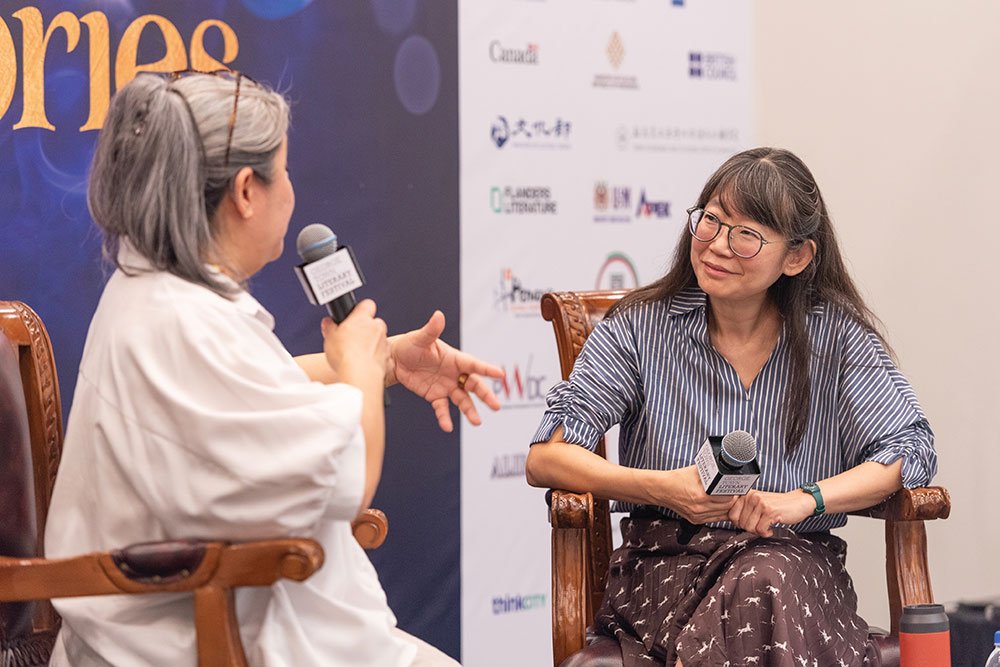
The rationale behind the Institute’s decision to adopt the festival as one of its key annual events several years ago is the belief that nation-building in a new country like Malaysia tends to ignore the humanities in favour of learning and skills that will supposedly lead to well-paying jobs. No doubt the latter is important, but when done at the cost of individual intellectual breadth and depth, the long-term consequences lay the groundwork for shallow discourses in human interactions and contemplations. Even alienation.
Realising that the demands of modern life makes contemplation, curiosity, and meditation difficult, and convinced that profound meanings become more easily available to those who love and master the use of language—such as those who appreciate how expressive, poetic, and evocative any language can be, and who believe that social interactions become deeper through healthy conversations—Penang Institute sees the GTLF as an effective vehicle through which to promote this vital understanding of literariness.
Discovering the joys of literariness, of proactive thinking, of intellectual interactions, according to ancient Chinese thought, constitutes civilisation itself. That is why, before the advent of Science and Technology as clearly defined subjects, the humanities were the basis for most human knowledge in most parts of the world.
While science and technology have given us much, they have also taken much away. Large parts of our shared heritage have become alien to human consciousness and to society’s integrity. A high speed of change is not conducive to self-knowledge and self-appreciation.
Human beings love stories. Narratives, discourses, tales, biographies, even conspiracies—these define us. They offer meaning; true or false is not even the point. A good story provides fodder for thought, for human interaction, for penetrative contemplation. That resource is valuable, and that is what makes us human. There are things AI cannot take from us: face-to-face conversations, the love affair between author and reader, the imagining of meaningful non-realities, the emotive transfer of insights. Epiphanies and poetic novelties.
With the invention of paper and printing, our minds expanded, and our ability to convey and generate knowledge and ideas multiplied a thousand-fold. The epistemic evolution that humans have experienced over the last few millennia has always come at a price at every stage. When it happens at great speed, as has been the case in the last couple of decades, what gets lost may not even be properly identified, and therefore the loss remains unmitigated and ignored.
Every thinking person’s job in the twenty-first century should be to recognise, identify, and remedy what humanity continues to lose by moving at a speed dictated by machines and money. Information technology, by its nature, is global. This naturally overwhelms the local, the immediate, and the personal.
GTLF celebrates these latter things. We promote authors who are fringe and who are local (in the sense of writing about the small, the fleeting, and the imaginary), but who touch on things generally human and who wish to communicate with a live audience.
The themes chosen over the last three years offer some insight into the train of thought and the type of activism promoted by Penang Institute as curator for the GTLF. In 2024, we told the people of George Town that the festival was as much their festival as anybody else’s. We focused on “Word on the Street”. With that phrase, we meant to say that everybody has tales to tell, and that we are, on a daily basis, surrounded by a legacy of words chosen for particular and personal reasons. These are the city’s Scrabble pieces, and they are part and parcel of our daily life.
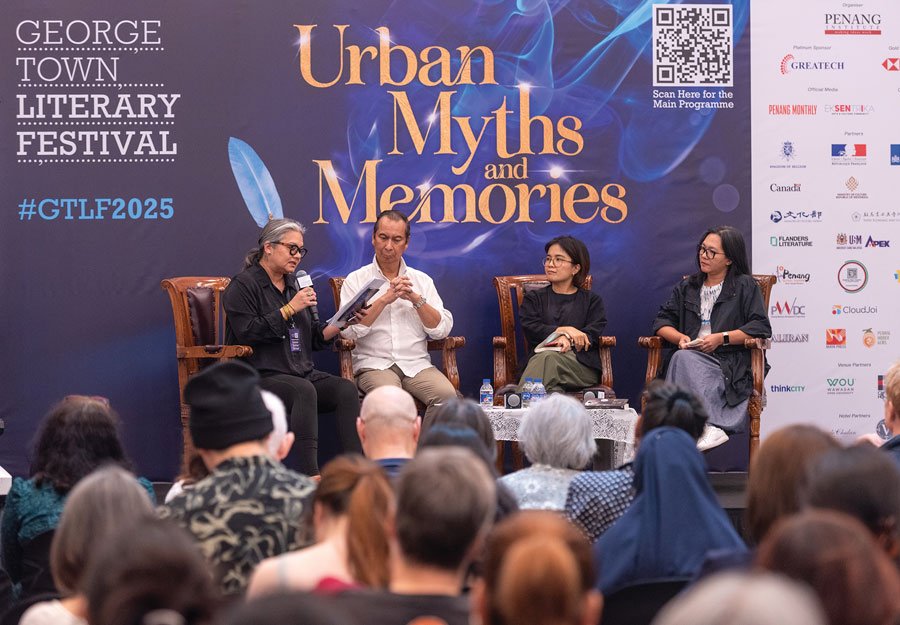
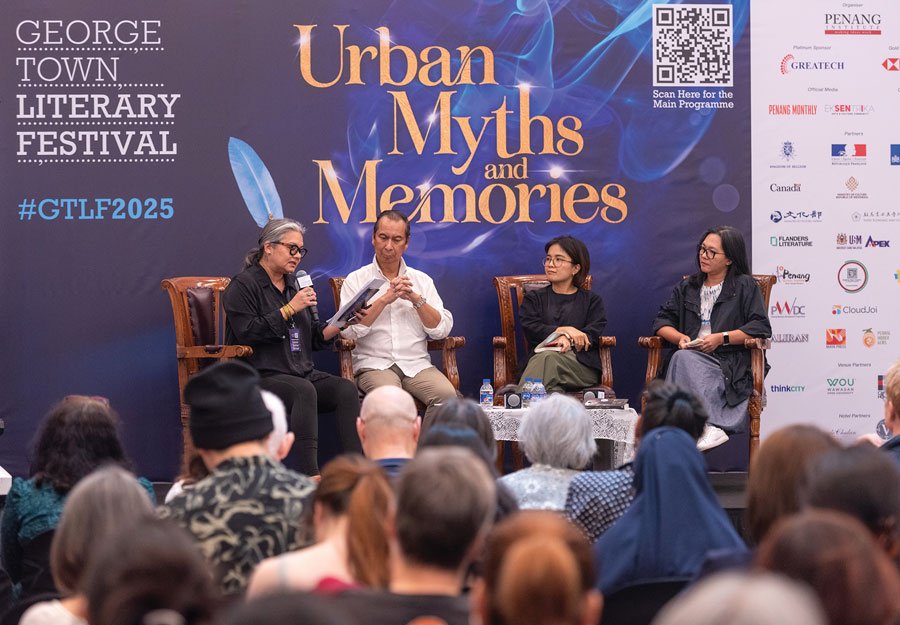
The following year, we wanted people to realise that the institutions and associations in George Town all have written sources hidden away in their cupboards and cellars which are valuable to historical research. The minutes of their board meetings can whisper tales in the eager hands of a gifted storyteller. The theme that year was “Urban Myths and Memories”. We shone a torch into the back lanes, dungeons, and dusty cabinets of Penang.
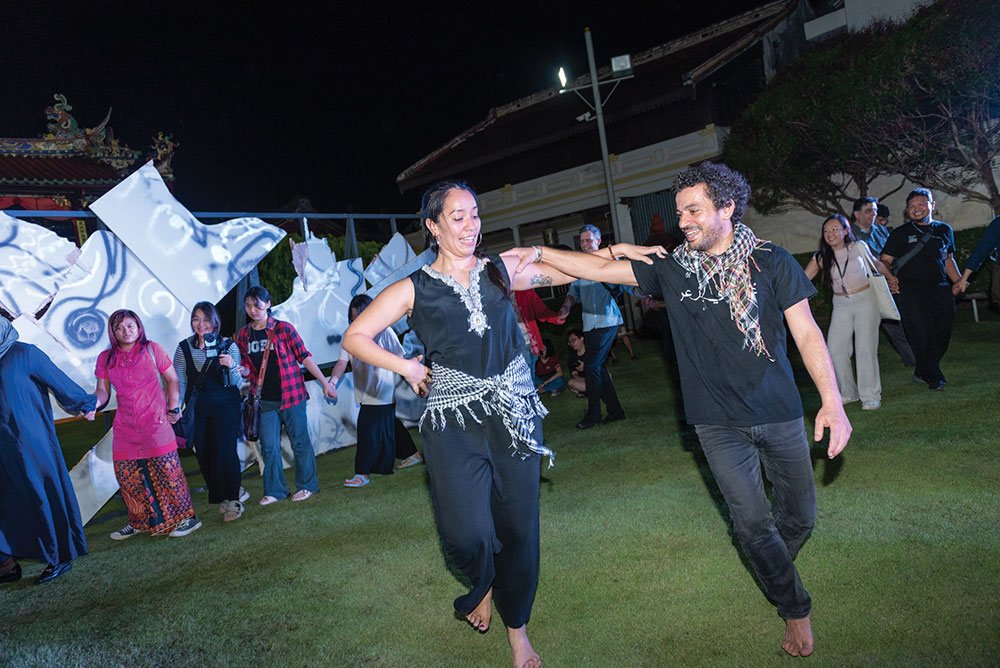
In 2026, the theme is “Cosmopolises”. Again, we stick to our deconstructive ambition to showcase differences rather than similarities. A cosmopolis is, by definition, a place where cultural differences and economic endeavours meet and interact. What we wish to highlight is the fact that such places are not repeats of each other. There are cosmopolises, and there are cosmopolises. Furthermore, there is no clear line across which a city becomes a cosmopolis—seemingly homogenous populaces can also be vibrant to an exciting extent.
Most importantly, a cosmopolis also suggests a limit to political control. For order to persist in a complex society—which is what a cosmopolis is—rules and social attitudes will need to be tentative and adaptive.
One could say that the George Town Literary Festival is Penang’s gift to those who seek personal expression, social celebration, and a meaningful future. It is a place for the rediscovery of self, and for the discovery of other minds.
It is where one can just simply be human.

More from Mekong Review
-

A literary festival with a political message
-

A poem from Hon-Wai Wong
-

A poem by Ryan J.M. Tan