

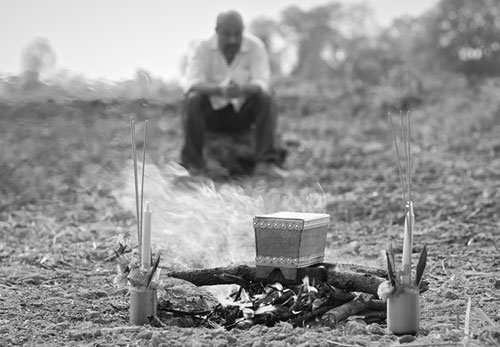
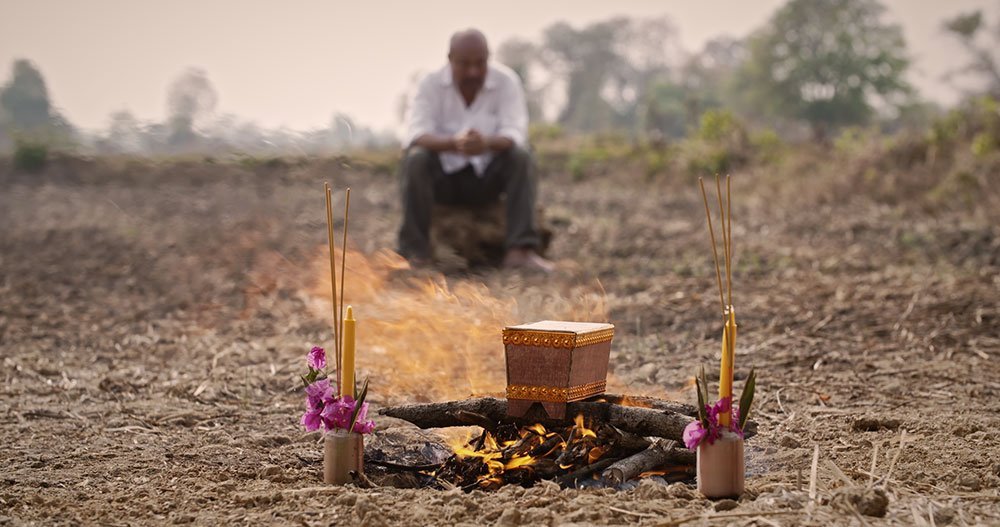
The accomplished Cambodian filmmaker Rithy Panh was just a boy when the Khmer Rouge entered Phnom Penh and, with the intention of creating a great agrarian utopia, forced its inhabitants to move to the countryside. Instead, the regime killed countless numbers of people, including nearly all of Rithy Panh’s family. His latest film, Graves Without a Name, in which he returns to a village to search for the remains of his family, is a confrontation with this personal loss. Like some other recent artistic works — such as the musical production, Bangsokol, by Him Sophy and to which Rithy Panh contributed — this film engages deeply with the Khmer Buddhist spiritual tradition to suggest a world in which the living coexist alongside the dead, and in which the desire for vengeance or despair is overcome.
Graves Without a Name begins in a wat, with an image of a monk shaving Rithy Panh’s head in preparation of a ceremony. The scene may remind those who have followed Rithy Panh’s career of a scene from Rice People (1994), in which a young woman in mourning for her father is shorn of her hair as well. Head shaving is part of the rituals of death, the process by which, with the help of the Khmer monks, survivors prepare their loved ones to die and be cremated, their souls ferried to heaven or hell so they may reintegrate the cycle of birth, death and reincarnation.
This is not, however, a typical funeral ceremony, for the dead are long gone, having disappeared during the “time of ideologies”. Quoting another of Rithy Panh’s titles, they are “wandering souls”, suffering and excluded from reincarnation. Forty years later, the monks now place paste figurines into tiny boats made of bamboo or banana leaves, to cross to the realm of the dead. They place the burial cloth — the bangsokol — over Rithy Panh himself and draw it back, as if he were the dead himself. This ritual is a kind of hav-praling, or a calling back of the souls, for of the nineteen small souls that supposedly inhabit the body, many are lost, and the monks must break the spell and call them back. For some Western psychologists, hav-praling belongs to the vocabulary of what they call “idioms of distress”: a Khmer way of dealing with debilitating loss.
More from Mekong Review
-

Poetry from Clarity Lim
-
Poetry from Richard Milazzo
-
Poetry from Maung Day
- Tags: film, Issue 13, Joseph Mai, Rithy Panh