

I wake up to a voice; a voice so low that I can’t tell whether it’s in my ears or in my head. Is it a remnant of a dream that I’ve forgotten? I can hear it even after I’m wide awake. Its hoarseness suggests it’s been calling for a while. I don’t recognise it. Yet it repeats my name in the intimate manner of a close friend.
I can hear other voices now. My wife Anita is calling out to our eleven-year-old daughter Reena. She is telling Reena to come, they’re getting late. Reena answers, ‘Coming, Mum.’ The digital clock on the bedside table informs me that it’s seven thirty. I’m usually up well before then to drop Reena at her school. Anita let me sleep in today, because I came home late last night after putting the final touches on the news magazine I edit.
I shove my feet into a pair of rubber slippers and hurry to the drawing room. Reena is there in her blue school uniform. Her school bag dangles from her shoulder. Anita has the car keys in her hands. I mouth a silent thank you in Anita’s direction as I bend down to kiss Reena goodbye.
I forget about the voice as I stand by the front door and watch them disappear inside the lift. It returns after I go back inside. Now it has a face—Neeta’s face.
It’s not the Neeta I remember. This Neeta has weary middle-age etched everywhere. Her skin is besieged by little lines. Her hair is a tired grey. Her eyes cower amidst dark shadows. I sink in a chair. This isn’t my memory serving her up. This is her calling out to me after twenty-five years.
In the year after Neeta left my life, I only had to close my eyes to find her standing in front of me. A few years later, I started finding her in bits and pieces. In no particular order I’d encounter the microscopic mole below her left eye, the silver stud in her right ear, the gentle slope of her forehead, the inquiring tip of her thin nose. As my memory expanded, I’d see her in various poses as if I were looking at someone profiled in a magazine. The contemplative Neeta gazing into the distance with her chin held between her forefinger and thumb. The attentive Neeta leaning forward in her desk with a ballpoint pen poised above her notebook. The happy Neeta with a smile big enough to pull her eyes shut…As I continued to look, the still pictures would come to life and she’d begin to walk and talk. And I’d watch her wondering how much I was seeing actually happened and how much my imagination was filling in for gaps in memory.
I met her for the first time in 1984. I was sixteen then. I’d received a scholarship to attend an upscale school in Delhi. Or, more accurately, a ticket out of back-of-beyond Banka. After reading the scholarship letter, I acted like I’d won a gold medal at the Olympics. Ignoring my mother’s stricken face, I ran about the house as if I were doing a victory lap with the letter held high above my head like a banner. My obvious joy neutralised the pain my parents felt about sending their only child away from home. They located a distant cousin in Delhi and asked him to act as my guardian. I was on my way before the new term commenced in July. Half the neighbourhood turned out to see me off at the station. I was heaped with blessings and garlands. The women queued up to do aarti. I stood with folded hands as steel plates circled my face and fingers marked my forehead with vermillion paste. By the time the train was ready to pull out, everyone was crying. I, too, got caught up in the hysteria. The tears were forgotten an hour into the journey, as the whole excitement of going to Delhi once again consumed me.
Two weeks later in the classroom that excitement quickly gave way to alarm. One look at the fancy boys and girls in the room and I wanted to disappear down a hole. My cousin had insisted I visit a temple to seek divine blessing before my first day of school. There an over-enthusiastic pundit smeared vermillion paste all over my forehead. Since it was the first day, my cousin accompanied me all the way to school, giving me little opportunity to wash the stuff off. Add the steel glasses, the gangly arms and legs, the hair dripping with oil. Not only did I look like a hick, but one who doubled as a geek.
If the way I looked was a noose round my neck, then my English bore down on my mouth like a gag. It was good enough for Banka, but here I was among boys and girls who conversed as if they were born to it. I was petrified of opening my mouth where fail became pail and visa bisa.
I could see my cousin outside the classroom through the open door. Running wasn’t an option. I spied two empty desks at the back of the room and slunk over to sink into one of them. I sank so low that I was hidden by the student in front. I dearly hoped that no one would sit next to me when a tall, slim girl with skin the colour of old ivory blew in through the door. Her large almond eyes panned all over the room to rest on the empty desk beside me. She strode over and dropped her backpack on the floor.
I swallowed.
‘Hi,’ she said with a smile that seemed to rise from deep within her to spread all over her face, reaching deep into her eyes. Its honest warmth was comforting. For a moment I forgot how I felt and said hi like it was the most natural thing in the world.
If she hadn’t told me, I’d never have guessed that she was a Sikh. While I didn’t know any Sikhs—there were hardly any in Banka—I knew their religion forbade them from cutting their hair. Neeta had short hair that tapered to a V above the nape of her neck. The fact she could flout a religious tenet filled me with wonder. In my world, religion was sacrosanct. I was even more taken aback to learn that she had a Hindu boyfriend. I came from an India where marriages were arranged and boyfriends and girlfriends were out of the question. Leave alone one from another faith. People died in honour killings merely for marrying outside their caste.
To this day I debate why she chose me for a friend. In the two years I spent at that school, I didn’t share more than a casual hi with my other classmates. Neeta warmed to me the very first day. I guess I aroused her curiosity. I was different from the others. They came from places where you expect your life to take off and arrive at its destination without incident. They were too young to realise that lives can crash after taking off or be forced to crash land miles away from where they intended to go. If they did, they believed such things happened to other people. The sense of entitlement gave them an arrogance that I lacked. I had no hard edges, no alpha male pretensions. I was like an adoring fan grateful to be in the orbit of a superstar.
Soon after we met, she introduced me to Sandeep. He was in the same school and a year older than us. He was built like a cricket fast bowler—all loose limbs and heavy shoulders—and ruggedly handsome with thick curly hair. Neeta and Sandeep had been together since preschool and resembled an old married couple in how well they gelled together. I was amazed at the way they’d pre-empt each other’s questions and complete each other’s sentences. My parents didn’t have that kind of chemistry after twenty-one years of marriage.
Sandeep was aloof to begin with. I guess he was making up his mind about me. It didn’t take him long to figure out that I wasn’t a threat when it came to Neeta. Once he did, he was happy to have me along. In the autumn of ’84 we went everywhere together. Neeta sat between the two of us in the cinema and reached for our hands during the scary bits. She let us fight for a free table in crowded fast-food restaurants and strode to the front of the queue to charm the manager into serving her first. On Saturday nights, the two of them dragged me to the Tabela discotheque at the Oberoi hotel. While they danced, I clapped my hands and wiggled.
Hope would surge inside me when her hand clasped mine more tightly than usual in the cinema, or our eyes met after a funny face or clever billboard struck us at the same time. But then she’d turn to Sandeep and I’d be reminded of their perfection and realise I didn’t stand a chance.
We were halfway through school the day we heard that Prime Minister Indira Gandhi had been shot by two Sikh body-guards. The teacher swallowed upon seeing the circular from the principal’s office. Her voice sounded strangled as she read it out. The principal had decided to close the school. Buses were being summoned to take everyone home.
None of us knew what to make of the shooting. We had heard about the Sikh secessionists operating in Punjab. But they were so far away from our lives that they may very well have been on the other side of the world. Some students were actually pleased that they were getting the rest of the day off.
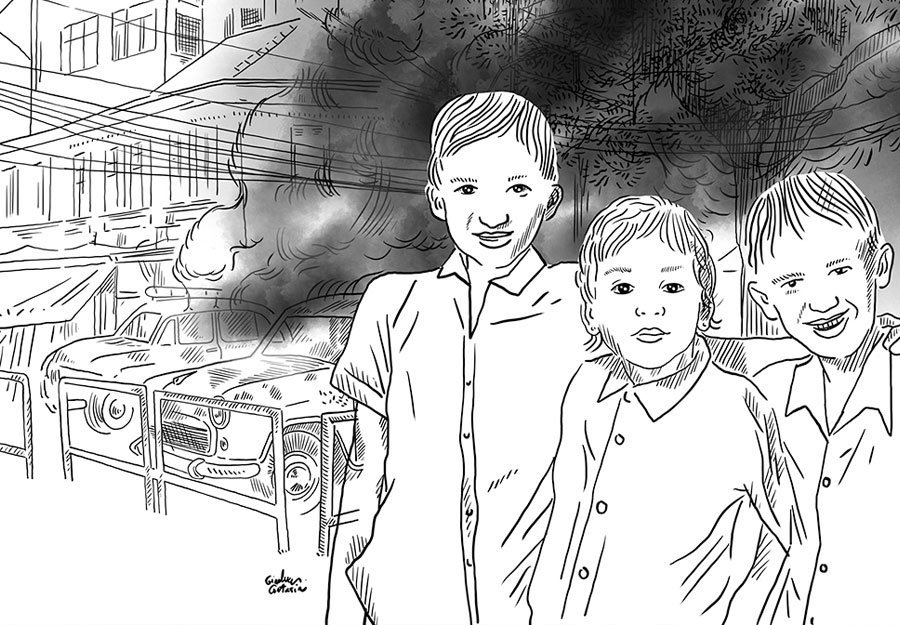
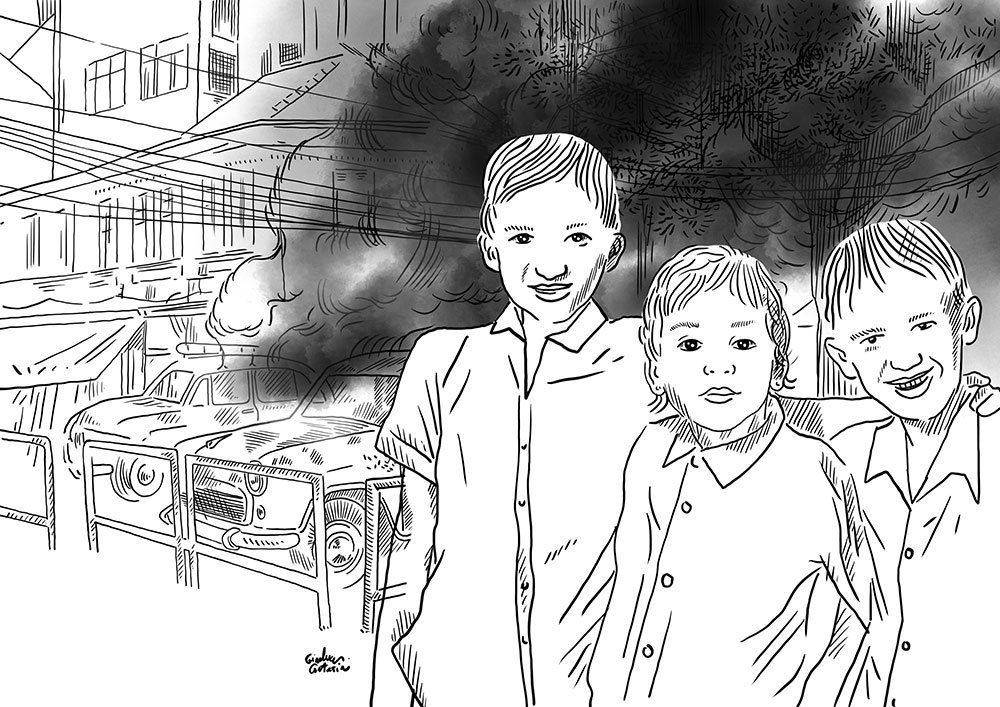
Unlike Sandeep and Neeta, I used local buses to commute. They were far cheaper than the school bus. I said goodbye to them outside the school gate and caught a DTC bus from the nearest bus stop. Everyone in the bus was talking about the shooting. The Sikhs deserve to be taught a lesson was the mantra. The lone Sikh in the bus appeared scared. He didn’t sit down when a seat opened up and edged closer to the exit at the front with each passing minute. Suddenly he bounded out of the doorless doorway at a red light. ‘He won’t get far,’ the thick-necked man sitting next to me muttered. Ten minutes later I got a ringside seat to what he meant as we passed a bunch of goons manhandling a Sikh on the street. The thick-necked man shouted encouragement to them and a few passengers cheered when they pulled off the man’s turban. A policeman, standing a few feet away, looked steadfastly in the other direction.
I thought of Neeta and knots tightened in my stomach.
By the evening the prime minister had been pronounced dead and armed mobs were attacking Sikhs all over the city. I was in a state about Neeta. I wanted to call her but my cousin didn’t have a phone. No one in our neighbourhood did. Back then you had to be rich or well-connected to own your own phone. The nearest pay phone was almost two kilometres away.
I tried to glean what I could from the radio and television. For them the only news worth reporting was a nation mourning its beloved leader. The TV broadcast images of Mrs Gandhi’s body lying in state with a host of dignitaries filing past. Radio stations played funereal music interspersed with glowing tributes to Mrs Gandhi. I switched over to shortwave and the BBC. My unease increased as report after report documented the growing lawlessness in Delhi.
It was three days before the government was willing to acknowledge the violence and impose curfew. The goons disappeared as gun-toting soldiers did flag marches in the streets. Two days later the city was declared safe enough for the curfew to be lifted in daylight hours. I rushed to the pay phone to call Neeta. There was no answer. I tried Sandeep’s house where his father brusquely informed me that he wasn’t home. He hung up before I could say anything. I was taken aback. His abrupt manner was at odds with the gracious man I’d met.
I tried Neeta again. There was still no answer.
Sandeep might’ve stepped out of his house for a while. But I couldn’t imagine anyone at Neeta’s home going out so soon after the violence.
I decided to call back in an hour. The same sequence of events repeated itself.
Even during the carnage I’d been able to sleep for a few hours every night. That night I lay awake wondering what had happened to Neeta. When the morning finally arrived, I left home as fast as I could to catch a bus to Neeta’s house on the other side of town. The hour-long journey did little to calm my nerves as a tableau of vandalised homes, buildings and Sikh temples razed to the ground rolled past my window.
I jumped off the bus at her stop and ran the last hundred metres or so to Neeta’s front gate. It was locked. A security guard informed me the entire family had left town. He couldn’t tell me where they had gone.
Sandeep had to know something, I reasoned. I made my way to his house six kilometres away. There I learned that he had been missing for four days.
Neeta had called him on the second night of the violence. To tell him about a mob that had collected outside her home. Men armed with machetes, hockey sticks and bicycle chains shouting death to all Sikhs. She was in tears. The phone connection snapped while she was talking. Later it came out that someone had cut the telephone wires.
Sandeep decided to go to her. His parents would have none of it. They locked him in his room when he remained adamant. His father unlocked the door an hour later to find the room empty and the bathroom window open.
Sandeep never arrived at Neeta’s house where her father, an ex-paratrooper had saved the day by firing shots in the air to scare away the mob. Plenty of people were burnt alive that day; their bodies impossible to identify. Sandeep may have been one of them. It was six months before his family gave up on him and held a prayer meeting in his memory. I attended, thinking Neeta would be there. She wasn’t.
I waited in vain for a word from her. No one could tell me where she was. Somewhere in Punjab was the general consensus. Her family owned a farmhouse outside Chandigarh and it was a Sikh-majority state. A classmate mentioned seeing a ‘for sale’ sign up in her front garden. The sign came down a week later. The school term ended in December. A new student took her desk after Christmas. She faded from conversation not long after.
The violence that followed Mrs Gandhi’s assassination turned the way I saw life on its head. Until then, I’d believed that only the sick had no control over their destiny. Now the whole idea of humans controlling their lives seemed so much poppycock. As a journalist, I have seen countless lives blown off course by riots, wars, floods, earthquakes. So much of life is accidental. You are lucky if your grand design survives your accidents. For so many, living is all about making do with their life’s unmaking.
For years I debated what made Sandeep do what he did that night. He must have known that it was futile. With hoodlums attacking anyone unlucky enough to be on the streets, he had little chance of getting anywhere near Neeta’s house. Even if he could, the mob would’ve done what it wanted by the time he got there.
It was only when I held my daughter for the first time that I felt I understood. In that moment, I realised it is possible to love people more than life itself. If my daughter were ever in danger, I’d have to do something, however futile. I couldn’t live with myself otherwise.
I could not begrudge him Neeta’s love. I knew I couldn’t have done what Sandeep did.
Neeta’s voice now has a keening edge to it. A glazed look has settled in her eyes. I know that look. I’ve seen it far too often in the eyes of survivors. It belies the fact that they’ve survived by dwelling on what they’ve lost. I can’t get it out of my mind as I get ready to go to work. The voice continues to sound like a persistent backbeat. I try to drown it by turning up the music in my car. It refuses to be submerged. It takes over my mind so completely at a red light that I don’t notice when the light changes. An angry horn jolts me back to the here and now. I hold up a hand in apology and ease my foot off the brake.
When I reach the office my secretary informs me that a Major Gill phoned from Chandigarh. This has to do with Neeta. I’m sure of it. I tell her to call him. I check my messages while I wait. There is a message from the printer saying the dummy of the issue we sent over last night will be delivered by the end of the day. The issue has Prime Minister Manmohan Singh on the cover. A Sikh prime minister.
The secretary calls. She has the Major on the phone.
‘Are you the Vijay Singh who was in school with my wife Neeta Ahluwalia?’ he asks.
He speaks in a deep baritone. I picture him as the kind of man who is most at home in the parade ground booming orders at his men.
‘Yes.’
There is a short pause before he says, ‘She wants to see you.’
It has been twenty-five years. Why now? I’ve been thinking that all morning. ‘What is this about?’ I ask him.
He takes a deep breath. ‘She has breast cancer. The doctors say it’s only a matter of time.’
He tracked me down through the school’s alumni association. There were three Vijay Singhs in our graduating class. He phoned each one.
I tell him I’d be happy to come to Chandigarh. He says he’ll have an army car sent over the next morning. We decide on a time.
I explain everything to Anita in the evening. I can sense the question lurking in her voice even though she agrees I have to go. Is Neeta just an old friend? She’s willing to shelve the thought for the moment. For once I’m glad we’re an old married couple.
The sky appears contemplative as I leave for Chandigarh in the morning. The occasional puff of breeze reminds me of the sigh that escapes when you reflect on something gone wrong. I gaze fixedly out the window from the back of the car. I drove down this road numerous times while covering the Sikh militancy in the late 1980s and early 1990s. I’d sit shrunken in the seat, ready to fall to the floor in case a salvo of bullets burst out of the wheat fields streaming to my right and left. The peace that broke out in the mid-1990s brought the urban sprawl that chewed up big chunks of the countryside. Today the city doesn’t seem to end as one unsightly building follows another.
It is past two by the time we enter Chandigarh. Chandigarh is as modern as an Indian city is going to get. It was built in the 1950s in sectors, each with its own park, school and market. Major Gill’s house is in Sector 7.
The house is a three-bedroom brownstone with a garden at the front and back. A girl in her mid-teens meets me at the front door. I guess she’s Neeta’s daughter. Presently the Major appears. He’s slightly built and no more than five foot nine. I was expecting him to be a big man. He has a pointed beard and is wearing a checked shirt and a pair of dark trousers. His head is covered by a red turban.
He doesn’t waste time on pleasantries, not even bothering to shake hands. He asks me to follow him in a terse voice. We go into a large bedroom with a king-sized bed. A dark woman in a yellow sari is seated in a cane chair next to the bed. I assume she is the nurse. The Major tells her to wait outside. Then he leaves me alone with Neeta.
I settle in the chair the woman has vacated. The room is bright, with pink walls. The curtains are drawn in an obvious attempt to soften the brightness. Only one of three lights, the one furthest from the patient, is switched on. Several bouquets of flowers rest on a long table standing against the wall in front of me. Get-well cards jostle for space on the table next to the bed.
She is lying on her back. The size of the bed makes her look even more shrunken. A blue patient’s gown encloses her frail body and white IV tubes protrude from her skeletal arms. Her cheeks appear as if holes have been drilled in them. None of it is entirely unexpected, but it comes as a shock after the image I’ve carried in my head for twenty-five years. I’m unable to speak. She breaks the silence. ‘I had no idea the Vijay Singh I was reading in India Today was you,’ she says. A smile breaks through the lines on her face. ‘I guess fail is no longer pail.’
I smile in spite of myself.
‘Thanks for coming,’ she says. ‘After the way I disappeared I would’ve understood if you hadn’t.’
There is a short pause as she stares straight ahead. ‘It was Daddy who decided Delhi wasn’t safe for us,’ she says finally. ‘I didn’t want to leave. Sandeep was in Delhi. All my friends were there. But Daddy wouldn’t listen. We had survived by the skin of our teeth. Next time we might not be so lucky. No sooner was the violence over than he sent me and my mother to our farmhouse near Chandigarh. Then he sold off everything he owned in Delhi as fast as he could. I …’
She pauses. She is short of breath. I start to rise. She holds up her hand. Soon her breathing returns to normal.
‘I called Sandeep the moment we reached the farmhouse,’ she says. She is speaking slowly now. ‘I hadn’t talked to him in days. Our phone in Delhi didn’t work after we were cut off.
‘His mother told me what had happened. She accused me of killing him. I was shattered. For days I simply sat in my room and cried. He’d still be alive if I hadn’t called. I knew he couldn’t do anything. Yet I called.’
Her voice wavers towards the end and dies. When she spoke Sandeep’s name it seemed he was in the room with us. And she’s spent her entire life blaming herself for his death.
‘You did nothing wrong,’ I tell her. ‘You were scared and reached for someone you loved. That’s natural. As for him, he did what he did because he couldn’t do otherwise.’
She is quiet. I think I see her face soften.
We speak a little longer. She asks me about my family. We reminisce about old times. When I see her tiring, I get up to say goodbye. She tries to smile, but the effort proves too much.
Knowing I’ll never see her again, I linger at the door to make one last memory.

More from Mekong Review
-
Nabaneeta Dev Sen’s final collection
-

Poetry from David Chandler
-
A poem by Aiden Heung
- Tags: fiction, India, Issue 23, Vikram Kapur