

The following was written in December 2025 and went to print in mid-January 2026, before the end of the final phase of the general election in Myanmar.
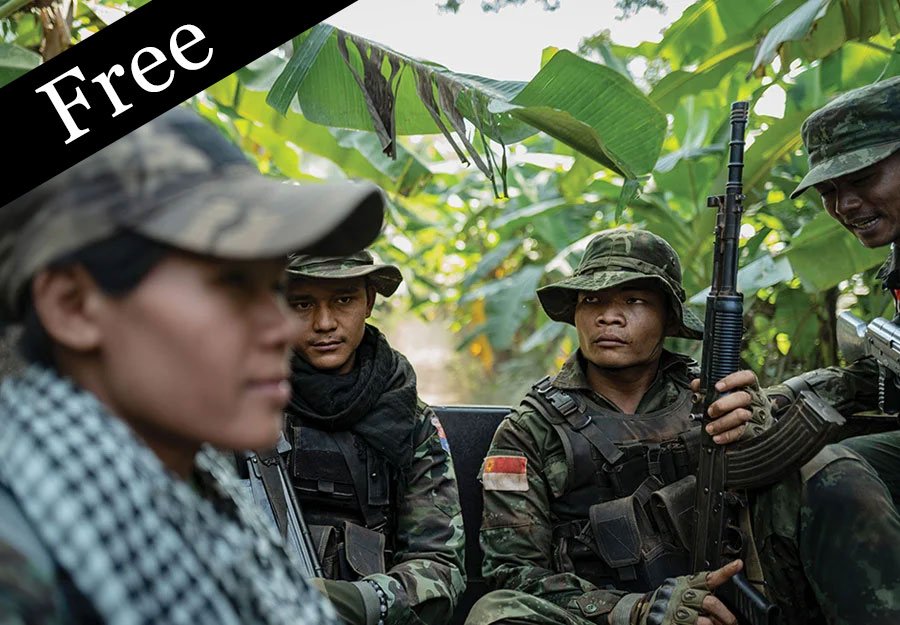
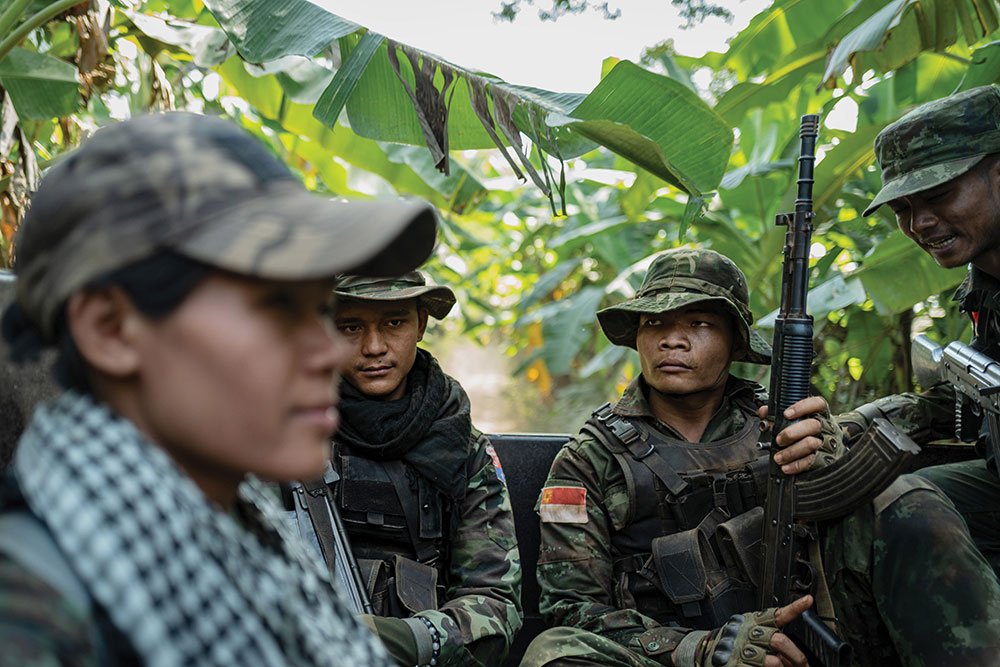
Yae Yint, a twenty-four-year-old resistance soldier, scrolls through his phone, connected to the internet via a Starlink satellite network. He skips Facebook posts about the election, lingering instead on music videos and entertainment. There’s no point reading those posts; he doesn’t recognise an election organised by a military that can launch airstrikes over his head at any moment as free or fair anyway.
The last general election in Myanmar was in November 2020. Yae Yint had been under eighteen then, and therefore ineligible to vote. Still, he remembers the excitement of watching friends and relatives cast their ballots. “I was happy for them,” he says. “They could vote for the party they wanted. I thought one day I’d be doing the same.”
Five years later, the military is staging another election. But opposition leaders and thousands of political prisoners remain behind bars, and airstrikes continue to hit civilian areas in regions where ethnic resistance groups are based. Yae Yint, who joined the Bamar People’s Liberation Army (BPLA) after the military coup in February 2021, questions how such an election could be described as legitimate.
“The regime wants to erase its atrocities and war crimes,” he says. The election is being held in phases, from December 2025 to January 2026. Invoking legislation ostensibly introduced to protect the electoral process, the junta has cracked down on dissent and criticism. As a resistance fighter, Yae Yint doesn’t worry about being intimidated into voting. But civilians living under military control, he says, don’t have that choice.
After just the first round of voting in December—and even before any official figures were published—the Union Solidarity and Development Party, the main pro-military political party, had already begun claiming a landslide victory.
Yae Yint grew up in a farming family in the Irrawaddy region and stopped going to school during the Covid-19 pandemic. When the military seized power in 2021, he joined local protests and assumed the crisis would pass within days. Instead, security forces began to crack down with increasing, even lethal, force. That was when Yae Yint, like so many in his generation, decided to take up arms.
He travelled with four of his cousins to Karen State, one of the areas where resistance groups operate. They contacted multiple armed groups through Facebook and eventually chose to join the BPLA, an armed organisation founded in 2021 by Maung Saungkha, a poet and activist. The BPLA is largely composed of young Bamar protesters who’d never handled a weapon before joining the armed struggle.
One morning in November 2025, Yae Yint’s platoon moved through the jungle. The air was cold and misty, the sky clear, but no one could predict if or when fighter jets would appear. Along the way, they encountered villagers who’d fled attacks launched by junta troops days earlier. The group was headed towards a camp for internally displaced people.
They walked together until the roar of jets cut through the air. Panic broke out. People scattered in every direction. They later learnt that the military had bombed a resistance camp nearby. Everyone in the group survived, but the civilians were separated from Yae Yint and his team. He found a boy, about six, standing alone in a red Power Rangers T-shirt. The child didn’t speak; he just stared. One of the soldiers knelt beside him. “Don’t worry. We’ll find your parents.”
They reached the displacement camp that night and shared a meal—rice, fish paste, and vegetables wrapped in banana leaves. Yae Yint watched the child. In another country, he thought, this boy would grow up differently.
They managed to reunite the child with his parents the next morning. A relief.
Yae Yint misses his own family, especially his mother. He doesn’t contact them much, for security reasons. He managed to call her during Thadingyut in October, the annual festival when younger people pay respects to their elders. It’d been four years since they last saw each other.
How can a genuine election be held under such conditions? People are angry but cautious. Yae Yint says his mother avoids political conversations. “She doesn’t think much about the election,” he says. “She’ll vote—unless it feels too dangerous.” There might not even be a choice; voting has been cancelled in multiple areas due to ongoing fighting.
Yae Yint hopes Myanmar will hold a free and fair election one day—after military rule has been dismantled. “I’ll continue to invest my life into the revolution until it happens,” he vows.
About 400 kilometres away from Yae Yint’s jungle post, Yangon appears to be bustling as usual with its shopping malls, bus stops, and traffic jams. But daily life has changed after the coup. Residents speak of rising food prices, frequent blackouts, and growing insecurity at the hands of the junta’s troops.
Ma Wai, a thirty-six-year-old single mother, grew up in a small town west of Yangon. In early 2021, her younger sister joined anti-coup protests and was later charged with possession of firearms. Soon after, her brother was arrested for allegedly supporting resistance groups. Then junta supporters destroyed the grocery store her family had run for years. Ma Wai moved to Yangon and started an online shopping business. “I’m strong,” she says. “I won’t collapse easily. I know others have suffered even more.”
Because of the election, Yangon is under tight control. Security forces have crushed protests and arrested suspected dissenters. Min Aung Hlaing, the junta chief, insists that voting is voluntary. Ma Wai doesn’t believe him. “We’re surrounded by guns,” she says. “We don’t know what would happen if we didn’t vote. I went even though I didn’t want to.”
Despite all the repression, people find ways to resist. A few weeks before Ma Wai grudgingly went to the ballot box, a long-absent voice returned to Yangon’s streets. On a crowded street corner, a Bluetooth speaker played a recorded speech by Aung San Suu Kyi, the jailed leader of the National League for Democracy.
“If you vote out of fear, I don’t want it,” her voice blared out of the speaker. “If you cast your vote because you fear an individual or an institution, you will remain afraid.”
Hiding nearby were Thant Zin and Gandamar, members of Yangon Four Brothers, an underground resistance group. Apart from the speaker, they’d also set up a wireless CCTV camera. It was a risky endeavour; if found, they’d have been arrested… or worse.
A handwritten sign beside the speaker read “DON’T TOUCH”. Security forces showed up but hesitated, worrying about an explosive device. The military’s bomb squad was called; the speech looped over and over again before they arrived. “That’s how we buy time,” Thant Zin later explained.
Once the officers noticed the camera, they blocked it with a wooden box and cut electricity to the entire neighbourhood for good measure. From his hiding place, Gandamar whispered into his phone, transmitting his voice through the camera feed: “Hey, motherfuckers… You’re in chaos. Min Aung Hlaing—motherfucker.” This prompted a search of the area; the officers hadn’t realised that the insult was coming from the camera.
Such stunts aren’t unusual for Yangon Four Brothers, whose slogan is “our voice, our fights, our rights”. The group carries out dozens of small actions each year to disrupt junta propaganda.
Thant Zin voted for the first time in 2020, when he was still an engineering student. Asked about his dreams, he shrugs. “I miss the future I lost,” he says.
Many young people have fled, either to Myanmar’s border or out of the country. Others sit in prison or, like Yae Yint, fight in the jungle. But Thant Zin and Gandamar chose to do their part for the revolution in Yangon.
The military has a history of targeting the relatives of activists, so Thant Zin avoids contact with his family. He survives on odd jobs, moving between apartments and hostels. When he goes out, he makes a point to dress like someone from a wealthy family. Soldiers leave him alone. This is how he avoids conscription and arrest.
Thant Zin shares the same sentiment as Yae Yint and Ma Wai: “No one, from the resistance-controlled jungles to the urban areas, wants this election. But people under military rule are forced to cast their votes.”
The mass protests that filled Myanmar’s streets in the immediate aftermath of the coup are gone now. Repression has deepened and the struggle for daily survival is at the forefront of most people’s minds. The military hopes an election will give their rule a veneer of legitimacy, but a vote largely rejected by the people as a sham will hardly soothe tensions. Fighting continues across the country as armed groups hold out against military forces. In the city, the work of Yangon Four Brothers and their peers exposes the regime’s lies, interrupts silence, and reminds people that resistance exists even when things seem business as usual.
“Every revolution has sacrifices,” Thant Zin says. “It’s worth taking the risk.”

More from Mekong Review
-

A poem from Maung Day
-

When Aung San Suu Kyi stopped supporting US sanctions against Myanmar, it changed everything.
-
A poem by Maung Htike Aung.
- Tags: Aung Naing Soe, Issue 42, Myanmar
