


The first thing U Kyaw Hla Aung asked when he met me, after I walked up the muddy lane to his house and climbed the rough-hewn stairs to the balcony where he spends much of his time, sitting and waiting, is whether I wanted to see his documents.
He keeps them in a fat green plastic folder, but they have long since burst their confines and spilled out the sides, like an uncontainable force.
“This is my lawyer certificate … These are the land ownership documents of my four grandparents … My father’s name … My uncle …”
These papers and photographs represent just a small fraction of what the Rohingya Muslim lawyer and activist has accumulated in his seventy-six years, but they are all he managed to save when a fire destroyed his house on 11 June 2012. That month, sectarian violence convulsed his hometown of Sittwe, the capital city of Rakhine state, also known as Arakan, on the far western frontier of Myanmar, sprawling out along the Bay of Bengal.
Tens of thousands of Rohingya were beaten and burned out of their homes by the state’s majority Buddhists; many others fled the country. The situation of the Muslims of Rakhine was already tenuous, but the violence in 2012 set off a crisis that is still ongoing. U Kyaw Hla Aung has not been back home since that day. After being detained briefly on trumped-up charges, and then for a longer stint in jail the following year, he, along with his wife and three of their daughters, found a house on the edge of Thak Kay Pyin, one of a colony of squalid camps that has metastasised along the coast to the south-west of the city, housing an estimated 120,000 Rohingya.
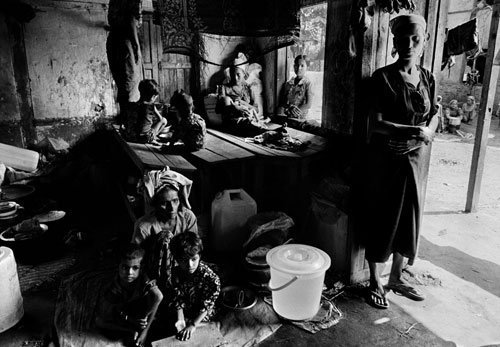
On a recent trip to Thak Kay Pyin and several adjacent camps, I braced myself for extravagant horrors, but many of the worst problems there, I realised, were hidden. Instead, the overwhelming impression was of stultifying boredom: the small, repeated horror of an empty life, of non-existence, waking up every day to realise that you are stuck and at the mercy of those who hate you. Like everywhere else in Myanmar, the ground in the camps is stained with blood-red gobs of betel spit; there are markets selling cell phones and hijabs; there are tea shops where a hundred kyat can buy you a mug of milk-sweetened brew or powdered coffee. But unlike in the tea shops of Yangon or Mandalay, which host excited deal-making and arguments about the news, the men here are sprawled around listlessly, free of many of the obligations of daily life, but also the pleasures: making one’s own way, stealing a moment from a busy day to rest. Here, these moments of rest are all that exist, punctuated by the twice-daily call to prayer.
“Life here is very … not so happy,” U Kyaw Hla Aung said wryly. A lawyer and former court clerk who ran for parliament in the 1980s, he is probably the best educated and wealthiest Rohingya here, the luckiest. The nature of his luck, then, is that he can afford to pay the bribes and sureties required to leave the area every now and then to travel to Yangon for medical treatment; he meets with UN officials and diplomats who pop in and out of the camps on brief “fact-finding” missions; and he sits and waits on a plastic chair in a tiny wooden house, rather than on a stool in a tea shop or a muddy stoop.
The documents were the first thing U Kyaw Hla Aung wanted to talk about because documentation, or the lack of it, has become the heart of the Rohingya story. The official justification for keeping the Rohingya in a state of de facto apartheid is that they are illegal immigrants who have seeped across the border from Bangladesh. But citizenship in Myanmar, under a 1982 law enacted by the military government, is a complex tangle of rules in which only members of 135 designated “national ethnicities” can ever be granted full rights. Even those who clearly qualify often have difficulty obtaining the correct documents; for the Rohingya, who are definitively off the list, it is impossible.
So the documents they do have are more precious than almost anything else; they seem to offer a kind of proof that they belong in the place where they live. Before the 1962 coup that set off more than four decades of brutal military rule, U Kyaw Hla Aung said, he and his family took it for granted that they were citizens. They attended public schools and were issued state documents without a second thought.
The documents that emerge from his folder are a motley assortment of colonial-era and post-independence certificates and photographs. There is a black-and-white photograph of the Weight-Lifters’ Association of University College Rangoon, a group of rather scrawny Burmese men, arms crossed in front of them and fiercely staring down the camera, a stack of barbells crossed in front of them. Instinctive citizens of the land. A picture of the Muslim Association of Rangoon University, 1958–9. “At that time it was normal, you can see … All these students are Rohingya, they were studying at Rangoon University …”
A certificate declares, in luscious cursive, that Mahamed Rasim, son of Mahamed Yusoof Abdul Badom, born 16 December 1941, is eligible to matriculate at the University of Rangoon. A 1939 certificate of registration from the Burma Medical Council, stamped with a red seal, certifies an ancestor known as Habibullah to practise medicine in Parein, a lush rural village several hours north of Sittwe.
And in his identity documents, a young U Kyaw Hla Aung looks into the camera with the startled stare of a child in the days before cameras were ubiquitous. In front of him a sign bears his ID number, AH028744. Another, similar, paper shows a teenage U Kyaw Hla Aung, still AH028744.
“This is my pension book — it is me!” he said.
In the rich literature of bureaucracy that arose alongside the modern state, there is a strong focus on the dehumanising aspects of the documents and certificates and offices that are integral to statecraft. Less obvious are the ways in which those same bureaucratic rules, by being blind to human difference, may confer protection and even a kind of humanity.
In U Kyaw Hla Aung’s green folder, he also holds a document that is not personal. It is a heavily underlined and highlighted photocopy of a 1799 article on the languages of Burma by the Scottish polymath and physician Francis Buchanan, who travelled through Asia as a ship’s doctor, cataloguing plants, places and people as he went. His passion for botany made him particularly keen on classification in all its forms.
U Kyaw Hla Aung read aloud: “I shall now add three dialects, spoken in the Burma empire, but evidently derived from the language of the Hindu nation. The first is that spoken by the Mohammedans, who have been long settled in Arakan, and who call themselves Rooingas, or natives of Arakan.”
He looked up in triumph, as if something had been settled.
Many Rohingya activists and advocates see this passage as definitive proof that their Muslim ancestors were living within what is now Myanmar several decades before British colonisation. The truth is far more complex. Some Rakhine Muslims have very deep roots in the area; others are believed to have migrated across the border much later, in the mid-twentieth century; still others might be more recent arrivals. Many are so poor, uneducated and desperate that they cannot trace how their families arrived. The term “Rohingya” was not widely used until relatively recently, as U Kyaw Hla Aung himself notes; it is a largely political construction, born of increasing sectarian violence and persecution.
A great deal of the recent debate over the Rohingya issue, especially within Myanmar, has devolved into a kind of parlour game, competing attempts to prove that Rohingya did (or did not) exist in Arakan as a coherent ethnic group at certain points. This is a game without a winner, because it hinges on the legitimacy of the concept of an ethnic homeland, an unbroken bloodline — the same ideas that fuel Arakanese nationalism and Bamar supremacy — but playing it is often irresistible.
Given the situation of the Rohingya — a vulnerable stateless minority within a minority state in a formerly totalitarian nation careering toward a kind of democracy — and the crucial role that history, nationalism and language played in bringing this to pass, a deeper scholarly look at their past and present is keenly needed.
Azeem Ibrahim’s The Rohingyas: Inside Myanmar’s Hidden Genocide seems perfectly poised to meet this need. On his website, Ibrahim, a camera-ready Scot, lists eight degrees after his name and provides a press kit in which he describes himself as a “globe-trotting polymath” — an effort to present himself as a latter-day Francis Buchanan, perhaps.
Unfortunately, this slim work (141 pages) does not venture deeply inside anywhere. Ibrahim appears to have travelled to Rakhine only briefly, and, despite a couple of interviews with refugees, there is no real evocation of what it is like to be a Rohingya villager subject to travel restrictions, to live inside a camp, to be sick, terrified, persecuted. There are also no voices from Rakhine Buddhists here, even though their perspectives and preoccupations are crucial to the social dynamics of the state. Most of his sources are newspaper and magazine articles, with a few Rohingya politicians and historians thrown in.
Instead, the book plays the unwinnable game. Ibrahim spends a great deal of time trying to prove things that are — or should be — irrelevant: that the Rohingya might have settled the area before the Rakhines; that they are a coherent and longstanding ethnic group which once dominated the region; that Buchanan’s paper is proof of this.
This may be because the book is clearly aimed at an audience of international “thought leaders” rather than actual readers who want to learn about the Rohingya. Its goal is not to inform, but to provide a platform for the author’s own punditry and to make recommendations to the international community. This approach makes Ibrahim distressingly prone to sweeping, anodyne statements, the kind of thing you might hear at a TED talk or a conference room at Davos (“The history of the region of Burma has seen a sequence of ethnic shifts, conquest, expansion and collapse that is quite typical of the history of most regions of the world,” we are told).
Perhaps because of the global resonance of the term “genocide”, the book places an almost perverse overemphasis on the concept. But in international law, genocide is a relatively narrow crime with specific preconditions; dwelling on this comes at the expense of a more complete evocation of the very serious crimes the Rohingya have clearly suffered. It also dates the book. Since its publication in May 2016, many of the “potential triggers for genocide” Ibrahim speculates about have come to pass: an October attack on a police station by what appears to be a group of radicalised Rohingyas has led to brutal reprisals and burnings of Muslim villages, leaving the human rights situation exponentially worse than it was at the start of the year.
Most crucially, Ibrahim’s work suffers from a lack of on-the-ground engagement with the people whose story is ostensibly being told. Where are the plastic chairs, where are the tarpaulins and the perpetually muddy ground of the camps, where are the rice paddy fields that stretch out around them, fenced off for the use of their Rakhine owners? Where is U Kyaw Hla Aung, sitting on his balcony, shuffling his papers, waiting for visitors who will help tell his story? Where are the Rakhines in The Rohingyas? Where are the Rohingya?

Azeem Ibrahim, The Rohingyas, Hurst & Company: 2016
More from Mekong Review
-
Ethnicity, terminology and identity in Rakhine State
-
The recent violence against the Rohingya continues a systemic attempt to strip them of their right to exist in Myanmar.
-

A poem from Maung Day
- Tags: Azeem Ibrahim, Issue 6, Myanmar, Rakhine, Rohingya