


Affan Kurniawan, a twenty-one-year-old motorcycle taxi rider, was working in Jakarta when he was struck by an armoured vehicle belonging to the Mobile Brigade Corps, an elite unit of the Indonesian National Police. The vehicle, weighing several tons, didn’t even try to avoid him; footage that circulated online shows how it pressed forward, mercilessly crushing Affan. He was rushed to hospital, but little could be done.
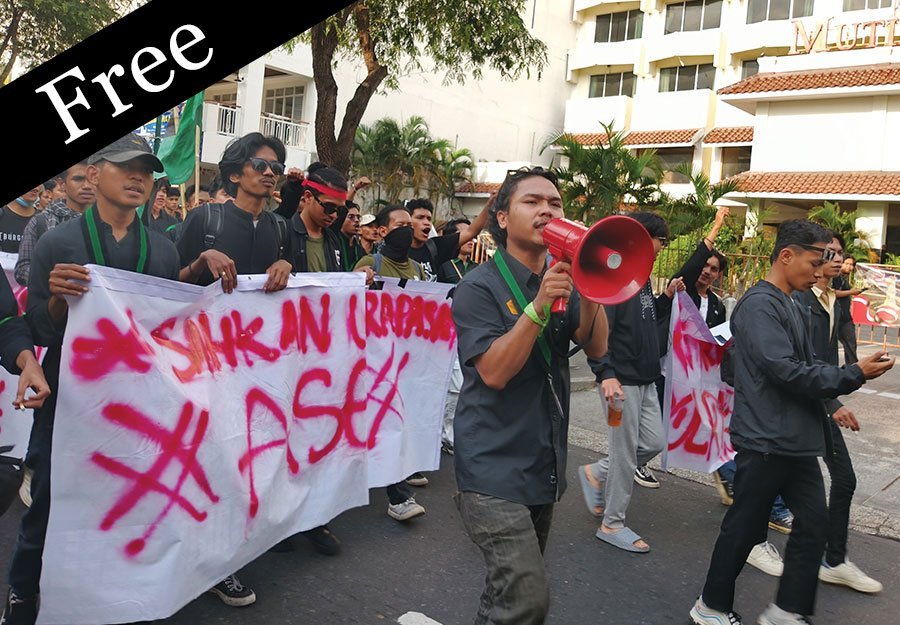
Affan was killed on 28 August 2025, a Thursday. Mass demonstrations had already been raging in Jakarta for three days. The protests had erupted in response to plans for a staggering increase in allowances for parliamentarians, at a time when many Indonesians are struggling to survive an economic crisis marked by mass layoffs. Public anger was further inflamed after several legislators derided those calling for the dissolution of Parliament; Ahmad Sahroni from the National Democratic Party scornfully described protesters as “the most foolish people on earth”.
Affan wasn’t a protester. He’d merely been delivering food on a street packed with demonstrators who’d been dispersed by the police from the parliament building nearby. He was a young man who’d dropped out of vocational high school because of financial difficulties, then worked tirelessly to help his parents make ends meet. He’d even paid for his younger sibling’s middle school education.
Many Indonesians live like Affan, struggling every day just to meet basic needs. Yet their existence is continually denied by successive governments that glorify rapid economic growth. As politicians push their developmentalist agendas, the absence of adequate social safety nets and redistributive policies has made socioeconomic inequality increasingly stark. Although Indonesia’s Central Bureau of Statistics (BPS)—using methodology that has since been criticised by researchers—reported in July 2025 that only 8.47 per cent of Indonesians live in poverty, the World Bank stated three months’ prior that 60.3 per cent live on less than US$6.85 per person per day (this being the poverty line the organisation has set for upper-middle-income countries).
There are also suspicions that the Indonesian government is manipulating economic growth data. BPS reports that Indonesia’s economy grew by 5.12 per cent year-on-year in the second quarter of 2025, but this bears little resemblance to the reality on the ground. Official figures on unemployment rates have also been called into question, since they exclude workers in informal sectors and the gig economy—that is, workers like Affan.
On the one hand, President Prabowo Subianto claims that national unemployment has fallen to its lowest level since 1998, and huge amounts of public funds have been spent on things like an ambitious—and rather disastrously implemented—free meals programme. On the other, he’s ordered budget efficiency measures that have, in practice, disrupted public services. In an effort to boost revenue, a number of regional governments resorted to dramatically raising—even doubling—property taxes.
Something was going to have to give.
People were already furious; after Affan’s murder, they became unstoppable. Waving the pirate flag from the popular Japanese anime One Piece—a pop culture reference also adopted by young protesters in Nepal and France—demonstrators took to the streets in thirty-two provinces across the archipelagic state.
Media outlets ran reports with attention-grabbing headlines about government buildings on fire, politicians’ homes being looted, and rioters in the streets. Popular social media platforms were awash with competing narratives, including ones that accused demonstrators of being bad-faith provocateurs. Wanting to hear directly from those on the ground, I reached out to a number of people from grassroots communities directly involved in protests; not only in the capital, but also in Bandung and Yogyakarta. For reasons of safety and security, all names have been changed.
Like Affan, Jiron works full-time as a motorcycle taxi rider. Living in Bandung, the twenty-year-old has been driving for more than two years, since his final year of vocational high school. An eight-hour work day gets him only about Rp 1 million (US$61) a month—far below Bandung’s 2025 minimum wage of about Rp 4.5 million (US$274). He was at home when he stumbled upon the video of Affan being crushed on social media. That night, he joined the motorcycle taxi community under a flyover in Bandung to pray for Affan. The solidarity he felt there pushed him to show up for the protest outside West Java’s provincial parliament building the following afternoon.
“I’m the same age as Affan. As a fellow motorcycle taxi driver, I know the struggles he faced on the road every day, especially since he was crushed while delivering food,” Jiron says, his voice breaking with emotion. “I feel deeply compelled to demand justice for him.”
He’s far from the only struggling twenty-something to have been triggered by the horrifying footage. Petrik, a twenty-four-year-old student at a state university in Bandung, had already been politically engaged, but Affan’s murder was the last straw. “Watching Affan being crushed, I knew it was time to return to the streets. The state had crossed a line.”
Petrik has long been acquainted with state violence, incompetence, and the punishing realities of a faltering economy. The soaring cost of tuition once forced him to sell water pumps door-to-door. His eyes well up with tears as he recounts how a relative injured in a traffic accident a year ago was abandoned by the hospital even though they’d never missed a payment to the national health insurance programme. Turning to the police for help, he says, not only failed to extricate his family from Indonesia’s tangled bureaucracy, but also exposed them to blatant extortion.
“The anger I’d been carrying toward the government and law enforcement could no longer be contained [after Affan’s death],” Petrik says. His friends shared the same fury. “That shared fate, that shared rage and energy, left us with no hesitation, and we were ready to march the very next day.”
Michelle, an artist and researcher from West Kalimantan now living in Yogyakarta, has long abandoned any expectation of justice from law enforcement. She believes that the root of the problem lies in the political system itself, and connects today’s troubles with the current president’s history.
Closely affiliated with the Suharto dictatorship that ruled for more than three decades, Prabowo, a former military officer, has a record littered with multiple accusations of human rights abuses, for which there has been little accountability. Now that he’s president, there are concerns about the expansion of military power in Indonesian politics. Michelle was outraged in March 2025 when the country’s military law was quietly revised, allowing members of the armed forces to occupy civilian posts.
The people’s disquiet had been building for some time. “People around me kept talking about how much had changed since Prabowo became president, and how we were being crushed endlessly without any way to fight back,” she says. Public goodwill was being rapidly eroded, and it didn’t help when legislators made outrageous statements that only drew attention to how disconnected they were from the ground. “I think the anger finally spilled over when the brutal video of Affan surfaced. My god, he was just working! I’m a worker, too. If someone like him, who wasn’t even protesting, could be killed while doing his job, then what does that mean for the rest of us?”
Michelle and her partner joined the protest outside Yogyakarta’s regional police headquarters the day after Affan’s death. What made her presence even more striking is the fact that she’s Chinese Indonesian—a community targeted and brutalised during the May 1998 riots. That tragedy has left deep scars, not all of which has been fully addressed or resolved. For someone like Michelle, taking to the streets in protest is simultaneously an act of confrontation and a breaking out of a shell of trauma.
Then there’s the mothers. Ibu Berisik (which translates to ‘Outspoken Mothers’) was formed in February 2025 by a group of women connected on Instagram, with the primary goal of raising political awareness among middle-class mothers. Ira, a small business owner and one of the collective’s founders, says the group’s membership ranges from housewives and street vendors to university lecturers. They believe that, although deep-seated political problems are relevant to all Indonesians, the middle class has been too reluctant to engage with political issues, lulled into complacency by a belief that the regime’s issues have little direct impact on their lives.
Ibu Berisik was mainly active online, but Affan’s death pushed them into offline spaces. “Mothers actually have demands as well, but protests have mostly been attended by students,” Ira says. This time, the women found their place doing what mothers tend to do best: feeding people. “We finally connected with key nodes of the movement. We participated in consolidation and field operations meetings, ran a communal kitchen, and prepared nasi cokot [rice balls] for the demonstrators.”
The way Ira sees it, being active and present in the streets is just as vital as providing political education on social media. And everyone can find a way to contribute. One of Ira’s colleagues had wanted to participate in the protest but couldn’t go because she was pregnant—so she took on a behind-the-scenes role as a bookkeeper and ambulance coordinator for injured demonstrators.
“I believe a mother’s presence is vital to the movement,” Ira declares. “Being there on the ground offers both psychological and spiritual strength, empowering the students to stand stronger and braver. Like them, we are filled with outrage. How long must we continue to be treated this way by the state? Why is it so impossible for them to listen?”
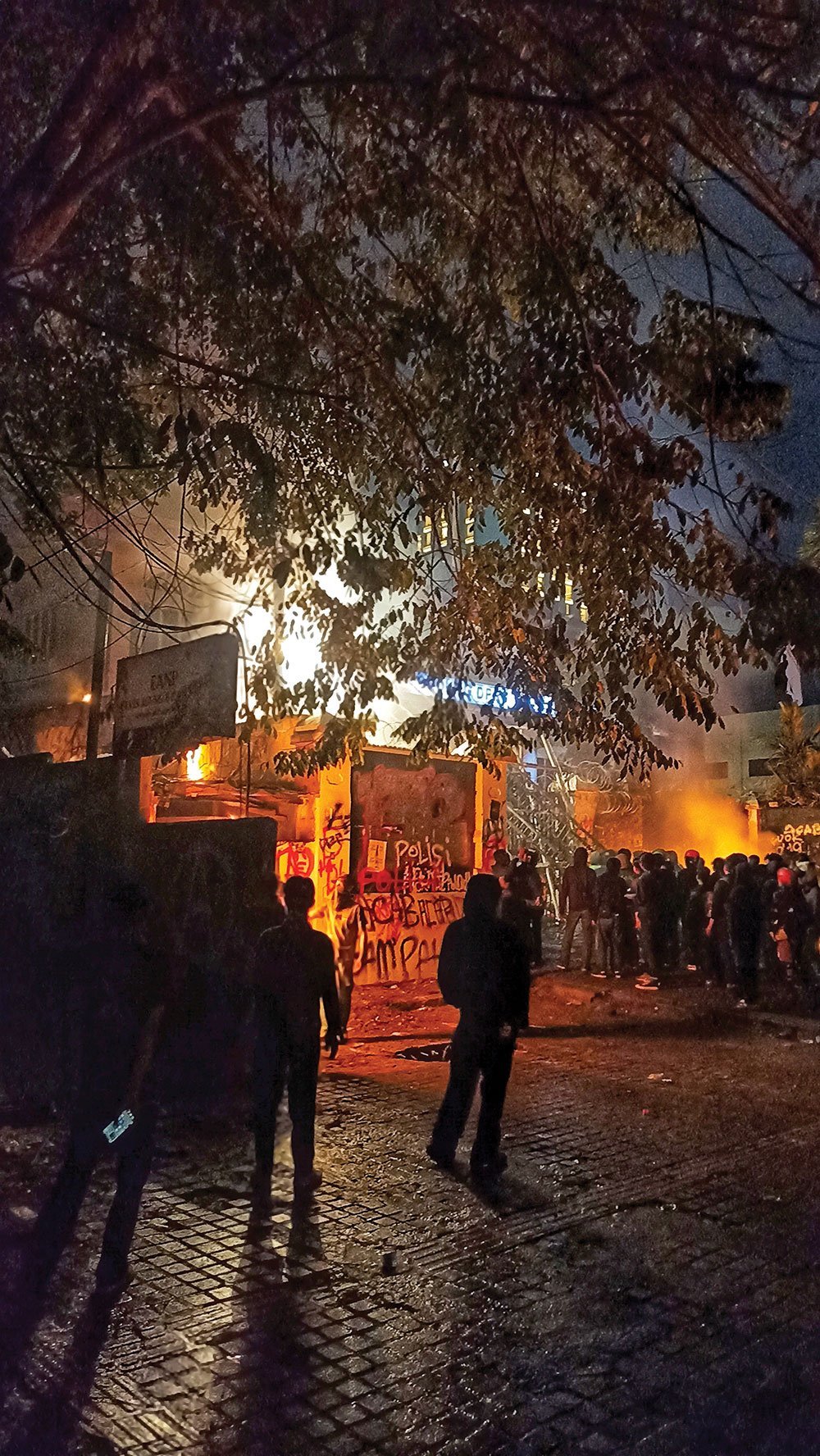
From gig workers to students and mothers, displays of people power are inspiring. But one cannot ignore that the protests have also been marked by violence. As of the time of writing, ten people have died across the country, thousands more injured. Buildings have been set ablaze, the homes of public officials looted.
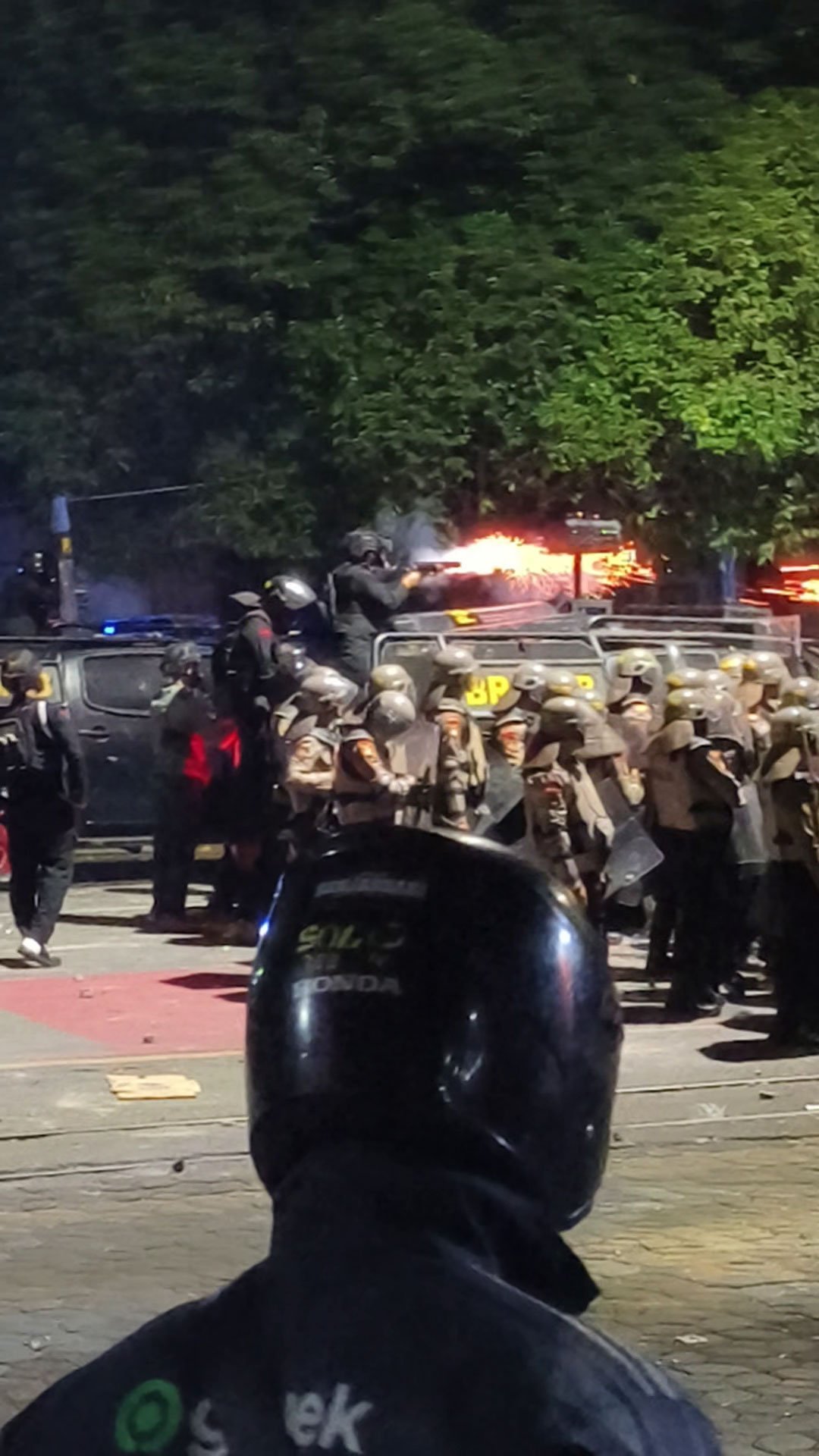
Prabowo has insisted that this unrest in many locations has been the work not of legitimate demonstrators, but rioters. Declaring that the chaotic situation has escalated into acts of treason and terrorism, he promised a firm crackdown. So far, the police have arrested more than 3,000 people across twenty cities. Local human rights organisations report that ten people died as a result of state violence, and allege multiple cases of enforced disappearances. Journalists, activists, and even ordinary citizens have become targets of physical and psychological state violence, including raids and intimidation and harassment online.
Every person I spoke with did not deny the possibility of provocateurs among the protesters, working to inflame tensions or scapegoat certain parties. Yet all also agreed that the fierce atmosphere, and acts like setting buildings on fire, might have been inevitable anyway, given how the people’s anger has reached boiling point.
“We’re always expected to express our demands politely and calmly, but just look at Kamisan,” Petrik says, referencing a peaceful protest, initiated by victims of severe human rights violations and their families, that has been held every Thursday since 2007. It’s been almost twenty years, but the state has so far ignored their calls for justice.
“For eighteen years, the victims have still not achieved justice. Sometimes, to be truly heard, we can’t fight only through quiet channels,” he adds. “There’s a reason why our fellow demonstrators set fires at certain locations, though that doesn’t mean we’re acting recklessly without strategy.”
Petrik explains that some fires, set along certain streets during demonstrations in Bandung, were meant to keep ordinary residents from passing through, so as to minimise risk of injury. Streets were also deliberately cleared to be used as evacuation routes for injured demonstrators—otherwise, they would have had to navigate roads used by fast-moving vehicles. Police posts were set on fire to make a symbolic, political point, and videotron screens erected in public spaces were torched to reflect residents’ disgust at the state’s wasteful spending.
“What do these videotron screens even give to the public? I suspect they were built with taxpayers’ money, yet all they show are ads we don’t want to see,” Petrik says. “On YouTube, we can at least skip the ads, but how can you escape them on the streets? On top of that, these screens ruin the city’s view, which should be filled with trees.”
Sari, a freelancer and activist from Bandung, is also frustrated by how the strength of public sentiment hasn’t been acknowledged: “I’m angry at those who accuse all demonstrators of provoking violence. Our anger is [being] dismissed, even reduced to [being characterised as] the actions of provocateurs.”
Even before Affan’s murder, Sari had witnessed fellow activists getting arrested, on vague charges, at a May Day protest earlier this year. Volunteering as part of a support team for demonstrators the day after Affan’s death, she was horrified to see a teenager get shot in the head with a rubber bullet from atop a building. The wound had to be stitched up.
“The state inflicts violence on its people first, yet our protests are never heard,” she says. “Why is it only the authorities who are allowed to use force, while we can’t defend ourselves? When the police attack, they aren’t blamed, but when people fight back, they are condemned. Why is it the state that monopolises the language of violence?”
What Sari saw demonstrates how protesters haven’t been the only ones resorting to violence—the state has escalated in its aggression against unarmed civilians. Violating standard operating procedures, Indonesian police have fired water cannons and tear gas without warning. On 1 September, police in Bandung recklessly fired multiple tear gas canisters at evacuation points in two universities that had previously been thought of as safe zones. Many students were injured and suffered breathing difficulties. At least forty-eight tear gas canisters were found across campus grounds.
Jiron, who lives near the two universities, says the stinging smell of the tear gas was so strong that it had lingered into the next afternoon. The night the police fired this tear gas, he’d seen helicopters and drones shuttling back and forth, and military tanks in the streets. He’d been utterly bewildered by this excessive display of force in an area that was supposed to be safe.
Karim, a journalist at BandungBergerak, an independent local media outlet, argues that any vandalism committed by protesters pales in comparison to the decades-long destruction wrought by the state through extractive industries like palm oil and mining. Such projects, either supported by or directly involving the state, have led to environmental catastrophe and human suffering. The current outpouring of emotion might seem chaotic now, but Karim believes that this public anger needs to be unleashed to make sure citizen demands are taken seriously.
Protesters aren’t the only ones who have to worry about state clampdown or retaliation. Between 25 to 31 August, the Advocacy Team for Democracy, a coalition providing legal support to those criminalised for participating in protests, recorded twenty-three cases of violence against journalists during protests across Indonesia. According to the Alliance of Independent Journalists, sixty cases of violence against journalists and the media have been documented between the beginning of the year and the end of August. Most of these incidents—including threats, intimidation, and digital attacks—are suspected to have been carried out by the military and the police.
“Covering intense demonstrations puts journalists at extreme risk,” Karim says. “Caught in the middle, we are exposed from every direction. We can’t join the protesters or the authorities might assume we’re part of the crowd. Yet standing behind the police is equally perilous as we could be detained or, at minimum, forced to delete our photos and videos.”
Karim himself has faced repeated attacks on social media, but remains committed to his work. To him, local media groups can provide perspectives missing from the bigger, national mainstream outlets that often echo government narratives about how the protesters are being manipulated by provocateurs unwilling to support Indonesia’s rise. The more the mainstream media repeats these talking points and prioritises political influencers over marginalised communities and people organising at the grassroots level, the less capable they become at articulating and reflecting Indonesians’ demands.
After the demonstrations, Prabowo reshuffled his cabinet and launched an economic stimulus package that includes food assistance and a programme that could create hundreds of thousands of temporary jobs. But these moves might be more performative than substantive, especially since the police continue to crack down: arresting, detaining, and charging activists, artists, office workers, students, even minors. It hardly seems as if the government is genuinely interested in engaging with and responding to the protesters.
Ridho, a special needs teacher who actively organises labour protests in Jakarta and Surabaya, sees the disconnect between the elite and the grassroots. He condemns the dominance of political influencers who are given huge platforms, yet ignore the interests of workers and vulnerable groups.
As an educator with fourteen years of experience, Ridho strongly disagrees with a circular issued by the Minister of Primary and Secondary Education urging students to refrain from participating in protests: “The anger of young people is valid. More and more youth are frustrated by economic inequality and rampant corruption. I always tell my students about the importance of upholding justice as the foundation of moral humanity. Protest is the highest expression of human intellect.”

More from Mekong Review
-

An interview with the founder and director of the Ubud Writers & Readers Festival
-

Decades after the end of Suharto’s New Order regime in Indonesia, a collective nostalgia for the supposed ‘good old days’—driven by historical revisionism and propaganda—is influencing contemporary Indonesian politics.
-

Magical realism meets gritty realism
- Tags: Indonesia, Issue 41, Sylvie Tanaga
