

Return of the Junta: Why Myanmar’s Military Must Go Back to the Barracks
Oliver Slow
Bloomsbury Academic: 2023
.
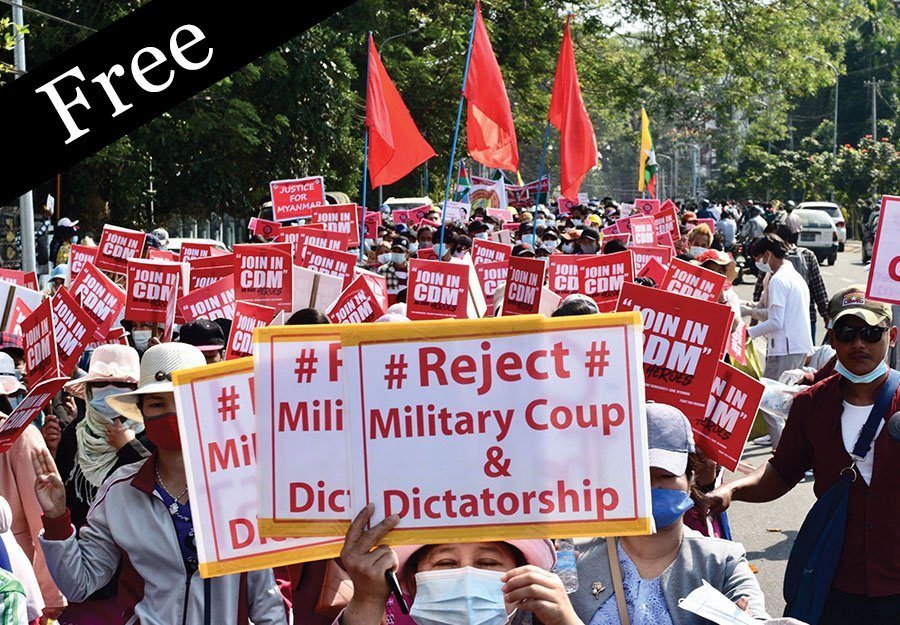
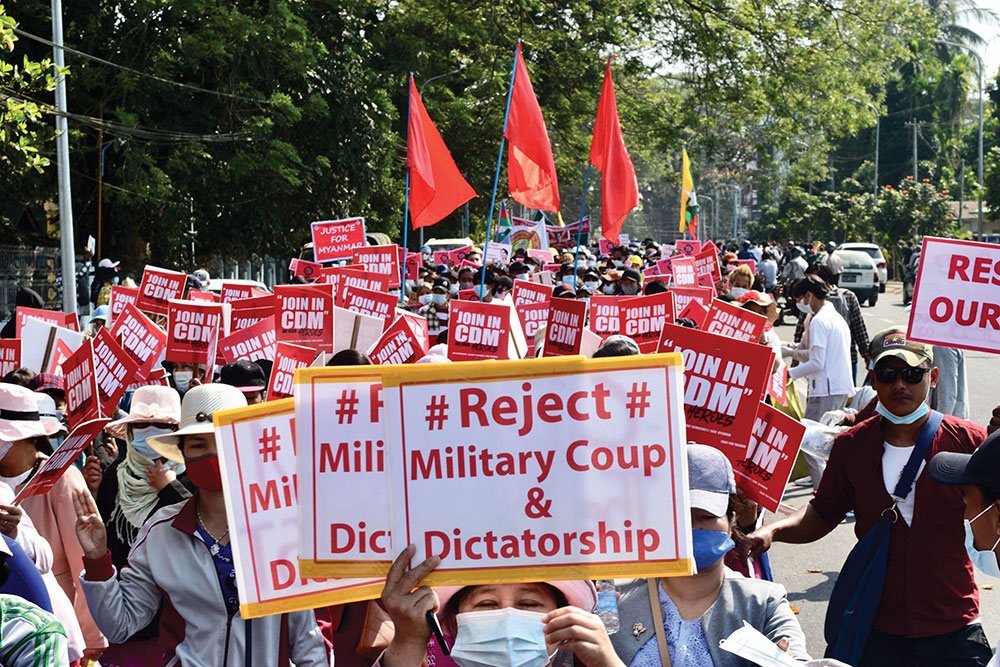
The world was shocked, for at least the length of one news cycle, when the military of Myanmar rolled their tanks into the capital, detained the politicians set to convene parliament that day and apparently staged yet another coup on 1 February 2021. But don’t call it a comeback—they’ve been there for years.
Oliver Slow’s Return of the Junta: Why Myanmar’s Military Must Go Back to the Barracks is a timely exploration of this military, with insights useful to students of history, political observers and activists. The book threads together personal anecdotes, conversations with reporters, scholarly research and shrewd analysis to examine the shadowy but omnipresent institution, and deftly balances accessibility with depth of exploration.
The author’s journalistic background shines through, and he frequently uses reporters as the lens through which to tell Myanmar’s history. This works well, because a chronic feature of Myanmar’s juntas has been their dislike of a free press as they sought to control public narratives. Thus, Slow is able to simultaneously tell a story with little-known facts—as Myanmar was largely closed off to outsiders for decades, journalists’ memories accordingly hold some of the most detailed accounts existing—and illustrate the military’s efforts to suppress free expression and information gathering. Notably, he includes conversations with ex-military personnel and military-adjacent figures—again, valuable troves in an environment of secrecy, propaganda and fear. These are particularly striking because they shed light on the mentality of actors involved in the military, including their perceptions once they have left it.
I enjoyed the book, but disagreed with the premise of its title, as I will explain after a digression about word choices in the Myanmar context, and a disclaimer: I am not from the country, I do not speak any language spoken there (except English) and I do not claim to understand the connotations or denotations of words in those languages. I am only talking about words as they are used in English.
Among the problems afflicting Myanmar are disagreements about what terms should be used to describe fairly straightforward concepts. The military, after asserting control in 1988 for at least a second time, decided to Burmanise the British name of the country (from Burma to Myanmar), its capital (Rangoon to Yangon), its most important river (Irrawaddy to Ayeyarwaddy) and other features of significance. This was perceived, by many ethnic minorities, as one of many attempts to assert the dominance of the largest ethnic group (the Bamar), which also dominates the military. One should not put too much stock in names; the reviled military rulers at that time called themselves the SLORC (which stands for the State Law and Order Restoration Council), but military leaders have also been called the BSPP (Burma Socialist Programme Party), SPDC (State Peace and Development Council), USDP (Union Solidarity and Development Party) and now SAC (State Administration Council). As Slow writes, “Myanmar’s dizzying array of acronyms would bring tears to the eyes of even the most avid supporter of the Judean People’s Front.” Groups and ideas are constantly shuffled, renamed, reacronymed, even as the essence remains largely the same. Since the coup, there has been ample talk about what to call the military institution: people disagree about whether it should be called the Tatmadaw, sit-tat, Myanmar military or otherwise. As a result, however Slow chooses to refer to these things, there are bound to be unhappy people.
When Slow says the military must go back to the barracks, he presumably means that the military should only be in the barracks—not in the halls of government or running the economy, and not outside firing its guns, particularly as Myanmar faces no obvious international military threats. However, readers may finish the book wondering if the military was ever so confined in the modern state of Myanmar. Slow walks the reader through the history of the country and its military—the two disturbingly intertwined—from the colonial era, when a British administration set the tone of politics through force; to the almost immediate imposition of military rule after independence; through successive military regimes and attempts to dislodge them; and a brief stage in the 2010s when the military uncharacteristically allowed democratic, economic and other much-desired progress for people.
In reality, the military has never relinquished political power. As Slow notes, in 2008 the military-run SPDC rammed a new constitution through a fraudulent ‘referendum’, cementing power until further notice. While that constitution seemed to allow for at least the patina of democracy, it also set terms that might be called ‘favourable’ for the military, including requirements that 25 per cent of parliamentary seats be held by unelected military members and that any constitutional amendment secure more then 75 per cent of parliament’s votes. Thirty-three constitutional provisions consider the eventuality of a state of emergency. The military cited these as its basis for replacing the elected parliament in 2021, and continues to cite them, albeit loosely when necessary. For example, according to the constitution, a state of emergency is to be invoked by the president; he has refused to declare one, despite pressure from the military since it detained him on 1 February 2021. The constitution also says that a state of emergency lasts a year, after which the National Defence and Security Council may “normally permit two extensions” of six months each. Notwithstanding the implications of this—more than two years after the provisions were invoked—the presence of the word “normally” in a section about a state of emergency likely sheds light on the drafters’ thoughts at the time.
The military has never relinquished economic power either. As Slow notes, the BSPP, SLORC and SPDC military regimes did an excellent job—for themselves—of creating and then privatising state-run enterprises in such a way that all are run by either military members or their cronies. The UN Independent International Fact-Finding Mission on Myanmar produced a report in 2019 linking two conglomerates run by top military members to at least 133 businesses spanning industries as diverse as banking, tourism, communications, resource extraction and the production and sale of diverse consumer goods. Granted, control over government purse strings since 2021 has given the military additional access to enterprises that are still state-run—including the oil and gas, gems and timber enterprises—but the military’s upper echelon had already been thriving financially. Some speculate that the apparent liberalisation of Myanmar’s economy and politics during the 2010s was actually aimed at economic gains for military and military-adjacent businesses, as diminished international sanctions led to increased foreign investment. Regardless of the intentions at the time, economic control has clearly remained with these actors; this is why, since the latest coup, activist groups have been so intent on cutting the flow of foreign money to diverse enterprises inside Myanmar.
Nor has the military ever stopped terrorising civilians and communities. Other than its persecution of the Rohingya (increasingly recognised as a genocide), it has targeted ethnic minority populations with abuses—executions of unarmed civilians, torture, rape and sexual assault, forced labour and conscription, among others—that likely amount to war crimes or crimes against humanity. The pervasive and ongoing nature of these harms is illustrated by the fact that, after the UN fact-finding mission released four lengthy reports on the military, the UN Human Rights Council established the Independent Investigative Mechanism for Myanmar to collect and analyse evidence of international criminal law violations, committed since 2011, that could be used in future court proceedings.
Unfortunately, though there have been efforts since the coup to punish the military politically and economically, prospects for legal accountability remain distant. A pending case before the International Court of Justice—in which the military is now asserting that Myanmar did not violate the Genocide Convention in relation to its treatment of the Rohingya—would, even if successful for the plaintiff, render a verdict against Myanmar as a state, rather than hold any individual accountable. Although the shadow civilian government has made efforts to ratify the Rome Statute, prosecution for any crime other than the deportation of Rohingya people into Bangladesh remains a remote possibility at the International Criminal Court. And, as Slow notes, there has been a paucity (absence, perhaps) of domestic accountability for any military actor in the country; he identifies this as the greatest driver of the military’s appalling behaviour. As an institution adept at weathering international isolation, the military’s greatest vulnerability now seems to come from a rising tide of armed resistance nationwide—but Return of the Junta, in providing insight into those at the helm of the military, could be a useful tool for devising better solutions.
At roughly 200 pages and written in a journalistic style, Return of the Junta is a quick read that should be on the list of any English speaker with an interest in Myanmar. It is full of ideas and arguments for change there—all of which require first reforming or overhauling the military. After reading this book, I would like even more to see that happen.

More from Mekong Review
-

A poem from Maung Day
-
Poetry from Jack Malik
-
The Burmanisation of language in Myanmar
- Tags: Daniel Benowitz, Free to read, Issue 31, Myanmar, Oliver Slow
