


Among the Braves: Hope, Struggle, and Exile in the Battle for Hong Kong and the Future of Global Democracy
Shibani Mahtani and Timothy McLaughlin
Hachette Books: 2023
.
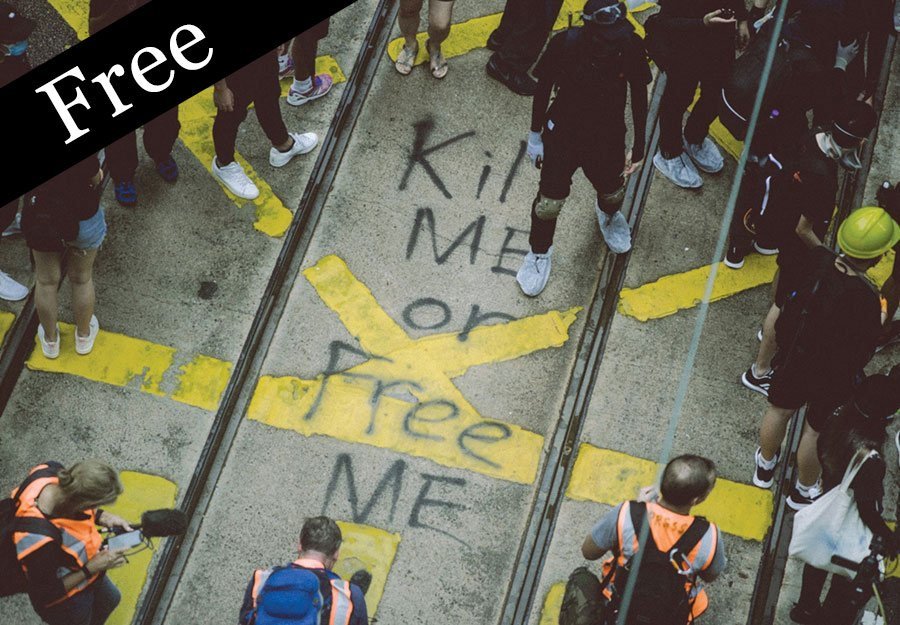
In 2019, a controversial bill that would allow extradition to mainland China sparked year-long citywide protests in Hong Kong. While the bill was ‘withdrawn’ in October that year—more than four months after the city’s first major demonstrations—it was already too late; the protests had developed into broader pro-democracy movements. The citizens of Hong Kong had witnessed and experienced police brutality that contrasted sharply with the authorities’ inaction when civilians were most in need, and they were incensed by the government’s unwillingness to listen to the people. Violent crackdowns failed to stop the protests, but in early 2020 the Covid-19 outbreak pushed people off the streets and back into their homes. On 30 June 2020, while people grappled with pandemic precautions, the Chinese government unilaterally imposed a national security law on the city. Hundreds have since been arrested under this broad and ambiguous piece of legislation. Ultimately, the political crisis triggered by the attempt to introduce the extradition law and the introduction of the national security law have led to the biggest exodus of Hong Kongers since the Tiananmen massacre in 1989.
Shibani Mahtani and Timothy McLaughlin—co-authors of Among the Braves: Hope, Struggle, and Exile in the Battle for Hong Kong and the Future of Global Democracy—were journalists based in Hong Kong during the anti-extradition protests in 2019, Mahtani reporting for The Washington Post and McLaughlin for The Atlantic. During that tumultuous period, they reported from the ground, interviewing people from different age groups and across the political spectrum—including speaking to pro-Beijing politicians to better understand their perspectives and reactions to the Hong Kong government’s choices and misreading of the people’s discontent.
Among the Braves is Mahtani and McLaughlin’s attempt to historicise the development of democracy in Hong Kong, tracing its trajectory to the anti-extradition demonstrations and the impact of the national security law, through the lives of the people who have been active in the decades-long movement. They recount the experiences of Reverend Chu Yiu-ming, a veteran pro-democracy activist who may be seen as a representative of the moderate ‘wo lei fei’ (or ‘peaceful, rational, non-violence’) faction; Finn Lau, a young surveyor who coined the strategy of ‘laam caau’ (or ‘burning together’) and who became a representative figure of the Hong Kong ‘international front’ applying pressure on their government from abroad; Gwyneth Ho, a journalist-turned-activist and politician who was eventually charged under the national security law; and Tommy, a militant ‘yung mo’ (or ‘valiant’) frontline activist. While the book translates the yung mo faction as “the braves”, I would argue that “the braves” in the title refers to many Hong Kongers, in different positions and generations, who have been fighting for the city’s democracy and future—including, but not limited to, this book’s protagonists. It is only through understanding “the braves” in this wider sense that I can make sense of the book title.
The book is divided into three parts. First, mainly through the stories of Reverend Chu and the other protagonists’ younger years, the authors paint a picture of the post-war development of Hong Kong: its political and legal system, the Sino-British Joint Declaration, the growth of pro-democracy movements and the impact of the Tiananmen massacre, up until the Umbrella Movement in 2014. The second part of the book focuses on the anti-extradition protests and its swift evolution into a broader pro-democracy struggle. Finally, Mahtani and McLaughlin narrate the aftermath of the 2019 protests and the impact of the national security law, including the arrest and detention of dissidents and Hong Kongers fleeing the city they love—mirroring how people fled mainland China to Hong Kong to escape communist rule decades ago. All of the book’s characters have either been arrested (Ho) or are living in exile (Chu, Lau and Tommy).
The second and third parts of the book shed light on incidents fixed in Hong Kongers’ memory, such as the violence that erupted on 21 July 2019. That night, after a day of protests downtown, civilians—protesters and otherwise—were indiscriminately assaulted by thugs in white at the Yuen Long metro station in the northwestern New Territories on their way home. People desperately sought help from the police, but the officers simply disappeared, arrived late or did nothing. The difference in attitude was clear when juxtaposed against the usual huge show of force at protest sites. Some of the attackers were later identified as gang members with links to the local rural villages, including village heads. After the attack, photos and video footage showing a pro-Beijing politician shaking hands with the thugs that night were circulated online. For many Hong Kongers, ‘721’—as the incident came to be known—symbolised the collusion of the government, police and gangsters. There was plenty of speculation that the government and the police had known about, if not supported, the gangsters’ plan to assault ordinary people.
In Among the Braves, Mahtani and McLaughlin suggest that both government officials and police officers had known of the plan. A police officer who was supposed to be responsible for cracking down on gangsters had “managed to gain access to the WhatsApp groupchat, giving him unfettered insight into the plans [of the attack], even before rumors reached the residents of the neighborhood”. The authors also argue that it should not “have been so difficult to connect the dots” and put forward that “the government already knew who some of the men [the attackers] were”. They report that a political assistant of close aides of Hong Kong’s top leader Carrie Lam, the chief executive, had attended a banquet with some of the village heads in Yuen Long, and had posed for a group photo the night before the attack. One of the men in the photo was caught on camera assaulting Ho, who was working as a journalist for a local media outlet at the time and live-streaming from the station. The authors put forward: “The government officials in attendance offered hints that they knew what was about to unfold” and were instructed to “wear only white”.
The distance between the government and the people is also highlighted in the book: while Hong Kongers used the online forum LIHKG to debate and discuss protest strategies, Lam’s inner circle continued to rely on mainstream television news as their main source of information.
Readers not familiar with Hong Kong may find useful the way Mahtani and McLaughlin ground the events of 2019 with a historical account of Hong Kongers’ long fight for democracy and social reforms. They show how the struggle extended back to when the city was still a British colony, countering claims—often made by Beijing and their supporters—that Hong Kongers had been apathetic and did not fight for democracy during the colonial period. Among the Braves tells the story of Hong Kongers’ support of the 1989 pro-democracy movement in China and participation in Operation Yellowbird, a clandestine mission to help Chinese dissidents escape the mainland after the Tiananmen protests. It also narrates the fight for universal suffrage after the British handed the city over to Beijing in 1997, and the way the Chinese government reneged on its promises.
These historical accounts are important context for understanding what led to the protests in 2019, especially for those who might otherwise think of Hong Kong only as a global financial centre that rewards expatriates with luxurious lifestyles, or merely see the city through the lens of a US-China rivalry. Among the Braves pierces these stereotypes and shows how generations of Hong Kongers exercised their agency and developed a sense of identity.
The fight for democracy is hardly a ‘colour revolution’—a term virtually unheard of in Hong Kong before 2019—provoked by Western countries, as claimed by the Chinese Communist Party. Instead of allegations of foreign intervention, the ‘international front’ was really a group of concerned and anxious Hong Kongers based locally or overseas who leveraged their networks and expertise to raise awareness of what was happening in Hong Kong and to call for solidarity and support. The authors tell of how, while on a trip in the US to address Congress, Ho took care of Joshua Wong and Brian Leung’s suits, so that these young activists would not show up in rumpled clothes like clueless teenagers. Anecdotes like this remind us that these are ordinary young people who were thrust too quickly and too suddenly into high-stakes adult roles.
While the book ends with stories of arrest and exile, largely focused on those who now languish behind bars or are rebuilding their lives far from home, I beg to differ on where to set our gaze. I believe that the hope, struggle and fight for the future of the city and global democracy also continue to lie in those who choose to stay in Hong Kong.
They, too, are among the braves.

More from Mekong Review
-

Poetry from Lok Man Law
-

How a teenager from Hong Kong came of political age
-

A poem in commemoration of Bleak House Books, an independent bookshop in Hong Kong, which ceased operations in October 2021. The store is set to reopen in upstate New York in the spring of 2023.
