


Celebrity Activism and Philanthropy in Asia: Toward a Cosmopolitical Imaginary
Dorothy Wai Sim Lau
Amsterdam University Press: 2024
.
In this social media age, it’s common to see celebrities use their platforms in service of causes that are, or at least appear to be, important to them. This might be a consequence of repeated catastrophes befalling parts of the world—prompting many people, from the ordinary to the dazzlingly famous, to speak out—but it could also be that there’s an increasing correlation between a fan’s values and a celebrity’s messaging. Simply put, fan support might sometimes depend on what position a celebrity takes on an issue. A celebrity’s publicly expressed political opinions are often not free from professional or financial influences. In this context, what does it mean to refer to a celebrity as an “activist” or “philanthropist”?
Among North American celebrities, big names like Angelina Jolie and George Clooney are recognised celebrity activists, so much so that this “activist” label is often more prominently recognised than the specifics of what they’ve actually done. What makes a celebrity an activist is how their audience interprets their actions.
In Celebrity Activism and Philanthropy in Asia: Toward a Cosmopolitical Imaginary, Dorothy Wai Sim Lau undertakes a nuanced interrogation of how fame, altruism and regional identity intersect in Asia’s transnational mediascape. Weaving together case studies from India, South Korea, Hong Kong, China and diasporic communities, Lau challenges Western-centric paradigms of celebrity humanitarianism while proposing an alternative framework for understanding solidarity, power and cultural production.
Current trends in global popular culture, such as the explosive growth of the Korean Wave, mean that today’s audiences are much more accustomed to content from countries and cultures different from the ones they were raised in. Despite this, Western media outlets are still prone to exoticisation. We’ve seen this with Korean actors like Lee Jung-jae and Lee Byung-hun of Squid Game, Song Kang-ho of Parasite and Youn Yuh-jung, who won an Oscar for her role in Minari. All four are big names in Korea, with established careers and accolades even without the hits that brought them to the attention of Western audiences. But after her historic Oscar triumph in 2021, American reporters repeatedly asked Youn about meeting Brad Pitt. In response to a chirpy question about what Pitt smelled like, Youn—who’s been acting professionally for almost as long as the Hollywood actor has been alive—jokingly said, “I didn’t smell him, I’m not [a] dog.”
This is the importance of context. In their home countries, actors like Youn are household names; in the US they’re mistaken as “rising stars” and might even be viewed as “activists” blazing a trail to better representation in the media. As Lau demonstrates in her book, all celebrity activists have to deal with the power dynamics at play between their own national backgrounds and the contexts of the areas within which they are participating (or seen to be participating) in activism.
Lau defines celebrity philanthropists “not as famed individuals but as an imagined alliance that can evoke a sense of ethnic communal identity within and across distinctive geopolitical spaces”. She builds on the concept of “inter-Asia” to examine the dialogue between diasporic communities and their origins. For example, Lau’s analysis of pandemic-era audio-visual texts reveals how Asian celebrities from the global diaspora articulated “crisis-driven solidarity” against Covid-related anti-Asian racism. She points to three initiatives—#OurIdentity, a virtual concert, #WashTheHate, an anti-hate awareness campaign, and #TakeOutHate, an initiative to support Asian restaurants in the US—as examples of activism that, despite being largely centred on the US and the Asian American community, created solidarity among celebrities across Asia.
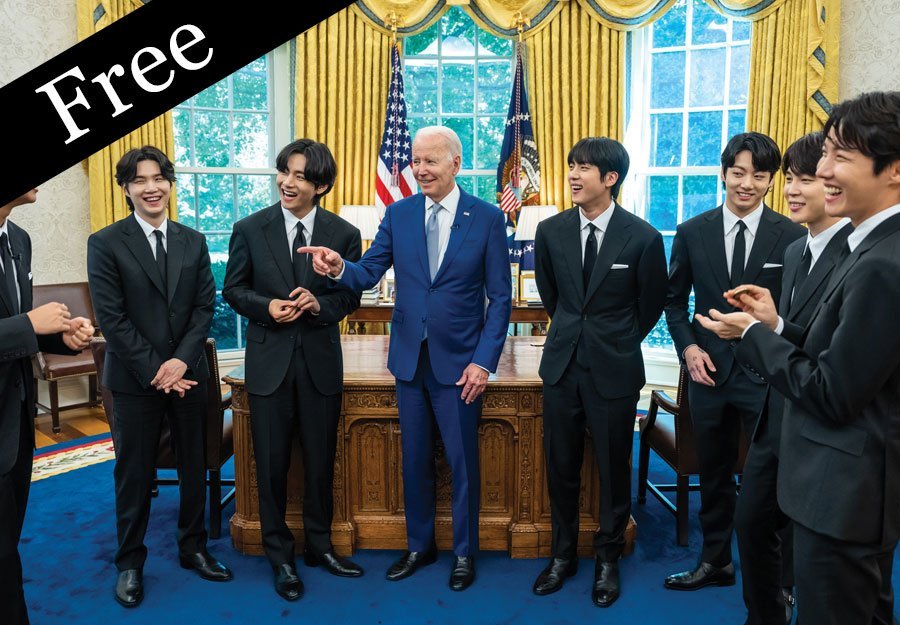
Another “inter-Asia” instance was the K-pop idol group BTS’s visit to the White House in 2022. This was at the invitation of Joe Biden, the US president at the time, to talk about the rise of hate crimes against Asians in the country. Some pointed out the incongruity of inviting Koreans to talk about anti-Asian hate in the US, but BTS’s appearance meant that they—and, by extension, the White House—could leverage their popularity to raise awareness of an issue that affects a significant part of their fanbase. This “cosmopolitical agenda” thrives on contradictions, assuming a “universal right to global citizenship” while remaining tethered to ethnoracial categories.
Lau presents multiple case studies: BTS, the Bollywood megastar Aamir Khan, the late Ryuichi Sakamoto from Japan, Hong Kong’s pro-democracy Cantopop singer Denise Ho and China’s “live-streaming queen” Weiya (or Viya).
As a Korean Studies specialist and K-pop researcher, I was especially interested in Lau’s chapter on BTS, “celebrity diplomacy” and how soft power can be a double-edged sword. BTS partnered with UNICEF in 2017 to launch the LOVE MYSELF campaign aimed at promoting self-esteem among young people and ending abuse and bullying. Leveraging the group’s huge international following, the campaign promoted universalist messages of youth empowerment; UNICEF boasted that it had reached “almost every country in the world with positive messages of self-love and self-care”.
Lau points out that BTS’s activism was also strategically coded to advance South Korea’s national image. She argues that the way in which BTS’s message has been used to support universal values “exposes the complex nature of star-led altruism and the entanglements fashioned by cosmopolitical process”. There’s complexity and contradiction: while K-pop idols participate in global activism, they tend to keep mum on political issues in their own country, usually because the very management companies that collaborate with international institutions also ban their artists from weighing in on local controversies for fear of triggering backlash.
It’s also important to point out that much of the activism attributed to artists comes from fan interpretation. BTS’s fans—collectively known as ARMY—not only resonate with the call for self-love in their music but also have their own takeaways from these broad themes. When BTS appeared at the UN in 2018, international ARMY were particularly moved when RM, the group’s leader, made a reference to gender identity. But this didn’t have the same impact on Korean ARMY, who mostly emphasised their pride in watching Korean artists thrive before worldwide audiences. Regardless of one’s cosmopolitical ambition, celebrity activism will always come up against the limitations and fixations of national contexts.
Lau deftly analyses the ways in which celebrities navigate the needs and priorities of different stakeholders, but a more systematic examination of how humanitarian organisations leverage celebrity influence would have strengthened the book’s critical framework. How does UNICEF, and other organisations like it, negotiate with celebrity agencies to align advocacy with branding? What compromises emerge when universal humanitarian goals intersect with national soft power agendas?
There are times when “activism” involves working with for-profit enterprises. Lau’s examination of Weiya’s collaboration with Alibaba, the Chinese e-commerce company, to sell agricultural products from China’s “destitute areas” hints at corporate conglomerates’ role in shaping philanthropic narratives. Philanthropy—or, at the very least, the appearance of it—can be good for business: by positioning Weiya as a “do-gooder”, the company can also bolster its own image. How substantially different is this from humanitarian organisations joining up with pop idols to produce sleek, packaged content, however noble the cause might be?
The tension between solidarity and commodification raises critical questions: Can “inter-Asia” alliances sustain themselves beyond moments of crisis or do they risk becoming ephemeral marketing tools? Lau’s case studies suggest the latter. The “imagined alliance” of celebrity philanthropists often fractures under scrutiny, as seen in Weiya’s 2021 tax evasion scandal—a fall from grace that exposed the fragility of state–celebrity symbiosis. Aamir Khan, meanwhile, differs from many of his peers in Bollywood by not charging a fixed fee for his roles. Instead, he takes a cut of the profit from the project, aligning his financial compensation with the audience’s reception of his work. This approach ensures creative freedom but also reinforces his public persona as a socially conscious celebrity. His “ambivalent altruistic image” reveals how celebrity activism can become entangled in capitalist logics, where benevolence is both a moral stance and a revenue stream.
Combining media analysis, critical theory and digital ethnography, Lau’s interdisciplinary approach offers a model for studying non-Western celebrity cultures. Using the framework of celebrity philanthropy, her book does an excellent job of showing how problematic conceptualisations of Asia can be.

More from Mekong Review
-

Poetry from Lok Man Law
-

A poem by Yago Tse.
-

How a teenager from Hong Kong came of political age
