

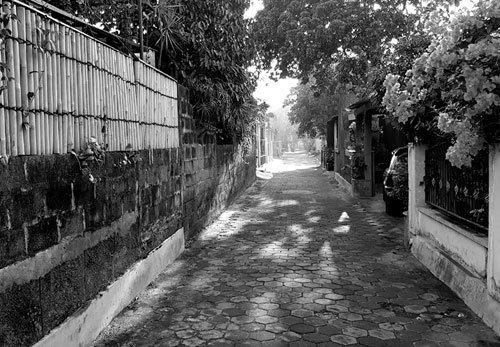
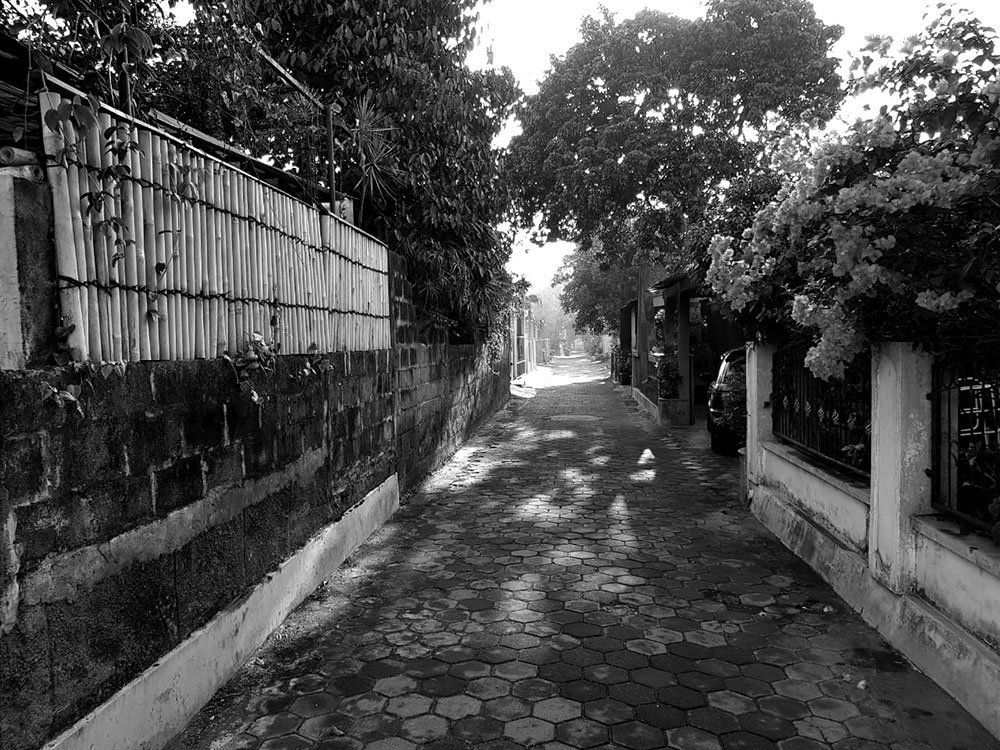
Kembaran, where I live in the south of Yogyakarta, is not affluent by any means. Predominantly lower middle class, I suppose. Most families own one motorbike, and quite a few, a car. The majority are Muslim, but there is a good sprinkling of Catholics. Nearby there is an Islamic boarding school, several very loud mosques, a Catholic church, a privately owned arts centre and a graveyard with Muslim, Chinese and Christian plots. My small Javanese-style house is set in a network of criss-crossing paved alleys and dirt paths leading off a busy main road. Kids still play in the alleys in the afternoons, food sellers pass by on motorbikes with recorded tunes or cries advertising their wares, and women come out to buy, chat and gossip. Many artists and students live in the vicinity — because others do and because it is relatively cheap.
My full address shows how neighbourhood works in Indonesia — in a network from the smallest unit to the largest: RT 4, Kembaran, Tirtonirmolo (the sub-district), Kasihan (the district), Bantul (the residency), Yogyakarta (the city), Daerah Istimewa Yogyakarta (the province). As far as nitty-gritty community issues go, the RT is where things happen (or not). RT (pronounced “air tay”) stands for Rukun Tetangga (Neighbours’ Harmony) and consists of between thirty and seventy households. It dates from the Second World War, when the occupying Japanese military government established associations modelled on the Japanese Tonarigumi or neighbourhood associations, and used them for propaganda, civil defence, mobilisation and surveillance. The Dutch colonial government had administered via traditional structures, which were hierarchical. The Rukun Tetangga was new in that it was egalitarian — each household had an equal voice. This remains true today.
More from Mekong Review
-

A poem by Jennifer Eagleton
-
A poem by Rory Harris
-

Eka Kurniawan’s new collection of short stories
- Tags: Indonesia, Issue 18, Jennifer Lindsay