


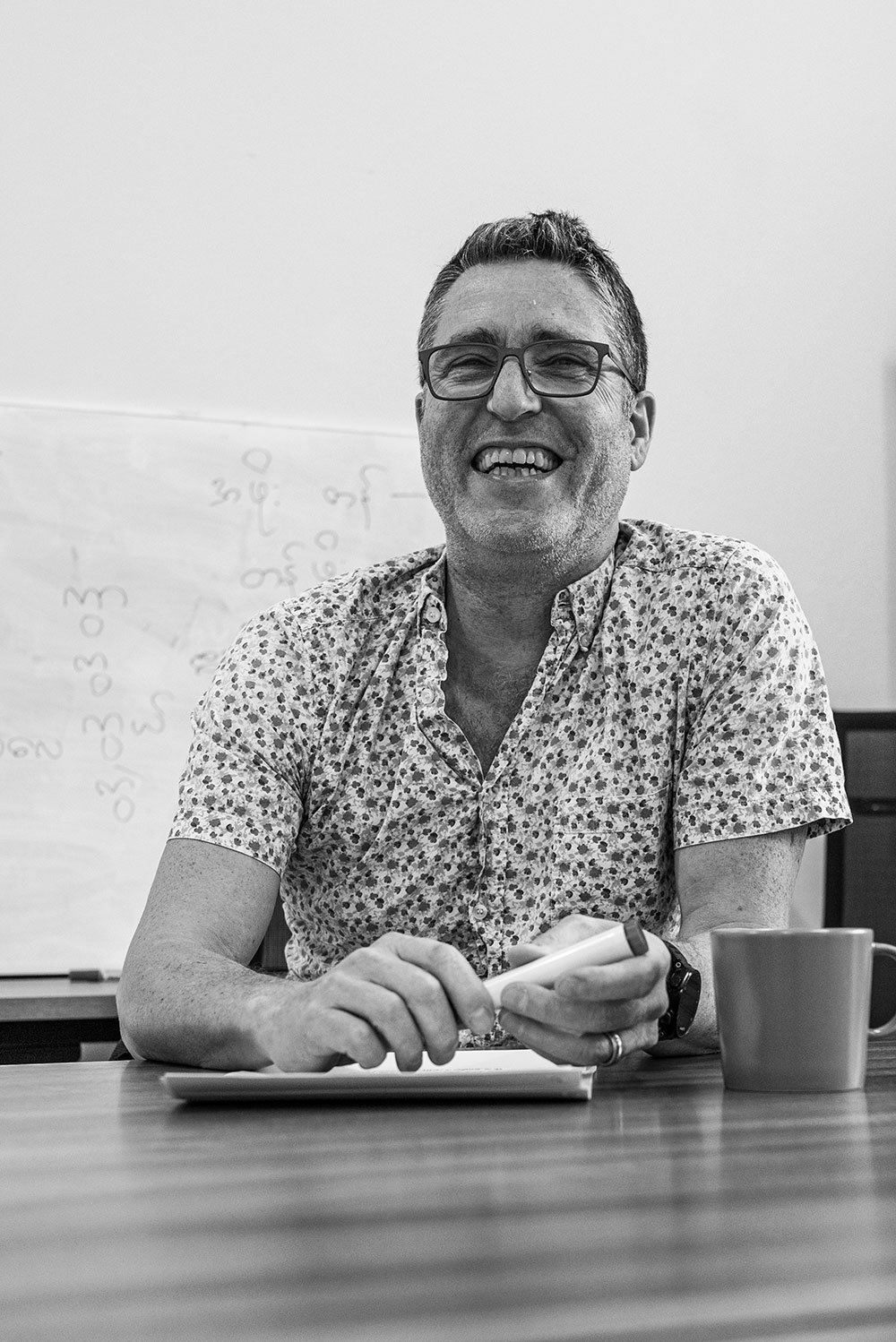
The British linguist Justin Watkins did not set out to study Burmese, let alone to become one of the world’s foremost teachers of the language. He studied French and German in high school; in university, he turned to Russian and Chinese. He spent a year teaching English in Japan. But the crucial encounter occurred in the 1990s when he was doing a master’s in phonetics at the School of Oriental and African Studies (SOAS) in London. He had to work on the sound system of an Asian or African language, and his teacher paired him up with Burmese because of its regional proximity to Chinese. It was “totally random”, Watkins, now fifty-two, said. “It could have been Zulu. It could easily have been Somali or Amharic.”
After graduate work on Burmese consonants, he started a PhD with a focus on Wa, a Mon-Khmer language spoken by about one million people in northeastern Myanmar and across the border in China. Wa State has its own army and remains largely inaccessible to both foreigners and Myanmar nationals. To do fieldwork, Watkins “rocked up in Lashio”, a city in Myanmar’s Shan State. He carried with him a device called a laryngograph. The process involved asking Wa speakers to read from a list of predetermined words as sensor plates on either side of the larynx recorded vocal cord movements. Watkins published The Phonetics of Wa as a monograph in 2002, a few years after taking up the post of professor of Burmese at SOAS. For the next several years he worked on a Wa-to-Chinese, Burmese and English dictionary, which was published in 2013. He also found time to study Khumi and Sumtu, languages spoken in Myanmar’s Chin State and Rakhine State respectively.
In February, Watkins and I chatted at the new Greenhouse coworking space, located in a tranquil and café-clustered part of Chiang Mai, where he was teaching a two-week Burmese language course. Haze from the annual burning season lay like a shroud over distant mountains. The soft light of a fading afternoon seeped through wide windows, illuminating a whiteboard covered in Burmese script. I was taking the course myself and had spent hours in that classroom sparring with relative clauses, complex sentence constructions and a short story by the Burmese writer Ma Sandar. The story, ‘TV Sickness’, is about a man, named U Maung Maung Lat, whose new television makes him so popular with guests that he becomes overwhelmed, worries about his kids’ grades and gets so anxious he has to see a doctor. The word ‘TV’ is a pun on TB, or tuberculosis.
For the past three years, Watkins has been a little like U Maung Maung Lat, beset with a series of stressful and heart-rending problems. “The time from then to now has been completely hideous,” he told me. Watkins and his partner had to deal with harsh pandemic lockdowns just ahead of having their second daughter. In August 2020, Watkins’s co-teacher and long-time mentor, the linguist and Burmese language doyen John Okell, died at the age of eighty-six. Because of the pandemic, Watkins could not attend his funeral. Last year, Watkins lost his job at SOAS.
He lights up when talking about Okell and their relationship. Okell taught Watkins beginners Burmese at SOAS. “We clicked from the beginning,” he told me in a later conversation via Zoom. “We were basically in touch almost daily for the rest of his life. He was very much a mentor and extremely close friend. Losing him was extremely difficult and sad.” They used to meet for dinner every couple of months. Okell would come prepared with a list of things he wanted to talk about. “We would just natter on about Burmese,” Watkins recalled. “Right until the end of his life he was completely fascinated by the language and we had that in common. He meant a great deal to me.” He misses those conversations, especially when he comes across a difficult sentence in Burmese and wishes he could discuss it with Okell.
Watkins credits Okell with nurturing his fascination with the language. Those beginner classes at SOAS were small, with only a couple of students sometimes. But the size of the class gave it a tinge of exclusivity, like being part of a club others didn’t know about. “It was great fun learning it with him, realising you were on to something special. Like a lot of people, once you get connected to Myanmar it sucks you in like nothing else. The introduction with John was one element. Particularly at SOAS, [there’s] this long tradition of people who had devoted their lives to studying the language, going right back a whole century.”
Watkins brings that same infectious enthusiasm to his courses. The mark of a great teacher is someone who can transmit their love of a subject to their students, like an inheritance. Watkins does that, in a way that only a linguist can, by revelling in the seemingly ordinary but cosmically important aspects of a language. When I asked him to give an example, he went into a detailed description of a specific particle that, when dropped on the end of a verb, can signify the action is taking place in a remote time or space. Even so, one can never really know everything about a language. “Teaching Burmese you often use the same material. But I almost always find something new, even in texts I’ve been using for twenty years,” he said.
In Chiang Mai, Watkins described the first intensive courses he started teaching alongside Okell in Myanmar in 2009—several hours a day, five days a week for two weeks. The course has long mixed traditional teaching methods with real-life materials, like news articles and pictures of shop signs. In 2009, Myanmar was under military rule, as it is once again after the 2021 coup that ended ten years of halting democratic progress. As a linguist with no political involvement, Watkins didn’t have much to fear, but they were still cautious. Their initial classes, held at the French institute in Yangon, were kept small and low-key. “It all had to be slightly sensitive,” Watkins said. “In the early years we were all a bit worried that the police would show up and drive us to the airport.”
Over time, the course turned into a rite of passage for diplomats, journalists and United Nations and NGO staff preparing for work in Myanmar. When the country opened up more in 2012, enrolment began to grow and diversify as businesses poured in. They went from a few dozen students to more than 100. There was a waiting list. “Suddenly in 2014, 2015, we’d start the class and some corporate American would stroll up and say, ‘I’m Ken. I’m working for Samsung’,” Watkins said. But Myanmar’s openness and tainted success story, which had always been built on fraught foundations, began to unravel. It did so horrifically and spectacularly with the Rohingya crisis in 2017. Then the pandemic took hold, and the coup capped it all off. The dream turned into a nightmare that the Myanmar people are still trapped in.
This year’s course, held in Chiang Mai instead of Myanmar, marked a return to in-person lessons after three years online. But the coup cast its shadow too; alongside useful phrases like ‘How long have you been having stomach pain?’ I learned others like ‘I’ve been arrested’. We spent several days studying a BBC Burmese article about the launch of the Yangon public bus system in early 2017. It hasn’t been that many years, but the article seemed quaint in comparison to the drumbeat of headlines from Myanmar today about violent crackdowns, airstrikes and economic meltdown.
At a time when it is especially important to engage with Myanmar, there is some uncertainty about the future of Burmese-language instruction, at least in English. Okell’s death has left a void, the shakeup at SOAS may diminish its draw as a top-tier place to learn the language and students wishing to travel to Myanmar and learn on the ground may be reluctant to go there.
Watkins officially lost his job in September 2022 despite the best efforts of his peers. Things had been uncertain since 2020, as budget cuts and funding problems loomed for academic institutions. Worried about the security of Watkins’s position, a global petition initiated last year by supporters at Australian National University—urging SOAS not to cut the professor of Burmese post—garnered about 1,000 signatures. The Myanmar tycoon Serge Pun had stepped in with a £200,000 pledge to support Burmese-language education, but the coup put an end to it. “All of that was off. It just died overnight,” Watkins said.
Burmese isn’t the only language for which resources have dried up, according to Watkins. He believes that SOAS is failing to live up to its founding commitment to teach the languages from the Asian and African countries reflected in its name. When asked for a response, SOAS said in an emailed statement that it does not comment on individual staffing matters. “SOAS teaches Burmese within the School of Languages, Cultures and Linguistics,” the statement added. “We offer opportunities to learn about Myanmar and Burmese culture through our BA Languages and Cultures and MA South East and Pacific Asian Studies degrees, where students can focus on South-East Asian Languages and Cultures. Both these courses offer the option to learn Burmese.”
Watkins isn’t waiting around for his luck to turn; he’s applying for jobs, ramping up online classes via Zoom and trying to come up with ways to make such teaching endeavours more sustainable. There are rewarding moments. One student has learned to read pages from a novel in Burmese through lessons held outside the formal educational structure that SOAS used to provide. “Maybe that’s it, maybe Burmese is one of the languages that just can’t thrive in a university context because it’s too costly,” he said. He hopes that his classes can help those who work with the people of Myanmar have closer interactions with their colleagues.
But if Burmese language classes begin disappearing from university curricula, there are serious implications to be considered: “What happens to Burmese scholarship? Who’s going to do research on the Burmese language? There’s a lot of things we don’t know and that could be written about. There are [also] many many other languages in the country that are crying out for research.” For Watkins, learning languages isn’t just about fulfilling immediate practical needs: “Freedom from English, freedom from dependence on English, is the root to better understanding, and that should be its own goal.”

More from Mekong Review
-

Once the beating heart of commerce in Myanmar, wet markets are under threat
-

Over 860 stations operate on what’s now known as the Myanmar Railways network
-

Mae Sot, Thailand, provides the anonymity a Burmese peace activist needs, although not without guarded boundaries and precarious undercurrents to navigate
- Tags: Free to read, Joe Freeman, Justin Watkins, Myanmar, Thailand
