

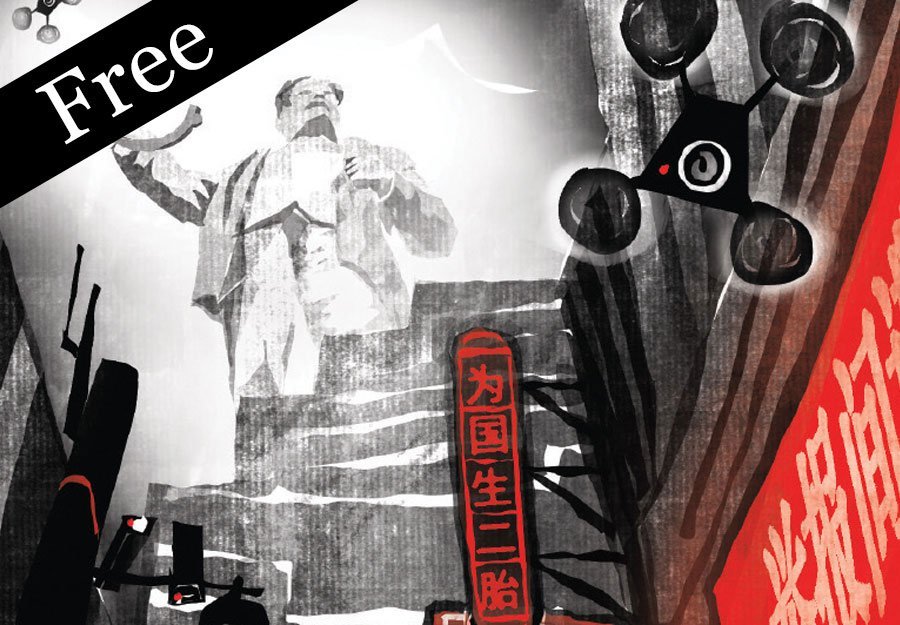

You Must Take Part in Revolution
Badiucao and Melissa Chan
Street Noise Books: 2025
.
Graphic fiction has become an ideal medium to represent unspeakable historical atrocities, bringing visual impact to readers about histories gradually fading into oblivion. In Taiwan, The Boy from Clearwater (來自清水的孩子) chronicles the life of Tsai Kun-lin (1930–2023), a victim of Taiwan’s White Terror era, exploring how political, social and international forces profoundly impacted individual lives. Tsai was sentenced to ten years in jail for “membership of an illegal organisation” after attending a high school book club.
Another graphic novel, Lunatic is the Night (夜長夢多), consists of five illustrators’ interpretations of life under autocracy. The nightmarish scenes, whether dream-like or realistic, are comparable to the dark aesthetics of You Must Take Part in Revolution.
This graphic novel presents a pre-apocalyptic story co-authored by journalist Melissa Chan and activist artist Badiucao. Chan was expelled by China in 2012, presumably due to her reports on sensitive political issues, such as the use of secret illegal prisons in Beijing. Meanwhile, Badiucao’s works have been banned by the Chinese regime and he now lives in exile. His art in You Must Take Part in Revolution is powerful and nostalgic, vividly representing the spaces he’s no longer able to step into. This book combines powerful imagery with a compelling plot to convey the political turmoil we’ve experienced and might face in the near future.
Set in the year 2035, we’re brought into a world where Hong Kong is under strict surveillance by the Chinese regime—with a social credit system that can detect even an individual’s vital signs—and Taiwan is a military base for the US and a battlefield between the US and China. It’s no longer a competition between democracy and authoritarianism; the US is now ruled by a person who seized power through a coup and drove the nation toward oligarchy. It’s remarkable that the authors started working on this book years ago—their prediction of the US’s political direction seems, unfortunately, to be correct.
One can see the authors’ attempt to address as many issues as possible: the terror of life under dictatorship and censorship, conflicts between different political stances, degrees of activism participation and the choice of violence as a method of revolution. I’d like to focus on the personal struggles of three major characters: Andy, Maggie and Olivia.
Driven by compassion for his peers, a deep sense of justice and a desire to overthrow the authoritarian regime, Andy’s role comes with immense pressure and responsibility. He grapples with the fear of endangering his fellow activists and loved ones, facing difficult decisions like choosing between individual safety and the movement’s broader goals. The psychological toll of leading high-stakes missions gradually leaves him with no choice but to remain strong while concealing his doubts and fears.
Maggie was arrested during an action in 2019. She’s since been incarcerated with other dissidents, such as Tenzin from Tibet, who taught her how to survive torture in prison through meditation. Her (dis)trust of Andy and Olivia is a constant test of her will to live. Maggie’s fate mirrors that of many imprisoned Hong Kong activists—what supports them in life? How much longer will they have to endure such inhumane isolation?
Making use of Andy’s trust, Olivia’s undercover work aims to disrupt underground operations by providing the regime with information and resources. Her struggle lies in the moral complexity of her actions. While she believes in the cause, she’s acutely aware of the potential negative consequences of her activities. She lives a double life where trust is a rare commodity. She must constantly navigate a world where betrayal could come from any direction, leading to a pervasive sense of insecurity and regret. The ghost of her conscience frequently visits her in her dreams.
It’s often our personal conditions, at any given point in time, that affect our decisions. And because no one is naturally courageous or heroic, we must try our best to prevent situations from becoming so dire that they require huge sacrifices. This is the role literature plays: to elevate awareness of injustice, power concentration and restrictions on freedom of speech as early as possible, so situations don’t become too bad to turn around.
There are many details in the graphic novel that show the authors’ meticulous plotting, providing historical clues for readers to investigate. Examples include the cross-generational cooperation between Granny Chan, who witnessed the Cultural Revolution in China, middle-aged men who mention the secret rescue plan for students during the 1989 movement, and young people who stood up for Hong Kong’s democracy. The newspaper protesters use to wrap Granny Chan’s broken arm is Apple Daily, the independent Hong Kong-based publication forced to close after the imposition of the national security law in 2020. (Jimmy Lai, the paper’s founder, is still incarcerated on charges of unauthorised assembly, sedition and collusion with foreign powers.) Meanwhile, Olivia’s father owns a watch given to soldiers of the People’s Liberation Army in recognition of their participation in the suppression of the pro-democracy protests in 1989—particularly the brutal crackdown around Tiananmen Square. The inscription and engraving on the watch is solid evidence of the massacre even as the regime exerts every means at its disposal to erase the incident.
The prison scenes are very realistic to Taiwanese people who’ve studied the White Terror that followed the slaughter on 28 February 1947, when the Kuomintang-led Republic of China government violently suppressed protests. Decades later, victims still recount the cruel measures and propaganda deployed during that period. Both You Must Take Part in Revolution and The Boy from Clearwater depict political prisoners’ tenacity and determination as they endure torture, terror, hard labour and brainwashing during their incarceration.
You Must Take Part in Revolution begins with the 2019 protests in Hong Kong against the proposed extradition law that would have allowed people accused of criminal offences to be sent to mainland China. But years earlier, in 2012, students had protested against the Hong Kong government’s proposal to introduce “moral and civic education” to foster a sense of national identity and patriotism towards China. Two years later, the Umbrella Movement was sparked by the decision of the Standing Committee of the National People’s Congress of China to pre-screen candidates for the 2017 election of Hong Kong’s Chief Executive—a move seen as reneging on the promise of universal suffrage.
If we push the timeframe even further back to the 1970s—when the UK began to negotiate Hong Kong’s future with China—lawmakers, solicitors, journalists and other activists worked hard to advocate for political reform in order to maintain Hong Kong’s democracy. The 1984 Sino-British Joint Declaration was meant to ensure that the city could maintain its existing system and way of life—including fundamental civil and political rights suppressed on the mainland—for fifty years after the 1997 handover. China’s controls began to tighten within just twenty years. Many public gatherings are now prohibited in Hong Kong and candlelight vigils for the Tiananmen massacre have been criminalised. Publications have been banned and owners of bookstores purged, harassed or intimidated. News outlets have been raided and shut down. Activists have been imprisoned, their trials conducted with obvious bias.
According to the Committee for Freedom in Hong Kong, run by human rights advocates in London and Washington DC, there are nearly two thousand political prisoners in Hong Kong. There’s little reason for us to be optimistic about the city’s future, which is probably why we see bleakness and despair in You Must Take Part in Revolution. But nothing is set in stone yet.
On 26 February, Chan and Badiucao presented their book in Taipei at an event hosted by Kuma Academy, an organisation focused on cultivating a “self-defense capability and will to defend Taiwan” among the Taiwanese public. The event was attended by nearly two hundred people. The cries for freedom are spreading. If books like this one can make as big an impact as possible, encouraging people to step up in struggles for justice and democracy, we might be surprised by what can be achieved.

More from Mekong Review
-

Poetry from Lok Man Law
-
At great cost, journalists continue to bear witness in Hong Kong
-

A poem by Yago Tse.
