

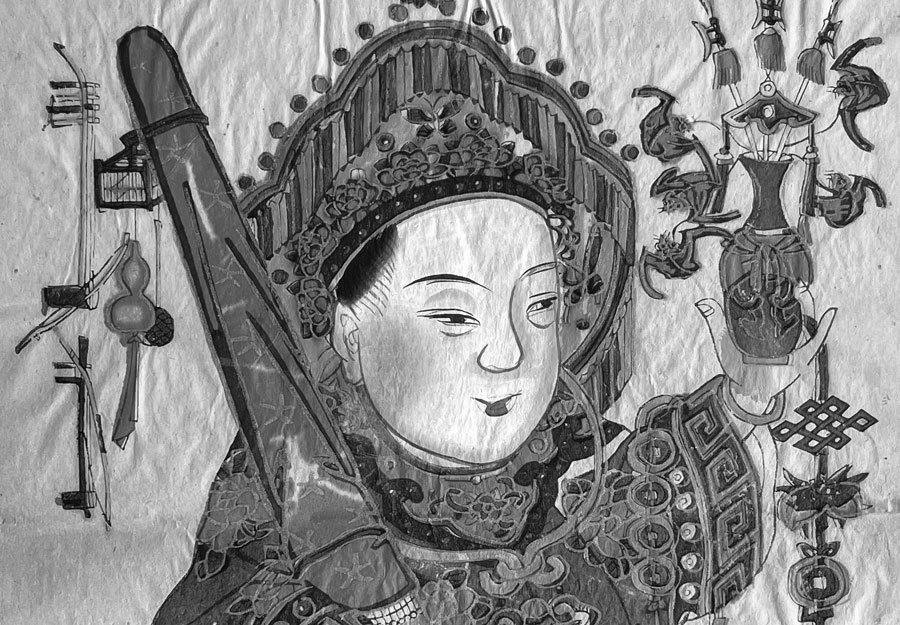

Paper Horses: Traditional Woodblock Prints of Gods from Northern China
David Leffman
Blacksmith Books: 2022
.
Although entitled Paper Horses, this pictorial volume presents two distinct forms of Chinese popular prints: ‘paper horse’ (zhima) and ‘New Year pictures’ (nianhua). Both forms were ubiquitous in China before the early to mid-twentieth century, yet very few of these prints survived into the present, and those that did are poorly understood. In bringing a previously unknown collection to light, David Leffman provides a service to the field of Chinese popular print studies, while introducing the casual reader to the extraordinary qualities of Chinese popular symbolism and religious iconography.
Paper horses, to begin with, are simple pictures of gods. We still do not have a clear picture of how the paper horse industry operated in the early twentieth century. We cannot say with any real confidence where any paper horse came from or who made it, and we can only guess as to what it may have meant to the user. Part of the difficulty in accounting for these prints is that they were never meant to be kept. Usually monochrome and crudely printed on cheap paper, most were burned as a form of sacrifice to their titular god. Few written records exist because China’s literati traditionally excluded materials of this nature from the realm of ‘culture’ and had little interest in investigating or interpreting the vast world of popular print.
More from Mekong Review
-

The spy novel in the 'Chinese century'
-

A poem from Ivan Stacy
-
A poem from Daniel J. Dolley
- Tags: China, David Leffman, Issue 29, James Flath