


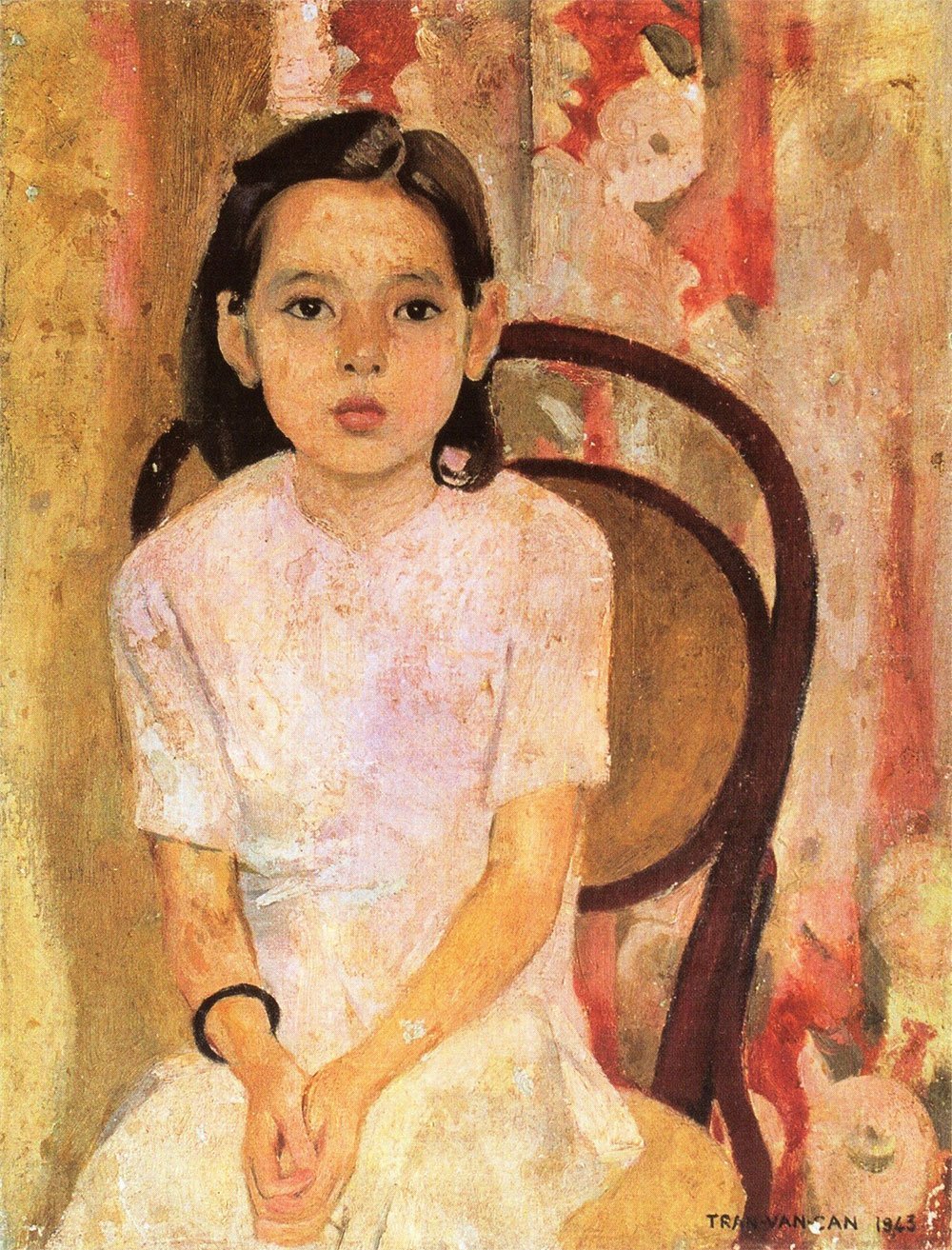
Little Thuy is waiting patiently, although it is not her I have come to see. “Em Thuy”, by Tran Van Can, is one of Vietnam’s best-loved oil paintings. Thuy poses dutifully in her pink frock, trying her best to sit still, hoping the artist will get a move on so she can go and play with her friends. It is a brilliant canvas. Like a child painted by a Dutch master, Thuy will still be fidgeting on that chair four centuries from now, utterly, compellingly present.
It is hot and damp in Hanoi. In contrast, the Fine Arts Museum is pleasantly cool. Tran Van Can’s child portrait dates back to an earlier period than the works I have come to see. Painted in 1943, “Em Thuy” is still very much in the European style. The first generation of twentieth-century Vietnamese painters were trained in the Ecole Supérieure des Beaux-Arts de l’Indochine (now the Vietnam University of Fine Arts), founded in 1925 by Victor Tardieu and Joseph Inguimberty, and Tran Van Can’s portrait is a highly accomplished product of his French classical training.
It was on a visit to the Temple of Literature, also in Hanoi, that Inguimberty fell in love with the Annamite lacquer used to decorate its pillars and walls. He decided to include lacquer work on the art school’s curriculum. Tran Van Can, a versatile artist who was at ease with watercolour, silk painting and oils, was to become a virtuoso of the medium. Turn your back to his “Em Thuy”, step into the next room, and a different world meets your eye: the domain of the great lacquer masters that largely coincided with the advent of socialism in Vietnam. These striking pictures are genuinely Vietnamese in technique, style and colouring and owe much less to the influence of the Beaux-Arts.
Lacquer works are painted on wood, not canvas, which makes the final result very heavy to lift. Crafting a picture takes a long time. Some of the larger paintings displayed here took up to three years to complete. The technique entails laboriously working the surface with coat after coat of resinous lacquer paint, each needing to be perfectly dry before the next can be applied. During the process a layer of cotton fabric is applied, followed by further coats of lacquer, before the board is rubbed with wet pumice. It is painting by subtraction rather than addition, because the surfaces are partially abraded to expose lower depths of colour, thus giving the pictures their peculiar profundity and radiance. The final result is then carefully polished. Few colours afford the right effect. The palette is restricted to black, browns and golds, a strange metallic blue, and a wide spectrum of reds. White detail is often added with crushed eggshell fragments that are tapped into depressions in the surface with a tiny hammer.
More from Mekong Review
-

An American protester in Ho Chi Minh City
-
The voice of the Mekong Delta
-

Memories are let loose in a Ho Chi Minh City quarantine facility