

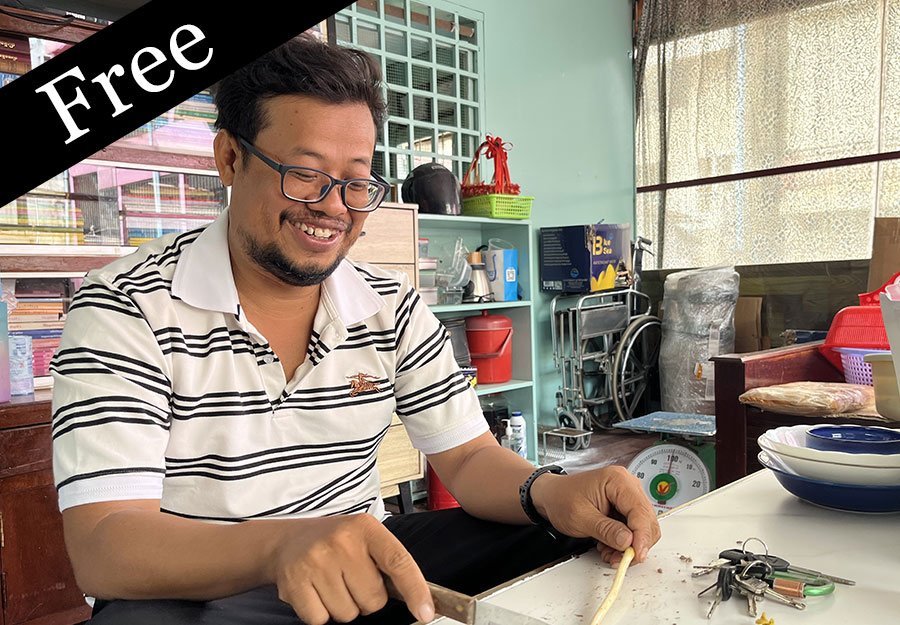
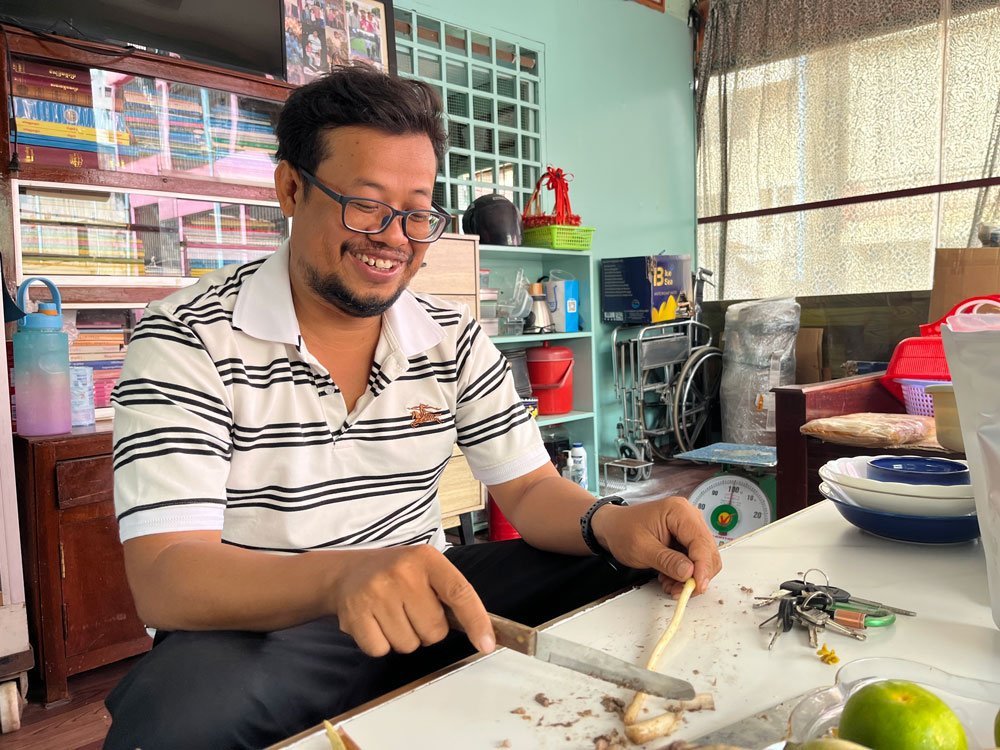
I ask a shopkeeper at the store for directions to Dara’s house. The middle-aged woman looks me over and asks who I am, what I do, why I’m looking for Dara and who this Dara is. I answer as if I’m being asked for a passkey to a bank account. She points to a house and tells me to ring the bell. “Phalla, Phalla,” she shouts, “your friend is coming.” He emerges from the small garden beside his house.
I drop my backpack in the tuktuk he uses for deliveries and giving rides to those who need them—some of whom occasionally surprise him with generous tips. Around us are eggplants, bittergourds, ginger and various tropical edible plants. I ask who picks the fruits and vegetables. “Neighbours or anyone who wants them,” he says. People come by often, like the woman who’d sized me up before. I’m happy to see him; he looks noticeably fresher and healthier than when I last saw him in March.
“Life’s getting boring,” he says. Eat, sleep, drink coffee, grow veggies, drive tuktuk—rinse and repeat. People sometimes wonder if he’ll return to journalism. His answer: “I don’t know.” Mech Dara, a thirty-seven-year-old renowned investigative journalist, was jailed for three weeks and released on bail in late October last year. The ordeal led him to tell Prime Minister Hun Manet himself that he was quitting the job he loved.
As he peels lotus rhizomes for his mother’s cooking, his thoughts drift to what he calls the “golden age” of his career—the period from early 2010 until the February 2023 shutdown of Voice of Democracy (VOD), the last newsroom he’d worked in. There was some pressure even then, but there was still space for journalism. That space has nearly vanished now, making it difficult for young reporters to remain optimistic. “What we witness today is a struggle to stay ‘hopelessly hopeful’,” Dara says. “Even when there’s no reason to believe things will improve, we can’t help but cling to this diminishing hope.”
When I landed in Cambodia after being away for two years, it was just before 9 p.m. on a typical Sunday. As my dad drove along the ASEAN Highway—also known as Russian Boulevard—I looked at the crowded streets packed with motorbikes weaving through cars and exclaimed, “Wow, so many young people!”
My dad giggled and replied, “So you’re old now?”
At exactly 9 p.m., the Voice of America (VOA) jingle came on the radio. My father turned up the volume. A familiar voice came on; it was Kann Vicheika, my former colleague. I pictured the recording studio with the VOA logo at the back. I thought about the promises made to those of us born in the late 1980s and early 1990s—promises of a free press that shaped who we became as journalists. This August will mark seventy years since VOA first found its way into Cambodian homes through the airwaves. But 14 March 2025, just months before that anniversary, was the Phnom Penh office’s last day. The gutting of US bodies like the US Agency for International Development (USAID) and the US Agency for Global Media, which funds VOA, has brought many projects to a screeching halt.
“I may have thought this could happen but didn’t think it would happen this way,” Vicheika says over coffee, one street away from the now-locked VOA office. Her teenage niece sits beside us, eyes fixed on her laptop. It feels unusual. In the past, the routine would have been coffee, work, coffee, deadlines. No family. No quiet pauses like this.
“If you ask what’s next for me? Honestly, I almost feel like I’m entering a retirement phase.” Vicheika, who’s only thirty-three, has just returned from a ten-day Vipassana meditation retreat, so we talk about that. She says it helped her ease some of the frustration.
I’ve always seen Vicheika as someone with answers. But when I gently press her on her future plans, she falls silent. She finally says, “I don’t know what more I have to teach as a trainer for journalism students.”
I frequently came across Phuong Vantha’s byline while conducting research on environmental communication for my thesis. His investigative reports—especially those co-authored with Gerry Flynn, a British journalist who was banned from Cambodia in January—are bookmarked in my browser. When we finally meet over coffee, I gain a deeper insight into the challenges facing freelance and independent journalists.
Cuts under the Trump administration have dried up funding for journalism projects, squeezing already tight resources and leaving freelancers like Vantha with fewer places to pitch stories. Promising new political leaders can suddenly change course, while stagnant economic conditions and technological transformation reshape public values and priorities for journalism. Pursuing stories in the field carries real risk. Publishing feels like walking through a minefield known as “SLAPP”—Strategic Litigation Against Public Participation, where lawsuits are filed in bad faith to silence critics. The fight against “fake news” has been weaponised by state officials to suppress independent reporting. Getting a press pass as a freelancer is like applying for permission to exist; years of experience or a journalism degree no longer makes you a journalist—you’re only one if the ministry says so. Self-censorship doesn’t just happen on the individual level; it’s now about media outlets avoiding entire subjects like scams or the activities of the country’s elite. As Sovann Sreypich, a journalist at the award-winning CamboJA News, observes, reporters are no longer picking niche topics to focus on; instead, they jump from subject matter to subject matter to avoid being targeted.
Today, reporting means one eye on the story, the other over your shoulder.
As conversations grow heavy, many journalists turn to their “golden age”—a mental refuge. Dara recalls the competition and urgency between the Cambodia Daily and the Phnom Penh Post. Sreypich, who began her journalism career in earnest at CamboJA in late 2021, feels she “wasn’t born early enough” to witness a golden age but remembers what it used to be like: “I saw people consuming news like drinking bottled water—they had choices and they read and listened with pride… but during my time, covering court cases and social activism has become less confrontational compared to the older generation. I didn’t witness the boldness and raw courage when journalism felt powerful.”
Vantha’s golden age is tied to a political climate where opposition parties existed and could openly debate the ruling party. Although press freedom was limited, journalists still had leads, scoops and dynamic newsrooms. The thirty-four-year-old recalls a prominent Radio Free Asia talk show where ruling party lawmaker Chheang Vun’s microphone was cut off by Chun Chanboth, the host, after repeated interruptions.
Vicheika thinks of 2014 to 2016 as her own golden age. “As professional journalists, we had access to information from many institutions. We could negotiate for access and in some cases, we were even prioritised,” she says. “I remember, if I approached ten people, nine would agree to speak. But after 2017 and now, if I approach ten people, maybe only one or two are willing to talk—even NGO officers are afraid. Self-censorship has become the norm.”
Dara shares a lesson young journalists might take to heart: when you enter someone’s house and the doorway is low while you’re tall, you can’t just walk straight in. What happens if you try? You’ll hit your head, get hurt and won’t be able to enter. You need to be humble, bend a little, to take that step through the door.
There’s wisdom in that, born from navigating unseen boundaries. But knowing where the red lines are isn’t easy or foolproof, even with competence and instinct. Sometimes you only know you’ve crossed them when the bruises remind you.
The idea of a golden age allows us to tell a story, even if it’s just to ourselves. For me, talking about them means searching for ‘Trey Visay’—a compass—to reclaim meaningful values and understand where we want to go. While it may not be historically precise, it carries emotional truth. If we want to do the right thing, to preserve a vestige of hope, we need to follow Trey Visay, pointing us to a golden age that we must believe could come again.

More from Mekong Review
-
A bookshop in Phnom Penh adapts to the times
-

The sounds and smells of Phnom Penh
-

Poetry by Aisha Khalid.
- Tags: Cambodia, Free to read, Issue 40, Sokummono Khan
