

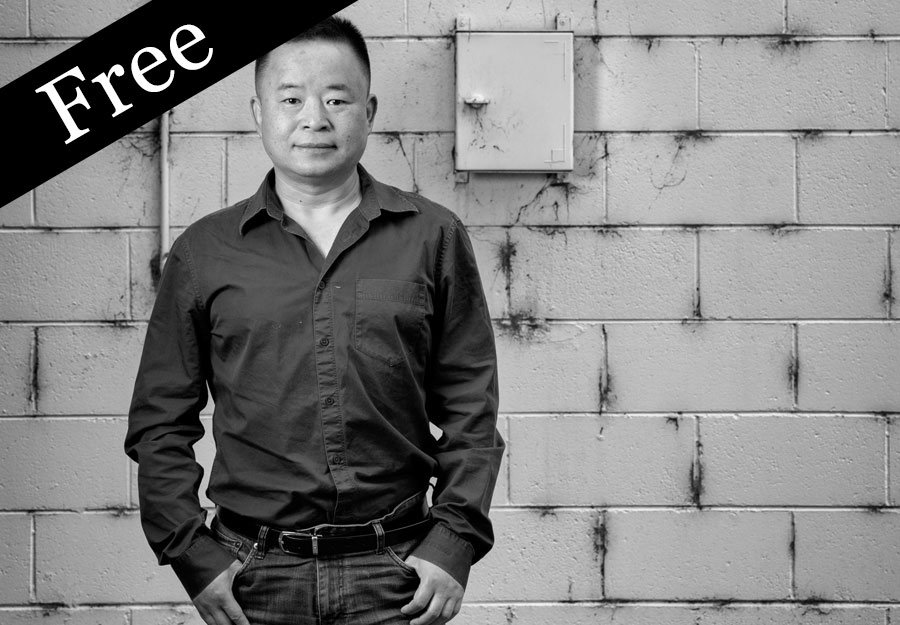

As China abandons three years of so-called zero Covid policies, writers who tried telling the truth about the early days of the coronavirus outbreak in Wuhan have suffered. Zhang Zhan continues to languish in jail. Fang Fang’s freedom of movement is still restricted. Chen Qiushi disappeared and reappeared, but now cuts a haunted figure, staying away from politics while promoting various commercial ventures.
And then there’s Murong Xuecun. We meet on a rainy early summer’s day in a suburban Australian café. His book Deadly Quiet City: Stories from Wuhan, COVID’s Ground Zero was published in 2022. He’d fled China in August the year before: “My Australian publisher said that the translation of my book into English was nearly finished. They thought it was time for me to leave.”
Rating his chances of being allowed to leave the country as only “half-half”, Murong headed to Beijing airport with a return plane ticket and minimal luggage. To his relief, he got through without trouble. He stayed in the United Kingdom for a time before moving to Australia, where he has since settled.
He’d had more than enough reason to take his publisher’s caution seriously. Arriving in Wuhan in early April 2020, he’d constantly looked over his shoulder while going about his interviews. His concerns were justified: about a month after his arrival, he received a call from a Chinese state security officer. “He said that Wuhan was not safe, and it would not be good for me if I were to catch Covid while there. His tone was threatening.” Murong left Wuhan almost immediately and started writing. “I would draft a chapter [of the book], then send it off to my Australian publisher, and then I would delete it from my own computer. When I finished the book, I deleted my interview notes too.”
Being threatened, writing surreptitiously, going into exile: none of this was inevitable for Murong. His life could have gone on vastly different trajectories.
Growing up poor in rural Shandong, Murong excelled academically. “My grades were actually good enough to get into law at Peking University, but the words ‘politics’ and ‘law’ sounded cool,” he says, explaining how he’d ended up studying law at the China University of Political Science and Law in Beijing. The school was a production line for China’s security apparatus. Many of his seniors and classmates ended up as police officers, prosecutors or judges. But Murong had other priorities. “I had a girlfriend in Sichuan at the time, so when I graduated I took a low-paid legal adviser job at a state-owned aviation company there instead.”
That job—and the girlfriend—did not last. By the late 1990s and early 2000s Murong was in Guangdong, working as a human resources manager at cosmetics manufacturing companies. “I earned well over 10,000 [Chinese yuan] a month, which was good money back then.” He could have easily looked forward to a comfortable commercial career.
Internet use in China was undergoing rapid growth then, and some bloggers, like Han Han, were getting famous. Murong, whose real name is Hao Qun, started writing and publishing online too. It was through such activity that his pen name was born. “I used lots of different names with wuxia [a genre of Chinese epic novels featuring heroes with almost superhuman martial arts capabilities] character styles when posting things and chatting with friends online.”
He wrote a serial web novel about a few young men and their hedonistic lives, fuelled by alcohol, drugs and sexual promiscuity, and published it under ‘Murong Xuecun’. The story was a hit, and was published in book form in 2003 with the title Leave Me Alone: A Novel of Chengdu. Its commercial success allowed Murong to quit his job and focus solely on writing. It also meant that his pen name stuck.
While Murong wrote more popular novels and even branched out to film and television—“many filmmakers and celebrities treated me as a friend,” he tells me—politics was never far away. “Many times, I was invited by writers and government officials to get involved in [state-backed] writers’ groups, including even the China Writers Association. It was often hinted that if I agreed to get involved, there would be a good chance I would ultimately be in official leadership positions in the literary world. I said no every time.” Murong laughs and raises his voice. “When they asked why, I would bluntly tell them that I look down on these groups!”
He lowers his voice again. He doesn’t regret turning down such offers, but, in hindsight, feels that he could perhaps have “turned them down in a more polite way”. He notes that he’s in a minority of writers who turned down such invitations. “Many people have families to look after, and submission brings more money-making opportunities. I was different because my parents died when I was young and I have no family of my own.”
For much of the 2000s, Murong walked a tightrope. He refused to get involved with state-backed groups and wrote about social problems—publishing a book on pyramid schemes in 2010 entitled China: In the Absence of a Remedy—but would take care “not to cross the line in public” when it came to politically sensitive topics. Then everything changed in early 2011.
That year, the writer Ran Yunfei was detained, accused of supporting pro-democracy protests inspired by movements in the Middle East. He was later charged for inciting subversion and ended up spending almost six months in state custody. As a close friend, Murong found it impossible to stay quiet. He used his Weibo account to rail against China’s authoritarian repression. He wrote for international publications and gave speeches around the world on these kinds of issues.
“When I started speaking out, China’s internet was still fairly open,” he recalls. “Lots of people were criticising the government, not just me.” But this relative openness was short-lived. Murong’s Weibo account was shut down in 2013 after he criticised the Chinese authorities’ ban on discussing universal values, press freedom, civil society, civil rights, errors of the Chinese Communist Party, crony capitalism and judicial independence.
Undeterred, he refused to keep his head down. In July 2014, about two months after a number of Chinese activists were detained for gathering to discuss the 1989 Tiananmen Square massacre, Murong publicly put himself forward for arrest. He’d meant to attend that gathering, but had missed it due to a visiting scholar’s stint in Australia. “Out of anger, I said while in Australia that once I returned to China, I would hand myself in. When I returned to Beijing, I was actually afraid, but because I already said this publicly, I felt I had to do it despite the risks, which I was willing to bear.”
This direct challenge to the Chinese authorities led Murong to be called to the police station. He was questioned by secret police for around eight hours, but not officially arrested. Nonetheless, Murong was thereafter regularly harassed and even, at times, subject to house arrest. People who used to be friendly with him started to keep their distance. Book publication, scriptwriting and publicity opportunities within the country became harder to come by.
By 2019, things were bad enough that Murong could no longer maintain his scriptwriting workshop and had to give it up. “I kept over 10,000 books in the workshop, many of which I’d read, but there were also lots that I bought and never read,” he says. He kept a few hundred; the rest were given away within a day after he announced on WeChat that he was looking for people to take them off his hands. “There was a real sense of relief after the books were gone. Material possessions really didn’t matter much after all.”
Within the span of thirty years—a period in which many of his university peers would have been working their way up state agencies—he’d gone from having a promising career earning decent money to becoming a celebrity author to living in a small apartment with reduced work and social engagements. When he did get commissioned to write scripts, he could only work on the basis that he would not be named in the credits. On the surface, things would appear to have taken a gloomy turn, but Murong says he hadn’t been overly bothered. “I always preferred to be a homebody anyway.”
Life had other plans. Covid-19 reared its ugly head, causing mayhem in Wuhan, and eventually, the rest of China and the world. As he watched Wuhan, the ninth most populous city in the country, struggle with the novel coronavirus, Murong received a call from the Australian academic and Chinese Communist Party critic Clive Hamilton. They’d met while Hamilton was writing his book Silent Invasion: China’s Influence in Australia, in which he’d quoted from a speech Murong had delivered in Sydney in 2015, and had stayed in touch. “Clive said, ‘You should go to Wuhan and document the truth about what is happening’, and I agreed.” So off Murong went to Wuhan. At the time, he had a sense that doing so might be dangerous, but hadn’t yet thought that it would be the first step of a journey that’d land him in Australia, unable to return to his homeland.
Throughout our conversation, Murong keeps a calm, cheerful smile on his face; sometimes he laughs or grimaces. He’s steady and collected as he looks back on his life choices—choosing a girlfriend over the iron rice bowl of joining China’s security agencies, giving up his cushy commercial job, crossing the line into overt criticism of the Chinese government—even though he’s paid a heavy price for straying further and further away from the typical ‘safe’ life that most people are likely to have preferred. “I’m happy with my life choices,” he says. “There’s no point in blaming the heavens or other people for setbacks.”
An exile’s life is far from easy. Homesickness and survivor’s guilt are commonly reported—no one is forced to leave their home country without sustaining some level of emotional trauma. But Murong seemed genuinely sanguine. “With me being alone, living anywhere is fine. Australia has lovely people and a nice environment.” And of course, the clincher: “I can now write whatever I want without fear!”
As our chat comes to an end, the torrential rain that had been noisily pelting the café’s sun roof finally stops. The sun shines through. Murong breaks into a big grin.

More from Mekong Review
-
While his predecessors chose to downplay China’s power, Xi Jinping has led an overhaul of China’s domestic political landscape and foreign policy. A review of Beijing’s Global Media Offensive: China’s Uneven Campaign to Influence Asia and the World by Joshua Kurlantzick.
-
The repressive era of Xi Jinping is often contrasted with the 1980s, when the question of what China could become seemed remarkably open. But it is during the fourteen years between 1978 and 1992, delineated in Julian Gewirtz’s Never Turn Back: China and the Forbidden History of the 1980s, that the foundations for Xi’s rule were laid.
-
What can a government achieve when given maximum access to public data? Josh Chin and Liza Lin of the Wall Street Journal do a deep dive into the impact of China’s panopticon in Surveillance State: Inside China’s Quest to Launch a New Era of Social Control.
- Tags: China, Free to read, Issue 30, Kevin Yam, Murong Xuecun
