



Is there a way to create a sustainable environment for creatives in the twenty-first century? This question motivated Michelle Cho when she founded her music company, Singing Beetle. After years of working in the K-pop industry in A&R (Artists and Repertoire) shaping the sound of major acts, she started the business as a songwriting and production boutique. In 2021, she decided to expand the company into a more traditional music label.
Now, with Cho as chief executive officer and Joe Lim—a newcomer to the entertainment industry—as chief financial officer, Singing Beetle’s first in-house produced act, 1VERSE, hit its first anniversary in July. A five-member K-pop idol group, 1VERSE—pronounced “universe”—is like no other in the industry. Featuring two North Koreans (Hyuk and Seok), two Asian Americans (Kenny and Nathan), and one Japanese member (Aito), the group has gained just as much attention for their music and social media presence as for their unique member dynamic.

While still operating within the traditional K-pop system, Singing Beetle is attempting to create a better, more sustainable framework for the group. Like many other K-pop acts, the young idols of 1VERSE are housed by the company. But unlike many of their industry peers, the members receive stipends regardless of the company’s financial profits, are involved in the planning and marketing of the group, and have the freedom to express themselves in ways that more controlling agencies would frown upon. During our interview, Cho mentioned that a member would be presenting a proposal the following week about some new idea he had.
There have been ups and downs—when we spoke in September, two members were on hiatus for health reasons and did not participate in the group’s latest single, ‘Loop’—but it’s an attempt to hit reset and reconsider what a company and act in the cutthroat K-pop industry have the potential to be.
How did you two come to work together?
Joe Lim: Back in 2019, we were both invited to a leadership conference hosted by the Obama Foundation. Michelle was asked the question, “What do you want to be doing five years later?” She said, “I would like to have my own idol group.” Mind you, it’s six years later now.
In our circle were also sitting some refugees from North Korea. And so, people—I guess they were half-joking but also quite serious—said, “Why don’t you try to have a group with North Koreans?” Michelle thought about it and said, “Well, if they’re talented, why not?” I was looking for investment opportunities at that time and said, “Sounds like something I would really like to support.”
Six, seven months after the conference, she called me up and said, “I think we have someone ready.” There was a guy from North Korea [Hyuk] that she found to be quite a persona. “You need to see this guy.” And so we started the whole journey in 2021.
[Michelle] was doing freelance music A&R, which means she was working with very famous idols. She was writing songs for them, she was arranging songs for them. She was doing quite well at the time. Much better than how she is doing now, I guess. She blames me for dragging her into this founder’s life.
Michelle Cho: We share the blame.
Lim: Right, she has her own responsibility, too. At the time I joined a different start-up which had an app that was supposed to help children with learning disabilities improve their learning markers. But I realised that it was getting into the medical space; a future in that space wasn’t what I was envisioning for my life. So I left and I decided I wanted to do more investing into different companies, getting involved. And I got way too involved in this one.
Cho: He first started as our investor and then I called on him again: “Hey, I need a partner to think together, to make plans together. And I think you would be a good person to do that.” I don’t know how he took it, but it’s probably more than what he thought I’d be asking for.
Lim: I was helping as more of an investor-advisor to the company, because this is the first time Michelle’s doing a start-up. But I happened to have experience, when I was younger, of producing a musical. And so I was very familiar with producing concerts [and] event management. Singing Beetle was preparing for a concert for one of the artists that they were managing at the time and they asked for help. So I came and I realised that they needed a little bit more help than what I thought, and so I got very much involved.
What was the original inspiration for Singing Beetle?
Cho: I took inspiration from this Aesop’s Fable that I used to read as a kid. It’s about ants and a grasshopper, where the ants work all day long to collect grains and the grasshopper just plays music on the side. And when the winter comes, the grasshopper has no food to eat and the ants give it food. I think the traditional lesson was, “You gotta work hard, otherwise you’ll starve. Don’t be the grasshopper.” But the way I took it when I was a kid was… No, the grasshopper wasn’t just chilling. It was playing music so that the ants could work in a joyous manner. So when the ants brought food to the grasshopper when the winter came, it wasn’t because they felt sorry for the grasshopper but because they were compensating the grasshopper for the service that it provided.
It’s so easy for people to forget that entertainment is a livelihood for some people. We forget that because music is consumed for people to rest [and enjoy]. It’s very easy to forget that people’s lives depend on it. I wanted to create a space, an environment, a network, to assist as many musicians [as possible] to continue to make great music, because this industry isn’t really built to support stable living.
We have a vision to create space for our artists where they feel empowered, where they feel safe to continue their artistic journey. For instance, [regardless of industry standards] we provide a monthly stipend to our artists so that even when we haven’t made profit yet, they’re still able to maintain a certain standard of living. We’re still trying to support our artists in ways [that] help them develop their creativity but also make sure that they can maintain this way of living, or way of working, for a long period of time.
What was the path towards debuting 1VERSE?
Lim: We had public and private auditions. The original idea was to start with North Koreans and so we wanted to exhaust all of the North Korean options first, [but they] definitely had to be above a certain standard. We were lucky to have some friends and colleagues who worked in that field and a few options emerged, and out of them we chose Hyuk and Seok.
Kenny, he came from a public audition. After he came, Kenny decided that he would accelerate the process and he started to provide hundreds of Instagram links and YouTube links to Michelle for her to review. Thanks to that we were able to meet Aito, who happened to be a trainee friend of Kenny’s when Kenny was training under a different label. Michelle saw his profile and was interested and went to Japan to interview him personally.
The last member we also found on the internet, Nathan. He was a self-made internet figure. Back in like 2016, 2017, he heard this one song by EXO and thought the song was amazing, and he started to dance to it. When he started, he wasn’t a really good dancer, but he recorded it and he showed his improvement over a period of time. That’s how he became a bit of a sensation himself. And so he’s the first K-pop idol to come from Arkansas.
Why did you want to build the group around two North Koreans?
Cho: I don’t think we built the team around North Koreans. This was conceived when we were talking about things like, “Oh, wouldn’t it be cool to have North Korean K-pop idols?” When I first met our first trainee out of North Korea, I guess that gave me a little bit of encouragement and inspiration to think that there could be more people like him. Maybe they just haven’t had the right opportunity or the right platform to pursue this kind of career.
Lim: Back when I made my decision to invest, [Michelle] pitched me this picture which really stood out to me. She said, “In my years of working in K-pop, you need two things to succeed as a small company, as opposed to being in a big company. One, you need to be able to turn heads. Two, you need to have good music.”
I was 100 per cent sure that having North Korean members in the group would turn heads. There’s just a natural curiosity and interest in North Korea. The current state is that the most famous North Korean is Kim Jong-un. There needs to be other famous people who could kind of counteract this image, right? North Koreans are people, too. They have their own lives that involve romance and everything else that everybody experiences anyway.
Is it a struggle to spotlight North Koreans and their experiences without exploiting them?
Lim: We needed to create idols and not somebody who you’d want to donate to. So we try to stay away from painting the North Korean members as needy, wretched, and helpless idols. Our internal goals that we’ve set as a company is for them to be known by their name and not by the preface of, “Oh, they’re the North Korean member.” I think, at least among our fans, we can say very confidently that they know them as Hyuk and Seok, and some of them are just surprised to find out that they’re North Korean.
Cho: North Koreans don’t have many platforms to talk about their personal stories. In this current world, whether it’s because you need donations, or you need funding, or to get the media’s attention, I feel like a lot of the time their stories are told in a certain way. But they have their first loves, they have their hearts broken, they had this best friend who they would do weird things with. So when we make music, we’ll sit down and just think, what is the emotion that we feel today? Where I tried to help them was to not fixate on North Korea and their life in North Korea, but as a human being, what is it that you want to share?
One of the songs that we released with Hyuk is called ‘Ordinary Person’. One of the hopes that he had was to live an ordinary life because, to him, that seemed unreachable. Because back in North Korea, maybe that’s what he thought was an ordinary life. But when he came to South Korea, he felt like, “Oh, I don’t even know the concept of what an ordinary life is in South Korea.” It’s a song about how he’s like, “I want to live an ordinary life. I don’t know how, so can you just show me how to do it?” It’s very raw, but it’s also something that everybody can relate to. I think it’s that kind of authenticity and the realness of their stories that is resonating with our fans. Feeling that same emotion—maybe in a slightly different context or very different context, but we’re all feeling that.
How do you approach the expectation of K-pop idols to always project a particular aspirational image?
Lim: We want to break the K-pop mould where artists are given a concept and they’re expected to live that concept. We actually welcome a bit of a Western artist notion, where they get to talk about their exes even. They get to talk about their private lives, who they are when they’re about to go to bed. We want to invite the fans to this type of world using the platform and artistry of K-pop.
Cho: We’re also trying to take advantage of the standard that K-pop has set. The perfection on stage is something that we strive for, that we would like our artists to present themselves with. So we want to build on top of an existing K-pop system where it nurtures and trains extremely talented artists. And we want to just add a little topping atop of it. Everybody brings really interesting stories, not just the North Korean members. Kenny has many interesting stories that he hasn’t shared with the world yet. Aito and Nathan… they all come with their own set of interesting stories that they want to share as well.
Does this feel radical when compared to your experience at other companies?
Cho: Yeah, but also it gives me a little bit of breathing room, because I believe at the end of the day what will drive everybody is the sense of ownership and responsibility they feel over a project. I can’t force them to do this and do that. So, in a way, me giving them that freedom is for them to feel responsibility and ownership, and that’s definitely not a type of management or production that I’ve typically seen in other K-pop companies. I think that’s what attracts the type of artists we have and that is also what helps them thrive. I hope it’s what will set us apart from the many K-pop teams that are coming every year.
Michelle, you mentioned in another interview that it’s really important for you to focus on the happiness and mental health of your artists. Those things are extremely hard in any environment, but especially so in K-pop. How do you support both the happiness and health of artists in such an industry?
Cho: I’m learning that it’s not always easy to achieve that. But I guess it starts with creating an environment where you are free to talk about what makes you happy and unhappy. In South Korea, the topic of mental health itself is a bit taboo. Although we’ve improved a lot, it’s still seen as an individual weakness that you need to overcome. So to create a space where you are not ashamed to talk about such things was the first step. However small you feel the issue is, talk about it, bring it out. Maybe you need a break. Let me know.
We’ve tried to get this little check-up system. Joe had this idea of using the traffic signal of green, yellow, and red to tell [others] how your mood is that week. It’s not to put anybody in the spotlight, but it’s more so everybody’s aware of how everybody is doing. I don’t know how long it’ll last because if we do get a lot busier, I think it’ll be more difficult for us to find time to do that.
After major events, we always try to find time for the staff and artists to rest. After every tour, we try to give everybody who participated at least a paid week off to recharge.
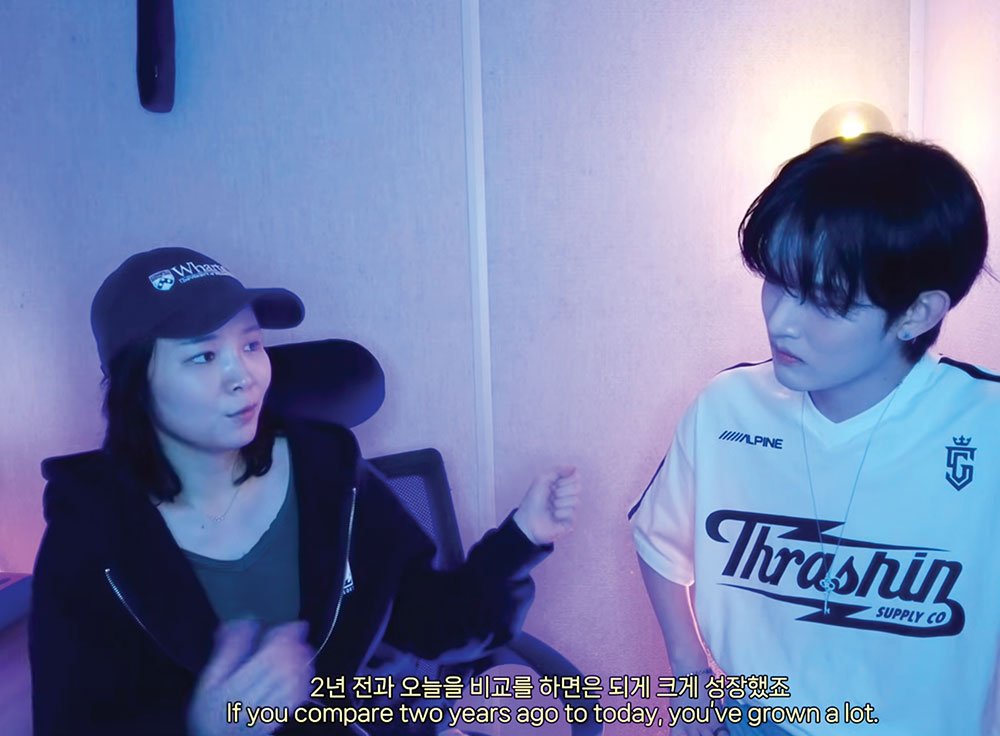
Is there any tension between being a company with contractual obligations and being good to the people you work with?
Lim: Ever since entering into this field, I learnt that [entertainment] is not like most corporate worlds. There’s no signing out of a relationship, especially when we’re housing artists inside of our system. And, you know, we have had them since they’re young, so the boundaries between company and personal relationships [are] very difficult to delineate. And so we’re trying to redefine the scope of the company. Right now, we’re creating management systems where we account for certain things that we previously thought were not the responsibility of the company. But we realised that if we don’t have a way to catch some of these issues, then it also bites us back in our artistry and in our company work. We’re keeping to the original goal of creating relatable but mature human beings, who are artists who could really share their lives with many people.
It almost sounds like you’re taking on not only a company role but also a sort of parenting role. Is that how you feel?
Lim: I think it’s inevitable as management. Especially when [the artists] come in around their teens. Not that I take on the role of a parent, but I think there’s an aspect of continuing the work that their parents were doing. We take artists who come from many different households and they live together, they interact with each other almost 24/7. It’s essential for us, not to be their parents, but at least to provide a structure. It’s very difficult, sometimes. It’s all been a very big learning experience.
It’s been a year since 1VERSE’s debut. How are you feeling about everything?
Cho: I think the whole experience of debuting 1VERSE was a series of experiments. We had hypotheses, and then we were testing them out. Many times, they didn’t work. But [when] it worked, it exceeded our expectations.
One of the goals was to make a team that’s good at live [performances], to have them tour even at a very early stage of their career. Within this year of debut, they’ve already toured twenty-one cities around the world. Many of them were sold-out shows; we even had to upgrade to a bigger venue. The number of audience that came to see a 1VERSE show was also a lot more than I’d ever anticipated.
I love that the boys have been great partners. They have ideas that they want to test out as well, and it’s definitely a team effort. You’ll probably see more hiccups on the way because we’re learning, but I think that’s what makes the whole experience more valuable.

More from Mekong Review
-
While Y2K’s SM Town artists reflected a new era and hopeful future, the K-pop artists of 2025 have been positioned as soft power cultural pawns.
-

Esther Yi’s debut novel grapples with social disconnectivity and fanaticism through an esoteric tale of a woman who falls desperately for a K-pop star and goes on a journey to integrate him into her life.
-

Roh Hoe-chan campaigned stoically against corruption
- Tags: K-Pop, South Korea, Tamar Herman
