

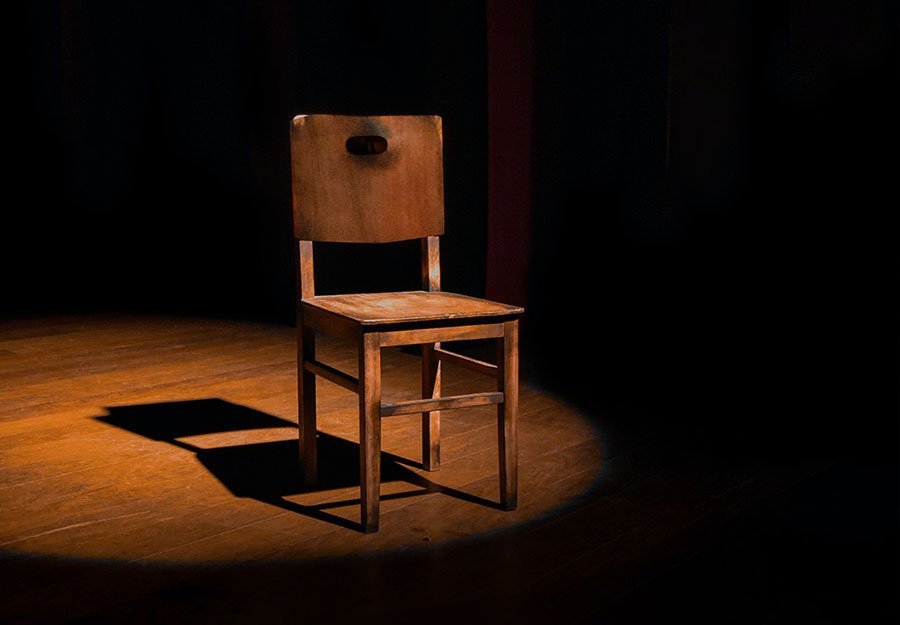

… because one of the four legs of his chair is uneven in length, a young man can’t find the right words for the opening line of a short story he wants to write. He begins his story with the second sentence, followed by the third, the fourth and so on without knowing the point of origin from which that first line refuses to emerge. Only later, he realises: the lame chair has been driving away his inspiration all this while with its nauseating thuds. Hyperbole now rolls at his feet: “After 10,000 years, the young man still can’t find the right words for the first line of a short story he wants to write.” He sits on his chair, stupefied, for a long time—for 10,000 years. Until the young man becomes an old man. The old man now wants to write a story that places a chair at a corner of its narrative—also without an opening line.
The One Who Plays | 1. A young man wants to write a short story but still can’t find the right words for his opening line. Because he wants to keep writing, he begins his story with the second sentence. He once read a remark by the short story writer Othman Puteh: “Personally, I still face a dilemma when I begin writing a story, the problem of arranging a good, interesting and powerful first line.” Perhaps that’s why the young man begins his story with the second sentence. It’s all in the wickedness of a chair. 2. The chair tries to stand upright on four legs. But it slants because one of its legs is shorter, inducing nausea with each thud. It’s enough for this chair to be an ordinary wooden chair, simple yet with an opulent soul. In the words of the architect Le Corbusier, “Chairs are architecture, sofas are bourgeois.” Once in a while this chair is set free to teeter till it runs riot with its four legs across the open field of the young man’s mind, before being summoned back for the young man to return to his seat—till he grows old. 3. An old man who wants to write a story with a chair placed at a corner of its narrative. But at this line, isn’t the story already strewn with chairs? With apologies to Pina Bausch where the scattered chairs in Café Müller (1978) are pulled away from her dancing limbs; in the old man’s Head Café, these chairs run away to evade being sat on. It’s true that the movements of chairs can no longer be read. 4. The reader.
More from Mekong Review
-

Democracy, the virus, and a missing year in Malaysia
-
In a family that struggles to express affection physically or verbally, food has become a means of demonstrating connection, care, and a deep love.
-

In The Accidental Malay by Karina Robles Bahrin, protagonist Jasmine Leong—heiress of a Chinese family business dealing in pork products—discovers that she’s actually Malay Muslim. What ensues highlights the fraught nature of race, religion and politics in Malaysia.
- Tags: Azrin Fauzi, Issue 30, Malaysia, Pauline Fan