


The End of August
Yu Miri, Translated by Morgan Giles
Tilted Axis Press: 2023
..
Though untranslatable, the Korean word ‘han’ (한) can best be described as an intergenerational feeling of sorrow, anger and grief. It is a heaviness that exists in the body of every Korean person, due to years of war, colonialism and unrest on the Korean peninsula. As Yu Miri writes in The End of August: “The sorrow of the han that permeates you is endless, and that han, which pierces through the earth to the heavens, may be grieved, but it cannot be undone.” It was han that made me feel undoubtedly Korean, especially as a diasporic Korean who grew up in the United States, even when I was unsure of what being Korean meant.
Scholars have argued that han first emerged as a Japanese colonial construct and, according to Sandra So Hee Chee Kim, the “innate melancholy of Koreans was just another sign of their racial decline, justifying the need for Japan’s superior leadership”. Kim goes on to assert that the idea of han was later adopted into Korean ethnonationalism—in other words, Korean people began to define themselves “with colonizer’s words”. As such, the evolution of han from a product of imperialism to an innately Korean trait begs the question: What are you born into and what is imposed? It is this question that is explored in Yu’s The End of August.
The novel was originally published in Japan as Hachi-gatsu no Hate in 2004, and Morgan Giles’s 2023 English translation centres voices rarely heard in English-language fiction—Koreans living in Japanese-occupied Korea and the zainichi Korean diaspora of Japan.
Just as the abovementioned question holds no clear answers, the trajectories of Yu’s characters are both indeterminable and uncertain. The End of August is a semi-autobiographical and multigenerational saga that spans nearly eighty years. The novel opens in the present day, where Yu attempts to awaken ancestors with the assistance of Korean shamans and is called upon to bring peace to the spirits of her grandfather and his family. Yu is told “they all bore a heavy han that weighs them down. Can you promise that you will lift them up? If you fulfil your promise it will end, but if you don’t, your promise continues. And it won’t end even when you die.” Readers are then transported to April 1925 in the village of Miryang in Japanese-occupied Korea, where twelve-year-old Lee Woo-cheol, Yu’s grandfather, dreams of being a marathon runner in the Olympics. It is Woo-cheol’s desire to be a runner for a free Korea that ultimately determines the fate of his family for decades to come.
When I tried to describe The End of August to my PhD supervisors, I said, “Think Pachinko meets Tolstoy meets Ulysses.” And although the historical context closely overlaps that of Min Jin Lee’s diasporic saga, the heftiness of a 720-page epic alludes to War and Peace and the nebulous way in which the narrative form ebbs and flows feels like a respectful nod to James Joyce, The End of August is at times difficult to fully contextualise due to the viscerality of the prose created by its central themes of breath, running and language.
The complex characters of The End of August are constantly running towards or away from the han that has come before them, is within them and will come after them, which reflects the uncertain trajectory of people displaced by colonialism. The characters struggle to make choices of their own, while being forced to react to the sociopolitical circumstances with which they are presented. They fall in and out of love. They grieve. They question the world around them. They go to extreme lengths to provide for their families and, at times, make disastrous decisions. They think thoughts which they would never dare to speak out loud.
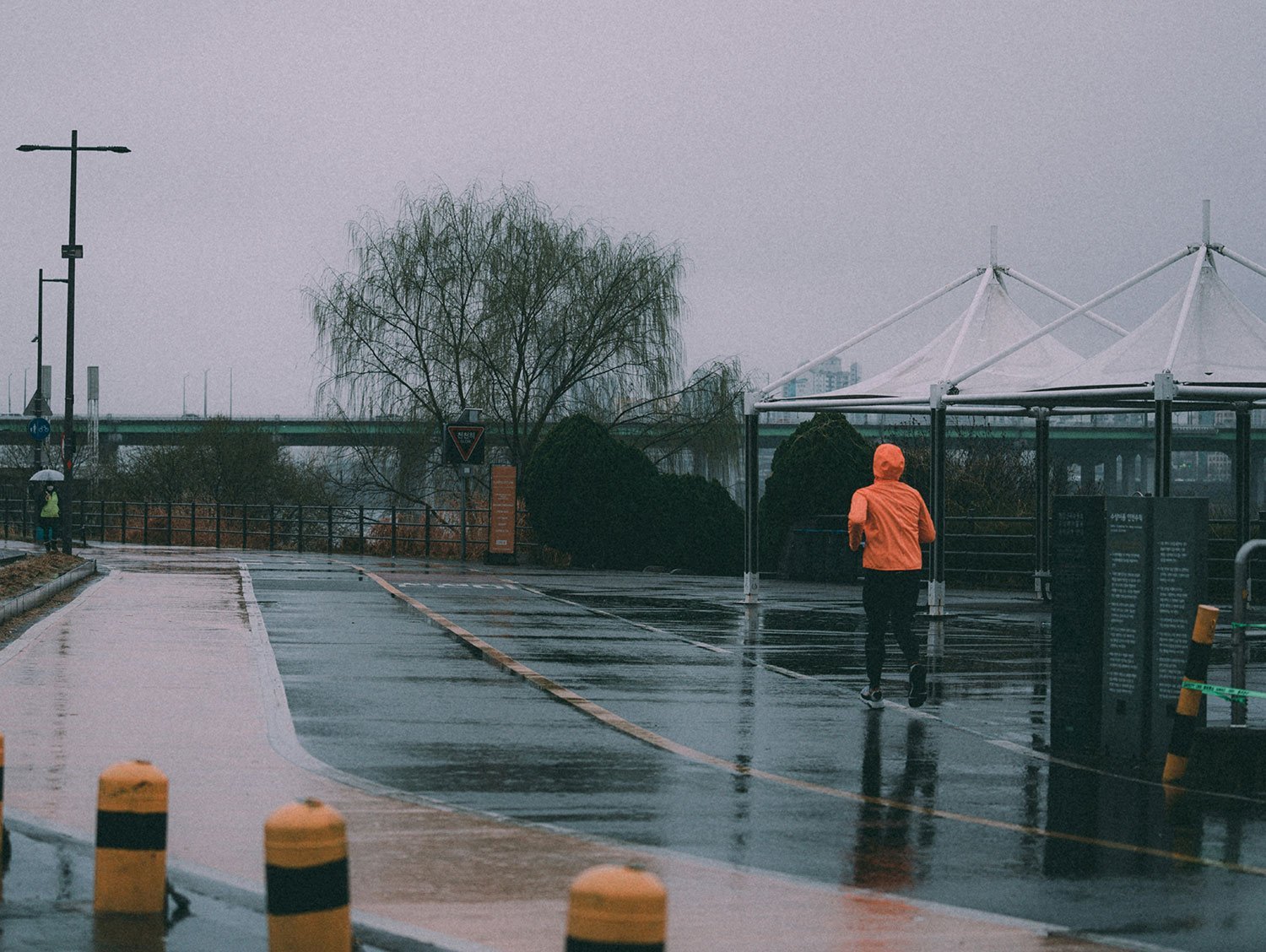
These inner monologues are punctuated with the audible breaths of the characters as “in-hale ex-hale” inserted throughout the prose. And just as han permeates every aspect of the characters’ decisions, the act of breathing serves as han puri ((한풀이)—the physical manifestation of han. In the second chapter, Yu runs the Seoul Marathon and thinks, “I feel your pain, people say in-hale ex-hale but that’s nothing more than well-intentioned bullshit in-hale ex-hale in-hale ex-hale you can’t feel someone else’s pain in-hale ex-hale no matter how important that person is to you no matter how much you wish to take away the pain in-hale ex-hale you can only feel the pain of not being able to feel that pain in-hale ex-hale you can only feel the pain of not being able to feel that pain in-hale ex-hale in-hale ex-hale in-hale ex-hale in-hale ex-hale in-hale ex-hale.”
Because “in-hale ex-hale” (or perhaps “han han puri”) is the heartbeat of The End of August, it is imperative for readers from outside the Korean diaspora to be mindful of the audience that Yu is writing for and why. As a zainichi Korean born in Japan, Yu is no stranger to being marginalised and said in a recent interview, “I am always writing my books for those who don’t feel like they belong anywhere. I started writing because there was nowhere I felt I belonged. I didn’t really have any place at all… The End of August is targeted towards the same people, to those who feel lost.”
The prose uses Korean and Japanese interchangeably as characters code-switch depending on where they are and to whom they are speaking. The Korean and Japanese remain largely untranslated, with some phrases ascertainable by context while others serve as a reminder of space and place. Tara Cheesman’s review of The End of August in Words Without Borders criticised the use of Japanese and Korean in Yu’s prose (and Giles’s translation) by saying, “She incorporates cultural, historical, and literary references that are not always obvious. Japanese and Korean words that will be unfamiliar to many English-language readers are left untranslated. The publisher does not include a glossary or notes, which arguably makes for a richer, more immersive reading experience, but which can also be disorienting.” But Cheesman’s failure to decentralise (or perhaps decolonise) her Eurocentric perspective while reading The End of August misses the very reason that the novel came into being. It is not unreasonable that the Korean diaspora will find deeper nuance in the novel and, if anything, it speaks to the laser-focus and careful research of Yu’s storytelling.
The use of language serves not only as a reminder that these are Korean characters living in Japanese-occupied Korea, but also acts as a mirror in which readers’ own biases may be reflected back to them. It is not the job of any author to teach readers a language, and people are welcome to look things up if their disorientation reaches what they deem to be unacceptable levels. One could postulate that criticism such as Cheesman’s highlights how The End of August not only brings historical colonialism into focus, but also sheds light on the invisible but pervasive colonialist attitudes that still exist today.
It is therefore impossible to ignore the use of Korean and Japanese as another embodiment of han in The End of August’s narrative structure. Takashi Genichiro said in his review of the original Japanese-language publication: “It is because the languages of these two countries, which could never mix together or be reconciled in reality, are here blended together miraculously, giving us a glimpse of a world that nobody has seen (or read) before… There is a cruel history surrounding language. Which is why language must not be lost.” Giles added to this in a recent interview by pointing out that the use of language in the English translation “should be jarring because this is… a novel that represents a linguistic reality that could not come to pass. So it should stand out to you in some way.” The use of Korean and Japanese in the novel represents the right to one’s own language and the consequences and subsequent han when that right is taken away.
The End of August runs from the han of trauma but also runs towards an imagined future. It is a ground-breaking novel that serves as a reminder that, for the Korean diaspora, the “han han puri” pulse of “in-hale ex-hale” is unbroken, momentous and eternal.

More from Mekong Review
-

Baek Sehee writes: “The world tends to focus too much on the very bright or the very dark.” She steers clear of both extremes in her book. For this alone, it merits attention.
-

In Ajoomma, a Singaporean-South Korean co-production directed by He Shuming, an auntie travels to South Korea to visit the shooting locations of her favourite K-dramas… but gets far more than she’d bargained for.
-

A coffee with a stranger opened up uncomfortable truths
- Tags: Free to read, Issue 34, South Korea, Taeyeon Song, Yu Miri
