

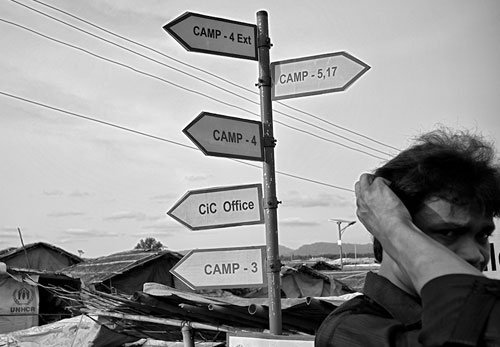

For four months in late 2017, Myanmar’s security forces committed genocide against the religious and ethnic minority Rohingya. Within the first month, more than 6,700 were killed, including at least 730 children under the age of five. Rohingyas were beaten, burned, shot, tortured and raped. By year’s end, an estimated 650,000 had been ethnically cleansed from the country. More than two years later, the number of those killed is unknown, while the number of refugees is nearly three quarters of a million. The violence was a stark revelation that the so-called Asian century would be no stranger to what the Genocide Convention defines as the “intent to destroy, in whole or in part, a national, ethnical, racial or religious group”. It was also a shameful reminder, mocking the vows of “never again” after Rwanda and Bosnia, that the world’s 194 other nations would do virtually nothing to stop or punish the gravest of international crimes.
Less momentous but more surprising, events in Myanmar also exposed an international human rights movement ill-prepared and ill-equipped to respond to genocide. Non-governmental organisations in particular, usually regarded as “force multipliers” in human rights crises, proved unable to advance a response proportionate to the crime, consistent with the urgency on the ground and calculated to produce an actual effect.
It was not for lack of effort. This article focusses on human rights NGOs working partly or exclusively on Asia or Southeast Asia, as distinct from those working only on other regions or on a single country (including Myanmar). These NGOs are generally seen as regional or international, as opposed to local, in their size, scope and funding. Their websites alone over the past two years testify to relentless on-the-ground research, rigorous analysis and high-level advocacy. Having been Amnesty International’s Myanmar researcher for five years until late 2012, and still friends with many NGO colleagues, I can attest to the pressure, commitment, uncertainty and emotional toll attendant to the work of these organisations. Although “impact assessment” is notoriously difficult in human rights, and counterfactuals (including those implicit in this article) impossible to prove, it is clear that their efforts registered in Myanmar and around the world, and that the Rohingya would be even worse off without them.
Nonetheless, one is forced to conclude that human rights NGOs failed to meet to the fullest of their potential the challenge posed by Myanmar’s genocide. Four separate but related reasons account for this collective failure, even if not all of them apply equally to each NGO. The chief reason, from which the others largely cascade, places NGOs well within conventional parameters of response to human rights violations but squarely at odds with genocide’s modern history.
Employing some of the brightest legal minds in the field, NGOs are generally aware that rights are stratified. Yet the right to life, among few others, is considered so fundamental that it cannot be violated, limited or suspended under any circumstances. As genocide by definition entails violating this right, its prohibition is likewise absolute. In contrast, most human rights are subject to varying and qualified levels of limitation or outright exemption under specific and temporary circumstances.
More from Mekong Review
-
Responding to Benjamin Zawacki's article
-
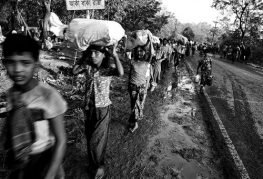
For decades, the Rohingya have languished along the Cox’s Bazar-Teknaf highway.
-

A poem by Rory Harris
- Tags: Bangladesh, Benjamin Zawacki, Issue 18, Myanmar, Rohingya