

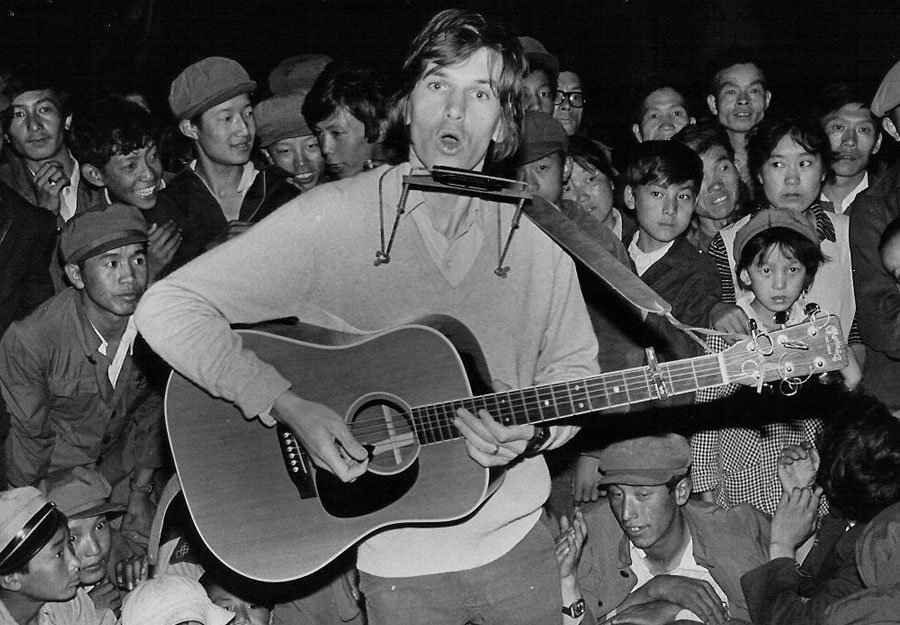

In 1979, when Graham Earnshaw, a British journalist, first moved to Beijing to be a Reuters correspondent, he packed a guitar. In the days when the Chinese capital was just emerging from the chaos of Mao’s Cultural Revolution and a musical landscape of little more than revolutionary opera, he formed a rock band with other western expats. They called themselves the Peking All-Stars and performed at expat watering holes—spaces that enjoyed relatively greater degrees of free expression in a restrictive China and, as American scholar Andrew Jones put it, a form of unofficial “extraterritoriality”.
In the early 1980s, aspiring local musicians regularly joined Earnshaw’s band in open jams—a young trumpet player named Cui Jian and saxophone player Liu Yuan among them. In May 1986, Cui, with Yuan in his band, became the first in China to perform rock ‘n’ roll to a national audience. Playing on a state television music programme, their rendition of ‘一无所有 (Nothing to My Name)’ is widely credited as the moment Chinese rock was born. It inscribed Cui as the father of the genre and the song as one of its most enduring anthems.
More from Mekong Review
-

Poetry by Ghojimuhemmed Muhemmed
-

One syllable brings the spice
-

China's popular prints beguile and enchant
- Tags: China, David Frazier, Graham Earnshaw, Issue 39