

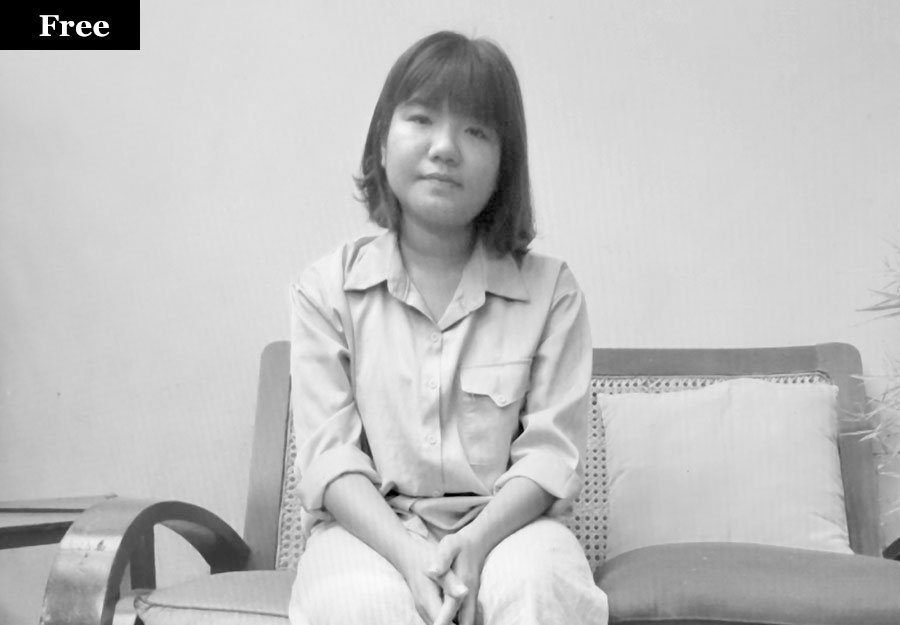
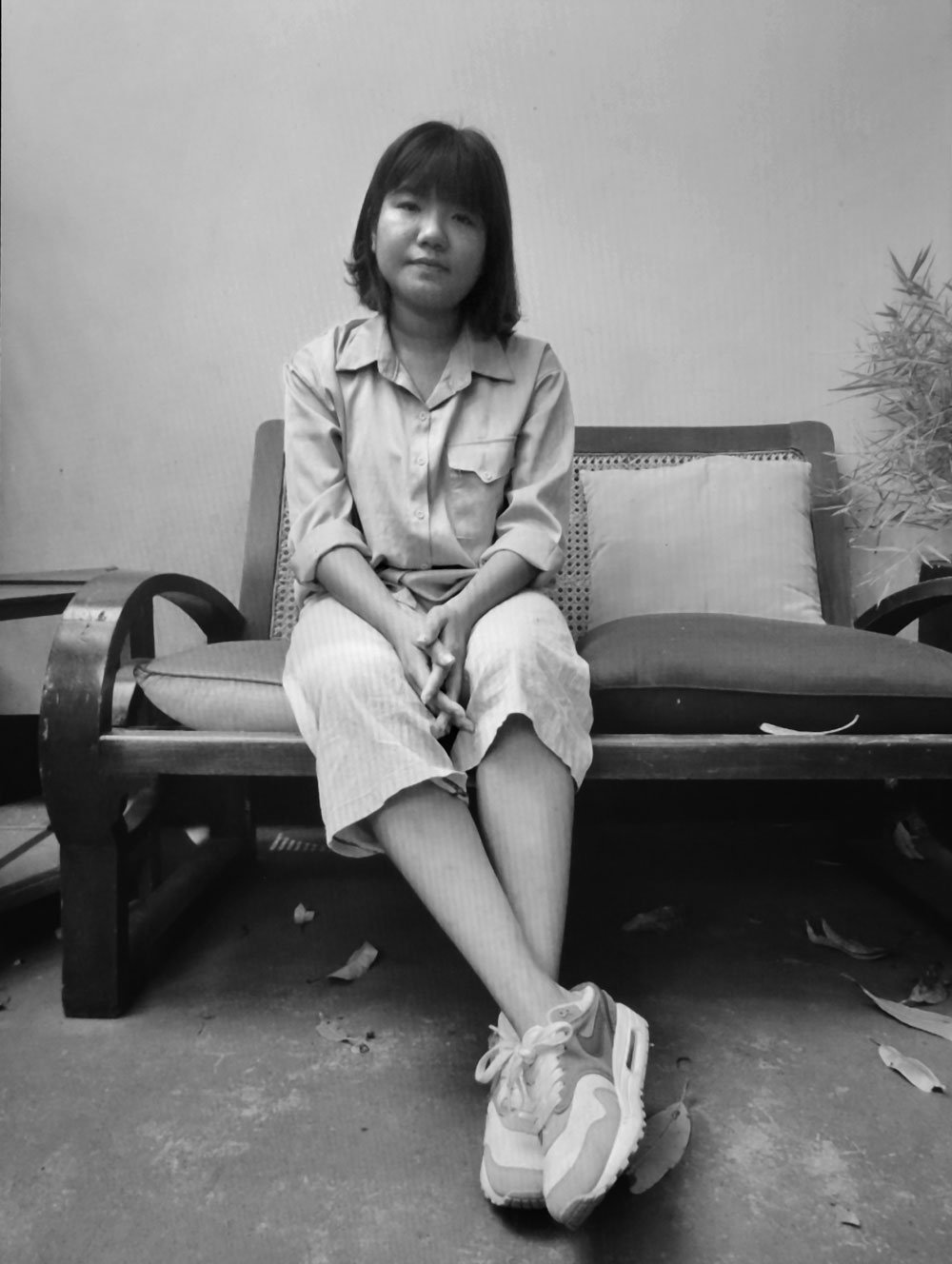
The first time I go to meet the activist Ei Thinzar Maung, she is nowhere to be found. It is the middle of March, six weeks after Myanmar’s military seized power from the civilian government, arrested its leaders and began a merciless campaign against ordinary citizens demanding a return to democratic rule. We are to speak virtually—she in a city unknown, me in New York—on an encrypted video platform favoured by those trying to evade detection by their governments. But just before we log on, the mobile data networks go dark across Myanmar. An intermediary who has helped arrange the interview cannot reach Ei Thinzar Maung; the mobile lines are down as well. Is she moving to a new safe house, one with internet connection? Or has she been quietly taken away in the middle of the night, like so many others?
When the twenty-six-year-old protest leader re-emerges, a week later, secure in yet another undisclosed location, the demonstrations are still going strong in spite of escalating military retaliation. Her windows face the street, and the sound of chanting at times is so loud we must pause our conversation. Ei Thinzar Maung tells me this happens every night, to coincide with the 8 p.m. curfew. The strike group calls for the release of Aung San Suu Kyi and the other jailed members of the National League for Democracy. Then they sing ‘Kabar Ma Kyay Bu’, the anthem of the 1988 revolution. The sound, floating up through the streets, through the tinny speakers and across thousands of miles, is haunting.
Demonstrations have been ongoing since 6 February, when thousands first took to the streets to fight the coup. Ei Thinzar Maung helped launch the earliest protests and has been a key organiser in the leaderless movement. That front-line role has made her a target of the military junta, which has killed hundreds of people during the protests and arrested, charged or sentenced thousands. Many of those imprisoned were taken from their homes in the dead of night. Some have yet to be heard from. Already, Ei Thinzar Maung faces charges under Section 505 of the penal code—a controversial military protection law widely used against government critics. Evading an arrest that could result in torture or even death, the activist has been in hiding for weeks now—reliant on a well-organised security operation to keep her safe, even as she continues to work with the civil disobedience movement.
There have been many arrests and you’re now in a situation where you have to move every few nights—how are you able to keep up your motivation?
I’ve been away from home for a while. [Yangon] is not my home town. So that hurts. But I have friends here—they give me emotional support. And it’s very inspiring to see the young people taking to the streets every day. Another thing is we are all very determined to fight until we have victory.
For security, I’ve been moving around a lot and I’ve been in hiding, so I can’t go out much these days. I feel very guilty because the rest of the people are taking the risks and I’m hiding. Even if we win this fight and then gain full-fledged democracy, I think I’ll feel guilty about enjoying that without participating.
How are you and other activists able to organise now that the internet and mobile networks are down?
The phone data connection has been cut completely and a lot of Wi-Fi service has also been blocked. Barely any Wi-Fi companies can still resist the order from the military junta at the time like this.
But actually we’ve been preparing for situations like this. In Rakhine state, there’s been an internet blackout for years. So there is a means to contact one another, and we prepare passwords and codewords to connect to each other in a time like this.
The problem is, with the internet blackout, we can no longer use Facebook. The only way we can reach out is by calling mobile phones, which is a very dangerous activity because we could easily be traced by the telecoms.
Given the situation with the internet, do protest leaders and activists still have some way to get the word to individuals?
It depends on different locations and different situations. In cities like Yangon, for example, a lot of protest leaders and strike leaders have been arrested, and some of them are still in hiding or there has been a warrant issued for their arrest. So they could only attend a meeting through the internet—which is also very limited right now.
But, still, in cities like Mandalay or in Myaungmya, they have local strike committees founded by local residents. So they can perform the activities by themselves.
The Special Advisory Council for Myanmar said in early March that the Tatmadaw seems to be moving towards a clearance operation like we have seen in Kachin or Rakhine states. Is this the feeling on the ground, that the situation is escalating?
First it started with the shooting of the protesters. They only shot at the protesters, so if you weren’t a protester, you might not have to be worried. But now, the soldiers are shooting anybody they see. If you live in your house and are in the protest groups, you’re no longer safe. Not just that. You can be kidnapped by soldiers in the middle of town, in broad daylight, and your family might have to come up with ransom to rescue you. Elsewhere, people are being forced to do free labour for the military.
So it is very clear that we are already in a war. Yangon and Mandalay and major cities are now like a war zone. The military is attacking civilians like they do in a real war.
But we can’t speak or present these things to the world because there’s an internet blackout. And if you’re being detained by the police or military, there is almost no trial. The trial that’s done is done through Zoom, so there is no transparency. But we can see human rights violations on the streets of Yangon and Mandalay. People cannot sleep because they are scared they might get arrested in the middle of the night. And they are no longer safe in the daytime either.
Can people stay on the street and can these strikes continue as the military grows more violent?
I think if the military keeps on shooting this way, some people will eventually pick up arms and fight back. If that happens, I think more people will die and be killed in this war. I very much hope that the military is able to find a solution in a political way. Because if they keep doing what they are doing, I think young people will join the armed resistance.
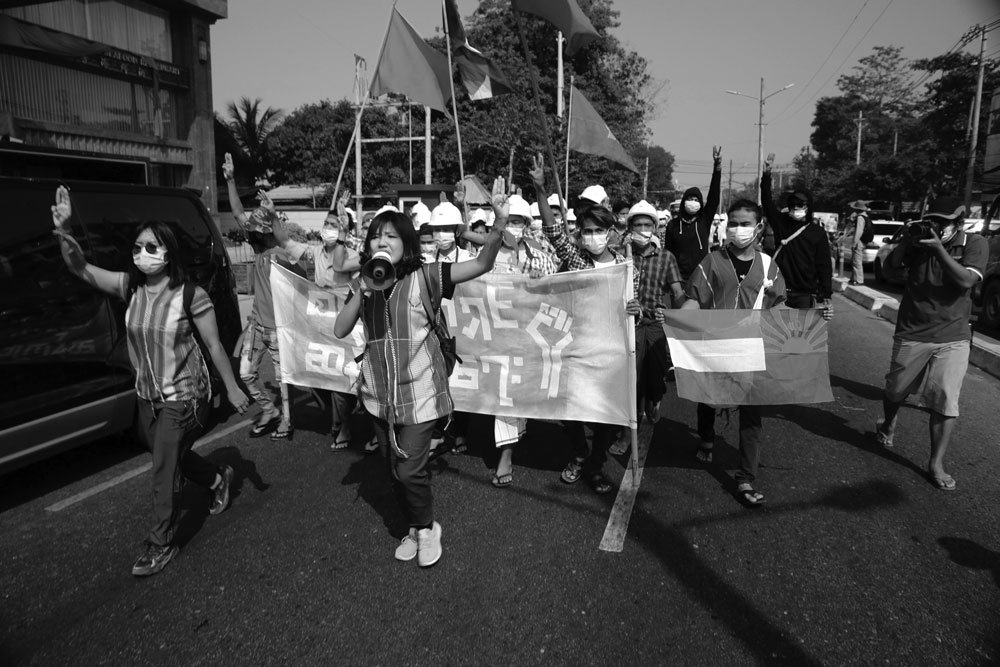
Long before the coup, Ei Thinzar Maung was outspoken about the shortcomings of Myanmar’s fledgling democracy. In November 2020, when the country held its second democratic general election, she ran for a parliamentary seat. (She lost to the NLD candidate.) In an interview with Irrawaddy, Ei Thinzar Maung spoke of the need to revoke Section 505 of the penal code, along with other laws that had been abused in recent years to silence government critics. By late last year, under the NLD government, hundreds of political prisoners were awaiting trial and dozens were serving lengthy sentences. ‘If you are a government, you will be subject to criticism. You can’t just listen to the voices from your supporters. You must also listen to those who do not like your policies’, she told the magazine.
Her chief criticism, however, was the government’s treatment of Myanmar’s ethnic minorities. Born and raised in Kachin state, Ei Thinzar Maung is intimately familiar with the struggles faced by the country’s ethnic minorities. The Tatmadaw has for decades been locked in conflict with ethnic armed groups in Rakhine, Chin, Shan, Kachin and Karen states. During those years of civil war, countless millions of civilians have faced ‘marginalization, discrimination and brutality at the hands of the Myanmar armed forces’, a UN fact-finding mission wrote in 2019. Still, the NLD did little to support minority rights, said Ei Thinzar Maung.
What made you aware of human rights issues in the first place, and what made you want to get into politics and activism?
The small town I was born in, the education system is poor. We don’t really have a lot of educational opportunities in my home town. Even though it’s the same public school system, the schools in Mandalay and Yangon are better.
My parents were concerned about my education. They were ambitious and wanted me to become an educated person, so when I was in eighth grade, in 2007, they sent me to school in Mandalay. That was the year of the Saffron Revolution. I was just a kid. At first, I was really happy because we got a long holiday. But then I witnessed the atrocities committed by the military. I saw monks severely beaten by the soldiers. Just like what’s happening right now—soldiers killed the people. So that haunted my mind and later encouraged me to become an activist.
In 2010, I was in university. That’s the year that Aung San Suu Kyi was released from house arrest. Although people didn’t have democracy and couldn’t speak about politics openly like now, a lot of people were starting to discuss politics. I joined the student union and became the first female president of the student union. So that led me to become who I am.
You were arrested when you were the president of the student union and you were in prison for more than a year. Did that prepare you in any way for what you’re going through in this moment?
Well, my experience in the prison gave me strength as well as trauma. Because I know what it looks like to be in prison. I was tortured in prison. So I know how it feels. I know and I don’t want to go back there. But on the bright side, it made me able to prepare. I want to become a politician, a good politician—although we have a lot of politicians in our country, there are not a lot of women politicians. I want to become a really qualified and active female politician.
After that experience and going through such trauma, did you not think about giving up? What made you continue to take these risks?
First of all, I’m a very stubborn person. I’m a strong type. People who are a different type can forget the pain. Another thing is: I don’t want other people to suffer what I suffered. I want us to be the last generation that suffers. If we lose, there will be another cycle of suffering. If we lose, we will suffer again and the next generation will suffer again—so we need to stop it.
I read that you and Esther Ze Naw organised the first protest against the coup. Why did you decide to go out that day?
Actually, if I could have done it according to my own decision, I would have taken to the streets earlier than we did.
After the coup a lot of people thought that we should wait seventy-two hours. If there were no uprisings and if the situation stayed calm and peaceful, Aung San Suu Kyi might be released. The military wouldn’t have any reason to keep holding power because people were peaceful and calm. That kind of idea went viral, so people were buying it. Normally, the reaction in other countries is, if there is a coup, that very day, the people take to the streets. But that didn’t happen here.
The other thing is that some people thought the protesters—whoever took to the streets at that moment—were perpetrators who instigate anger and try to do violent things, and the military would have more reasons to hold power. Even NLD supporters believed that. So if you took to the streets you’d be severely criticised. And if you’re unlucky, there would be shooting and beating from the police.
So we had to have a lot of discussions. Because if we were going to take to the streets, it would have to be a mass protest. We would need a lot of participants, hundreds of thousands of participants. So first, I had to have discussions and agreements with student unions, labour unions and so on, and we had to make sure we agreed on the political objectives of the movement—that is why it took some time to take to the streets.
If I could do it by my own decision, though, I would have taken to the streets earlier than that.
Do you see this protest movement as different in any ways from 1988 or 2007? What do you hope will happen and what do you think will happen?
After the ’88 revolution, there was an election in the 1990s and the NLD won by a landslide, but the military still refused to accept the results. So there was no government. But this time there were election results and a legitimate body of the government. Another important thing is that there have been ten years of democratic transition. So people my age were able to enjoy a certain amount of freedom in our lives.
All the young people in my generation understand, if we bow down to this oppression, we will always be on our knees. That is why we are risking everything to fight back, to resist. For the ’88 generation, there was no period of democracy where they could enjoy the freedoms. There was the 1966 coup, and then up to 1988 there was a dictatorship. That is why there is a generation gap between Generation Z and the older generations.
Gen Z are more fearless. I’ll give you one example: When we are trying to organise our self-defence mechanisms, the older generation doesn’t really support that because they have more fear. The military junta declared after the coup that it would hold an election one year later. So there are some people in the older generation willing to accept that offer. But not us.
Is there also a difference in how the young generation wants to expand democracy so it’s available for all ethnic groups?
We are witnessing huge political progress at this time. The civil war has been going on in remote areas, especially in ethnic minority areas, but people living in the mainland don’t really notice.
Although a lot of people suffered in the ’88 revolution, they tend to forget that and even overlook the atrocities committed by the military.
Until now, people have been living with propaganda spread by the military for decades. But now, the propaganda has been destroyed because they are witnessing civil war right in front of their eyes in major cities. They see that the military is willing to commit atrocities against anybody who is going to resist their power. They don’t really care if you’re a monk, or a young person, or a student—as long as you resist, they’re going to kill you. So they are witnessing the truth and that somehow destroys the military propaganda.
Now people living in mainland areas realise they were wrong for ignoring the ethnic minorities’ issues.
After 1988, the military tried to expand its ideas and values, education and social pillars so that these things cloud the people’s minds.
That’s why previously people were very ignorant about the Rohingya issue. They believed the military propaganda about Rohingya being dangerous and wanting to break the country to pieces and stuff like that.
But during this short period of spring revolution, people see the truth. Some even apologise about being ignorant about the Rohingya issue and ethnic minority issue. They see that it’s very important to form a federal democratic union to cover all the ethnic minorities. So I think it’s very important for the politicians at a time like this to increase the democratisation and decrease the militarisation.
What is your ultimate hope with these protests? I know you hope democracy will be restored, but how will that happen?
In the current situation the people are scared because of the shootings. But it’s not just the people who are scared, the military is also really scared because they cannot govern the country. They are confused, and they don’t know what’s going on. That is why they are shooting and killing the people. That’s a response from somebody who is really scared.
Both sides have their own exit strategy—the people and the military. And I think it’s very important to give an exit strategy for the military, because without it, they will be killing more people.
For the people, they want to form a federal democratic union; that’s their exit. And for the military, they already declared that they will hold elections in one year.
But both sides can’t negotiate; we’ve reached a point where the people and the military cannot compromise any more.
I think it is very important for the CRPH [the Committee Representing the Pyidaungsu Hluttaw, set up by civilian leaders in hiding], the ethnic armed organisations and the international community to work together and put pressure on the military. The so-called military isn’t the military anymore because the CRPH declared them a terrorist organisation. So it’s very important for the international community to support the CRPH. The CRPH, as a legitimate body of the government, can offer exits for the military to lay down its arms and join them.
Is there anything else you would like to add?
What we are having now is different and even bigger than the recent Rohingya crisis. Then, hundreds of thousands of Rohingya had to flee to other countries, and the case was submitted to the ICJ, which means that it reached the point where the international community had to get involved. But now we have an even bigger crisis. There are [54] million people in our country; they have no weapons, and if things get worse and worse we have no idea how they will flee, and we don’t know which countries will be able to accept these refugees. So there could be another, bigger crisis if the international community doesn’t do a timely intervention.
It’s very important for the international community to help Burmese people immediately in this situation or the world will witness a bigger crisis. It’s also very important, especially for China and ASEAN countries, to support the people and to intervene.
What type of intervention would you like to see from the international community or from China or ASEAN?
I think it’s very important for the international community to impose an arms embargo, including on jet fuel. Stop selling arms, ammunition and fuel for military use. Complete sanctions. And it’s very important to put sanctions on military-owned businesses and military family member-owned businesses. For example, if they have businesses in Thailand and Singapore, the US, EU and UN should put pressure on these businesses. If Thai and Singaporean businesses have a share in a military business, they shouldn’t be able to do business in the US or EU.
The immediate need is that the US, EU and UN should send groups and missions to monitor the ground situation like protests and mass killings and use of live ammunition against peaceful protesters. It must be done immediately or more people will be killed. At the same time, it’s very important to support the legitimacy of CRPH.
China and ASEAN could do a lot to implement what I just mentioned: To stop their economic ties to the military and to stop diplomatic and political support to the terrorist organisation. For China, they are more interested in the economy rather than the politics of a nation—if they would like to have a stable economic environment in Burma, it’s very important for China to respect the people’s will. If they respect the people’s will, there is no reason for Burmese people to hate or boycott Chinese businesses.

More from Mekong Review
-

A poem from Maung Day
-
Poetry by the late K Za Win
-
As things fall apart, a foreign journalist is forced to pack his bags
- Tags: Abby Seiff, Ei Thinzar Maung, Issue 23, Myanmar