

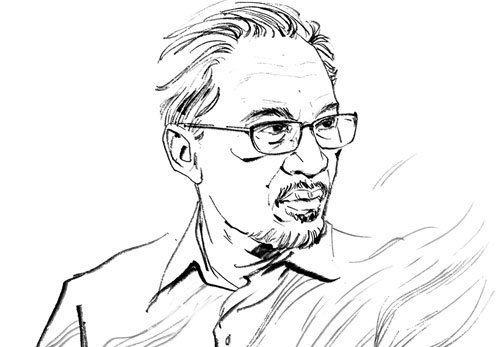

For many of my generation, the name Anwar Ibrahim will forever be connected to these images: the black eye, the Federal Reserve Unit tank, a tear-gas cylinder, that wave of victory after 9 May 2018. For twenty years the Malaysian story hinged upon a man who was feared and revered, a man who created the Islamist dakwah movement in Malaysia, a man who spoke of a new Malaysian dawn, and believed in the possibilities of freedom.
But who is Anwar? This is a man who reads Kafka and Camus and memorises Shakespeare’s sonnets and who frequents the theatre, who speaks Arabic like a scholar, who reads poetry and who is one of the most powerful orators I’ve ever heard.
I have probably met Anwar on about six different occasions over two decades. He was there congratulating us, the cast of the 1995 play Scorpion Orchid; at the opening of a bookstore in Bangsar; and, before his arrest on 20 September 1998, at his Damansara house with his supporters shouting “Allahu Akhbar! Allahu Akhbar!”
Anwar became my hero, as he did to many of my friends. We campaigned for him, we took to the streets, we got tear-gassed, some of us got arrested, because we believed in a man who had been wronged and vilified in public. All because he had tried to upend the tyranny of Mahathir Mohamad.
In 2018, in my final year as the director of the George Town Literary Festival, I invited Anwar to participate in a panel, which I would moderate. When he accepted the invitation, I was thrilled yet nervous at the prospect of the interview.
More from Mekong Review
-

Poetry from David Chandler
-
Poetry from Rory Harris
-
What to do with an unripe jackfruit
- Tags: Anwar Ibrahim, Bernice Chauly, Issue 15, Malaysia