


First stop, Tagbilaran
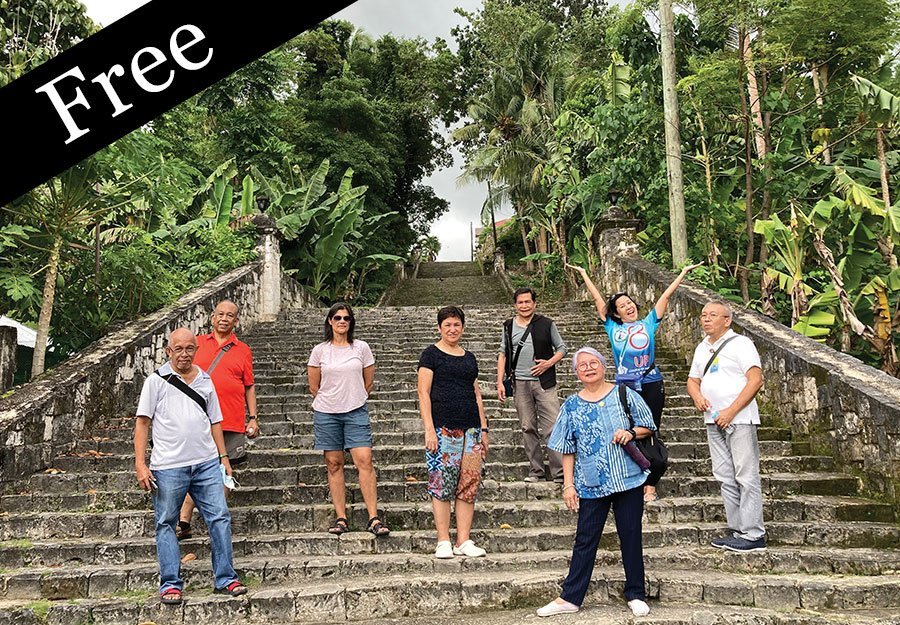
Michelle: We’re in St Joseph’s Cathedral in Tagbilaran City on the island of Bohol. Our guide, Marianito, is showing us how to pray for healing. He dips forward and back, hips swiveling to music we can’t hear. One hand touches his shoulder, then his flank, then one knee. All the while his gaze is trained on the image of St Joseph above the altar.
“You touch the part of the body that needs healing,” he tells us. “Prayer can be a dance…”
I love this idea. Prayer not just as supplication but as a form of exchange. I ask for healing; I give a dance. It feels in the spirit of my first visit to the Philippines and to Bohol.
I’m here with Marj Evasco, one of the country’s best-loved poets born on this island. Emeritus Professor Lily-Rose Tope rounds out our party. We are part of WrICE, a programme of collaborative residencies that brings writers and their literary cultures together (and yes, the acronym is meant to be read as ‘rice’ because most of us are from the Asia-Pacific region).
This trip, however, is not a residency. Instead, Lily-Rose and I are here to observe an innovative local writing project run by Marj, one that not only responds to climate change but does so across generations, exemplifying the UNESCO principle that “culture is a key resource for mitigating and adapting to climate change”.
Marj: The prototype Dagat Bohol workshop was implemented in Jagna in 2023. Two master artisanal fishermen met with six senior high school writers writing in Binísayà. Underscoring the project is the urgency of the effects of the global climate emergency—such as rising sea levels—that will foreseeably change the lifeways of coastal villages in Bohol. Young writers from northwestern towns learn from artisanal fishermen, as village elders, how to live sustainably in their coastal villages. The Dagat Bohol project draws from Boholano’s deep connection with the sea.
When they meet, Boholanos greet each other with an exchange of questions: “Asa ka padulóng? (Where are you going?)”
“Ikaw, asa man pud ka padulóng? (And you, where are you also off to?)”
The root of the word ‘padulóng’ is ‘dulóng’, the name given to the prow of a sakayan (boat). This word harks back to the times when Boholanos travelled by hand-hewn boats called ‘bigíw’ and peoples of the islands of the Visayas used sea routes that joined their communities and cultures in the trading of goods and useful knowledge.
We hope that the next iteration of the project will take place in Loon (pronounced as two syllables: ‘lò-ón’). We’re travelling there to meet with the town’s cultural officer—who is also the local government administrator—to negotiate the running of the project.
On the road to Loon
Lily: The van is a babel of voices—English, Filipino, Boholano and, occasionally, Binísayà. I’m Filipino, born and raised in Manila, the historical capital of the Philippines, urban and chaotic. Michelle understands English and I understand English and Filipino, but we’re not privy to conversations in the other languages. I’m struck by how Southeast Asian the van is. English is understood by all—we’re all children of Western colonisation. Filipino, sometimes Tagalog—understood by all except Michelle—is the language of the Philippine capital. It was imposed by the Americans, our second coloniser, who were perhaps persuaded by then Philippine President of the Commonwealth, the Tagalog-speaking Manuel Quezon, to declare it the national language. Thus began Manila’s colonialism of the other provinces.
Our two lingua franca makes everyone in the van comfortable. But it feels like a different world when our friends speak Boholano; I’m hearing, but not understanding, one of the languages spoken by my people before Spanish colonisation. I know our friends are talking about food that’s only available locally, absent from Manila supermarkets. They speak of flora and fauna I know nothing about—specific types of fish found only in Bohol, some types of trees endemic to Bohol.
They talk about preserving their culture with a passion I don’t see in my urban surroundings. They want to preserve their songs, dances, even funeral practices. They want to honour artists who will never grace the covers of Manila magazines. I realise my upbringing in the capital has separated me from the truly local, indigenous Filipino life. So must many Southeast Asian urbanites who have cut ties with their kampungs and hometowns.
Along the Maribojoc-Loon coast
Lily: Every town in the Philippines has a Roman Catholic church. While Bohol has its fair share of grand churches, the churches in the towns nearest the sea are older and seemingly sturdier than those I’ve seen in inland towns. They’re less ornate, hinting that the builders were eager to establish their religious presence early. They face the sea, evidently defiant of the storms and pirates that battered the towns.

uplifted by the 7.2 magnitude earthquake in 2013. Photo: Marj Evasco
All Philippine town plazas have a statue of Jose Rizal, the national hero, a doctor and a writer among many things. The one in Loon has a replica of the Statue of Liberty on top of its arch. I’m floored by the discovery. It makes me think of the hundreds of citizens, especially children, who may have understood its presence as eternal American superiority. Even Rizal allowed the symbol of America to live above him. The person responsible for this anomaly must have been enamoured of America. Perhaps they were a recipient of its bounties. It reminds me of my grandfather, a history teacher sent to Columbia University for his Masters, who was ever loyal to the US. When we, the grandchildren, tell him about American atrocities during the Pacification, he would get upset, take out his diploma—signed by an American president—and proudly show it to us to shut us up.
Michelle: In every Filipino town I visit, I’m taken to see the statute of Rizal first and the church second. Rizal always carries a coat. I wonder why; it looks far too hot for this climate. The churches are always huge. On Bohol, they are mostly made of coral stone.
“Look closely at the stones,” the cultural officer of Loon tells me about his own town’s church. I find impressions of seaweed, coral blooms and sea creatures. The churches are made of ocean in the same way the boat is embedded in the Boholano tongue.
Will all that fossilised life be returned to the water when the ocean rises?
From Loon to Cabilao Island
Lily: Then there is the sea. Voyaging with friends on a sea ambulance with wide benches and flooring is like a Mercedes Benz ride to Cabilao Island. The sea wind and friendly waves make me a bit drowsy, calming my information-laden mind. The sea is evocative of Nature’s grandeur and generosity; it’s the highway of life. I think of boats from Malacca, Indonesia, even China, navigating these islands to trade. With trade comes the exchange of knowledge and cultural practices. But this traffic ended with colonialism. Then came ships, not to trade but to conquer. I can understand what the conquistadores saw in Bohol, or in any Philippine island for that matter—natural resources, malleable natives, an opportunity for God, Gold, Glory iges of the Spanish presence can be seen in the churches.
Looking at the sea on Cabilao Island, one hardly feels the colonial presence. The women in the community have established livelihood programmes. Michelle has a nice dip in the water. I continue looking at the sea, wondering about its role in the making of a people.
Michelle: We’re going to sail out to where Loon’s fisherfolk drop their lines, off Cabilao Island. I’ve seen their boats, which are small, light and strongly resemble the canoes I grew up with in Canada. Someone tells me that hammerhead sharks breed in these waters. I pack my swimsuit anyway. The water is turquoise, clear. Salty, refreshing. The same creatures fossilised in Bohol’s churches now slip through my toes.

More from Mekong Review
-

Poetry from Lawdenmarc Decamora
-

A poem by Alyza Taguilaso
-
Poetry from Tilde Acuña
