

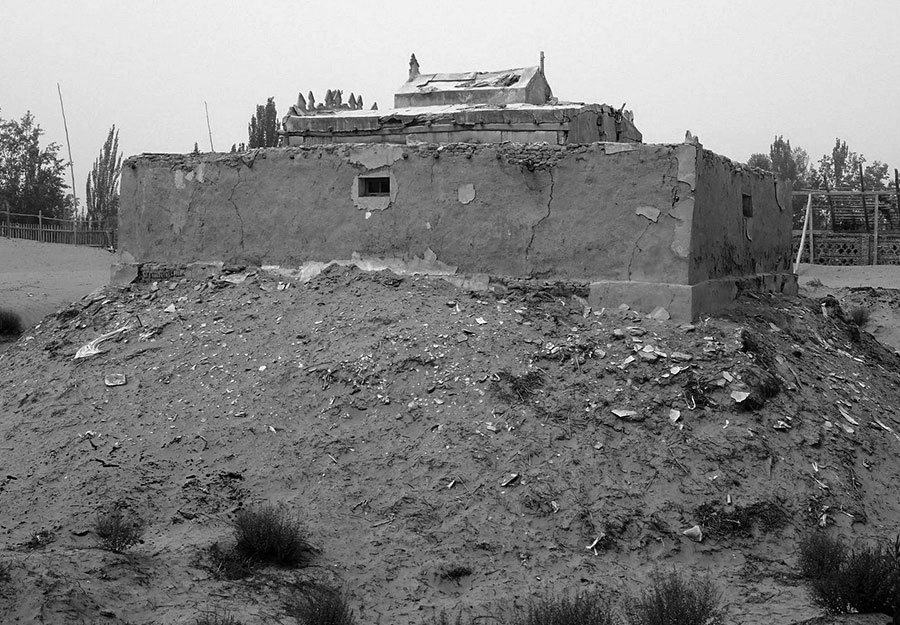
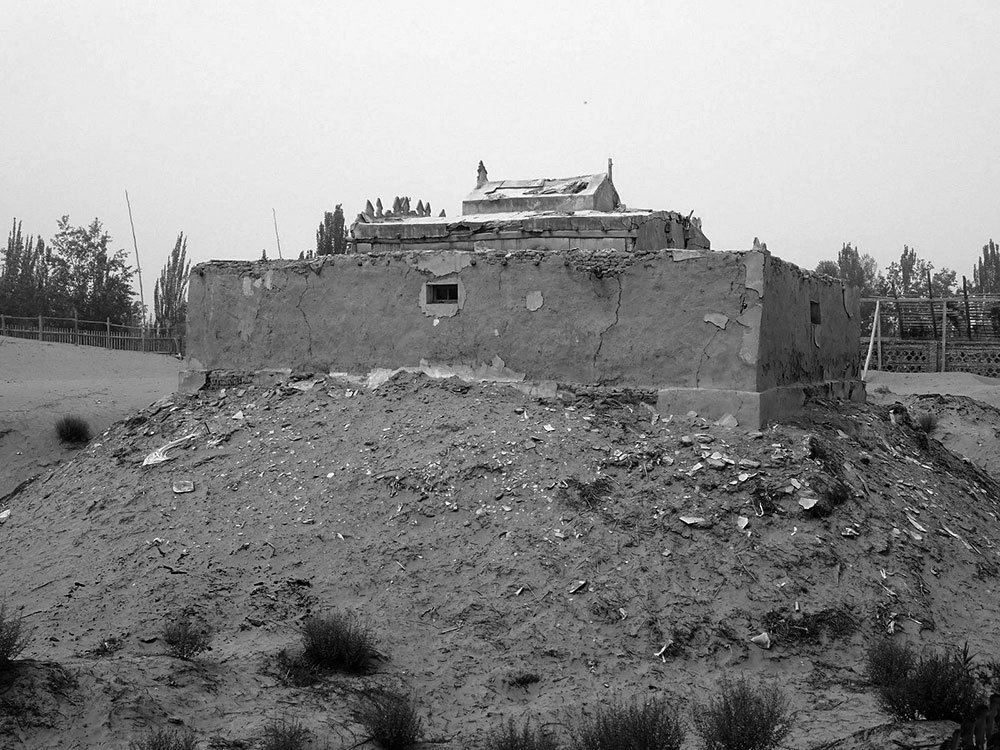
Some time between 10 and 17 March 2018, on a high sand dune seventy-five kilometres from the town of Niya, a beloved historical monument disappeared. For at least 450 years, the site had drawn pilgrims from across the expanse of Altishahr, the southern half of what is now variously known as Eastern Turkestan or Xinjiang. Pilgrims came to be in the presence of Imam Je’firi Sadiq, a founding father and hero who had died there a thousand years earlier while bringing Islam to their homeland. At his tomb they wept, prayed and gained blessings from contact with the physical structure.
The white-painted tomb had the shape of an ordinary grave marker, but on the scale of a giant, like a grave for someone six metres tall, resting on a platform fifteen metres squared. Some pilgrims wrote graffiti in a wooden, box-like prayer house erected in the sand near by, recording their shared presence with the saint in the very location where their society and their history were born. All around, flags and strips of cloth whipped loudly in the wind, thousands of offerings tied to various sacred structures, testifying to the crowds of fellow Uyghurs who had come over the years to venerate this point of historical origin and connection to the divine. In the early autumn, pilgrims came in especially large numbers, cooking communal meals in a gigantic pot and sleeping near the site. All of this disappeared in the middle of March 2018, leaving an empty dune.
More from Mekong Review
-

Poetry by Ghojimuhemmed Muhemmed
-

Poetry from Muyesser Abdul’ehed Hendan
-

How China uses surveillance technology to terrorise the Uyghurs