


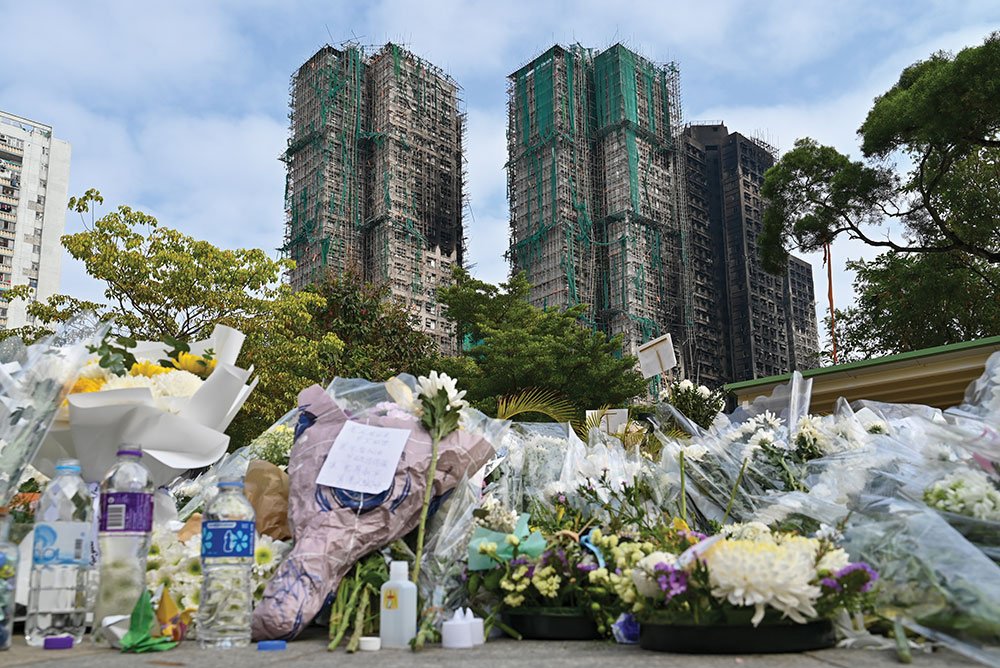
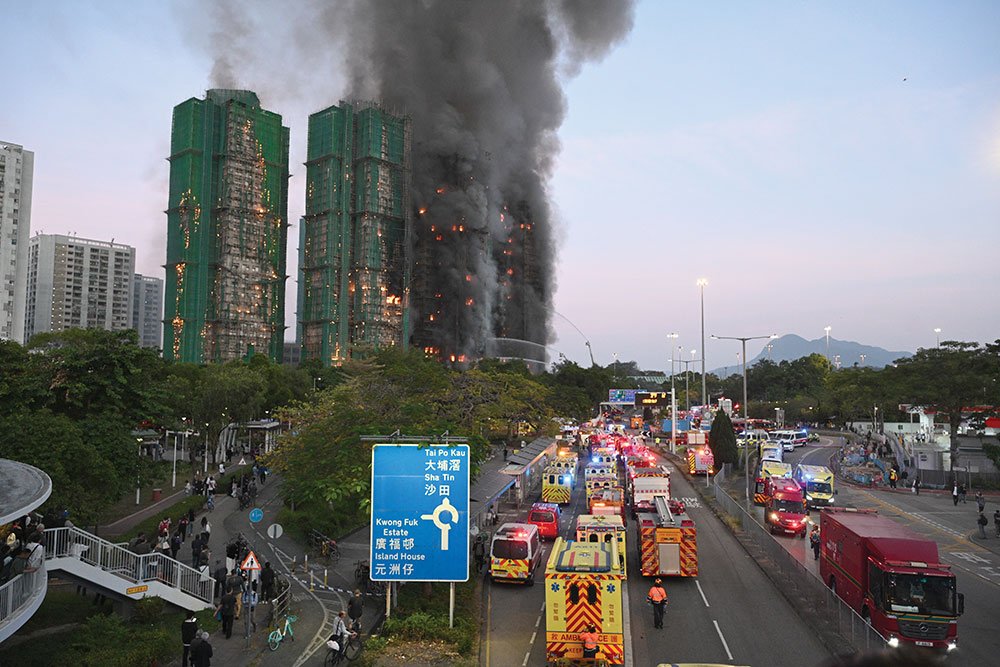
On 26 November 2025, a fire broke out at Wang Fuk Court in Tai Po, a largely residential district in Hong Kong’s New Territories. It was one of the deadliest residential fires in the city’s recent history.
The incident immediately drew intense media attention, including from international outlets. My phone buzzed with notifications bearing news of the inferno, but the captions that accompanied images of the blaze weren’t what I had expected.
“Bamboo scaffolding may be to blame,” many of the international media outlets claimed, pointing their fingers at bamboo structures common to most construction sites in Hong Kong. The eight residential towers of Wang Fuk Court had all been surrounded by these scaffolds—which were then wrapped in safety mesh—as part of major repairs that were ongoing at the time.
It was an unsettling conclusion, echoing what the Hong Kong government had suggested even before any serious investigation had begun. It was a narrative that brushed past a series of systemic failures. For years, residents and whistleblowers had raised concerns about the flammable nylon mesh around the scaffolds, workers smoking on site, windows sealed with Styrofoam, and fire alarms dismantled to make it easier for the construction workers to come and go. There were also suspicions of bid-rigging in the process of selecting contractors and possible corruption within the owners’ corporation. All of this unfolded against a backdrop of weak and ineffective government oversight.
Scapegoating bamboo scaffolding as the primary culprit offers the government an easy out: replace bamboo with metal and declare the problem solved. But a reliance on misleading narratives and lazy solutions means we fail to deal with problems at their roots, leaving thousands of other residents across the city in buildings with similar unresolved risks.
International media outlets had reported critically during periods of political turmoil in Hong Kong. Yet, in this case, they ended up (even if unintentionally) perpetuating the Hong Kong government’s propaganda under the guise of reporting.
A day after the fire broke out, Huang Xinyan, an associate professor at the Hong Kong Polytechnic University’s Department of Building Environment and Energy Engineering, was interviewed by the British public broadcaster Channel 4. “Here in Hong Kong, we have the combustible bamboo scaffolding—as well as some plastic net and some other plastic material—used during the renovation process,” Huang said, going on to suggest that the scaffolding had contributed to the fire’s rapid vertical spread.
Conducting the interview over a video link, the news anchor in the UK pointed out that while the mainland Chinese government had banned the use of bamboo scaffolding in 2021, it was only at the beginning of 2025 that the Hong Kong government had announced that such scaffolding would be gradually phased out. “It’s a clear mistake, isn’t it, on the basis of this fire? This should have been sorted out years ago,” the anchor asked.
“To some sense, yes,” Huang replied, adding that there were many cases of “bamboo scaffolding fire” every year, only none of these incidents had received much attention because “none of these past fires caused major loss or death”.
Outraged Hongkongers immediately began pushing back against Huang’s statements. They wrote complaint letters to Channel 4, shared screenshots of the interview, and wrote rebuttals challenging his claims. A few days after the interview, Huang published a statement on his university’s website acknowledging that, on top of incorrectly stating that fire engines from mainland China had entered Hong Kong to help fight the blaze, his comments “may have given the impression that bamboo scaffolding was the major factor in the fire’s spread”.
“This was not my intention,” he added. “The actual contribution of bamboo, relative to other materials, is a complex scientific question that requires systematic investigation and fire experiments. At present, there is no comprehensive research on this issue in Hong Kong or elsewhere.”
By that point, Huang had already become a key expert cited by outlets like CNN and Al Jazeera English, and his initial framing spread far more quickly than his later clarification. He wasn’t the only one: other academics and industry figures who pointed the finger at bamboo scaffolding were also widely quoted, all before any official investigation had even begun. For many outside Hong Kong, the impression that bamboo scaffolding had been the major cause for the tragedy had already stuck.
Watching the Channel 4 interview as a Hongkonger, I felt uneasy about both Huang’s inaccurate claims and the way the questions had been framed. The anchor had asked why Hong Kong hadn’t followed the Chinese government’s “lead”, as if Beijing’s policies were a natural standard that Hong Kong had failed to meet. In reality, many policy changes made by Hong Kong’s government to align with the mainland are often seen as gestures of patriotism towards China rather than responses to practical needs.
As international outlets swarmed the story, much of the cultural context was lost. Culture is often the least visible part of a story, and the hardest to translate. In Hong Kong—especially in recent years—it has also become deeply entangled with politics, spanning from the people’s tense relationship with the government to anxieties about hegemonic impulses from mainland China overwhelming local practices, traditions, and ways of life.
A failure to appreciate such subtleties does more than flatten a story. It can reproduce stereotypes, misdirect blame, and further narrow the space Hongkongers have to defend the things that make our city distinct.
The use of bamboo scaffolding in Hong Kong dates back to the nineteenth century, shortly after the region was established as a British colony. Its use quickly spread across the building industry, from houses and small multistorey buildings to shipyards, and also for short-term projects like stages for Cantonese opera performances and religious festivals.
By the early 2000s, safety standards and training for working with bamboo scaffolds were increasingly formalised through the Construction Sites (Safety) Regulations, dedicated codes of practice issued by the Labour Department, and design guidelines from the Buildings Department. A key mandatory licensing system for construction workers, including bamboo scaffolders, was introduced in the mid-2000s.
In a concrete jungle like Hong Kong, bamboo scaffolding sometimes seems like the only practical option. It’s light enough to be carried through narrow, crowded streets; it can be bent and wrapped around tall, skinny, and irregularly shaped buildings. Scaffolders and workers favour it for how easily it lets them patch up façades, replace pipes and window sills, and carry out repairs on suspended objects like neon signboards.
Bamboo scaffolding has made multiple appearances representing Hong Kong on international stages. In 1986, Hong Kong’s box-shaped pavilion at the 1986 World Exposition on Transportation and Communication in Vancouver was wrapped in a grid of bamboo. In 2000, Rocco Design Architects, led by architect Rocco Yim, built a bamboo pavilion for Festival of Vision: Hong Kong in Berlin, an exchange project between the two cities. The structure showcased bamboo as a modern, sustainable material capable of complex forms and traditional Chinese aesthetics, building a bridge between local craft and global design.
For most Hongkongers, bamboo scaffolding is part of the backdrop of our lives: we see it on the way to work or school, appearing and vanishing overnight as construction work begins and ends. We see it when a temporary theatre is set up for shows or celebrations. In a city where almost nothing stays still, where shops flip and trends shift, the bamboo scaffolding used to create these changes is, paradoxically, one of the few constants. It doesn’t demand attention but quietly holds up the ‘glory’ of Hong Kong.
In March 2025, Hong Kong’s Development Bureau issued a memo requiring at least half of all government projects to use metal scaffolding, on the basis that metal offers better fire resistance and is more rigid and durable. Perhaps nothing breeds a strong attachment to something more than the prospect of losing it; the announcement got Hongkongers talking about the significance of bamboo to the city and why it shouldn’t be replaced. But the discontent was scattered and muted, and while the local news started interviewing scaffolders more often, the stories tended to read more like human interest pieces than serious critiques of the government’s decision.
Then the Tai Po fire broke out. This time, the fault lines came sharply into focus.
No discussion of the fire, or the narratives that have swirled around it, is complete without acknowledging the political reality in Hong Kong.
Since the pro-democracy movements of 2014 and 2019, when large numbers of Hongkongers mobilised to demand universal suffrage and resist closer political integration with the mainland, many have emigrated. Those who stayed have had to navigate growing constraints as the authorities reshaped the city’s political order. Under the “patriots governing Hong Kong” framework, space for protest and free expression has contracted, especially after the implementation of the national security law.
Hongkongers, both in and out of the city, are now hyper-aware of the need to defend our culture in all shapes and forms. After the Tai Po fire, bamboo scaffolding joined the list of things to hold on to, becoming a symbol of defiance against encroaching Chinese supervision and control. This is not an easy thing to do. The space for speaking openly against the Chinese government is narrowing, if not disappearing completely. Influencers, journalists, and commentators now operate under a constant risk of censorship and persecution.
In the aftermath of the fire, online influencer Hailey Cheng set up an archive to preserve documents that might otherwise vanish: for example, a contractor performance report that’s been called into question, and minutes from a meeting of the owners’ corporation detailing the construction project’s quoted price. Journalist Ellie Yuen produced several explainers that went viral on social media. Writer and commentator Bacchus Pang also gained traction online for scrutinising the government’s District Services and Community Care Teams, a publicly funded scheme intended to “consolidate community resources to support the Government’s district work”. Pang argued that these teams had been quick to claim credit while sidelining self-organised volunteers who’d stepped forward to assist from the moment the fire broke out. All three published disclaimers alongside their work, stressing that they had no intention of “inciting hatred” against China. Two went further, saying they would not take further interviews or make any additional comments about the fire.
In another case, Miles Kwan, a university student, was arrested for his involvement in launching a petition—calling for, among other things, an independent inquiry into the fire and government accountability—and distributing flyers. Local media reports say that he was arrested on suspicion of sedition and that he’s currently out on bail. The evening of Kwan’s arrest, Beijing’s national security office in Hong Kong warned “anti-China disruptors” not to “incite resentment” against the government.
Under such conditions, Hongkongers increasingly rely on foreign media outlets to tell their stories and platform voices that cannot be heard at home. But while international media publications might theoretically enjoy more freedom, the way the news is produced often leaves much to be desired.
Looking across English-language coverage of the Tai Po fire, a few patterns stand out: a heavy reliance on individual voices based in Hong Kong, the parachuting of foreign journalists with little background knowledge into the city at short notice, and a relatively thin bench of regional correspondents.
Journalists and news outlets unfamiliar with the local scene and desperate for talking heads to interview likely all flocked to the same few—such as Huang—picking them up from one another’s reporting. Without the time, knowledge, or language skills to build networks and access a wider variety of sources, reporters fell back on official government statements or easily accessible elite voices. Catering to never-ending demands for novelty, there was little opportunity or interest in revisiting old ground—thus, the lack of attention to Huang’s clarifications after his Channel 4 interview. Context and depth were sacrificed for speed.
While interviews and soundbites are standard journalistic practice, an over-reliance on a single voice, or a small group of voices, runs the risk of hardening the opinions of a few into a definitive account. Foreign audiences who rely on the journalists and media outlets to convey ground realities aren’t in a position to see through oversimplified narratives and understand the complex social and political currents that run under the surface.
With few resources available, there aren’t many ways for ordinary Hongkongers to intervene in the stories told to the world about us and our city. Yet, as the city grieved and tried to pick up the pieces, some found ways to navigate around the constraints.
Hongkongers reacted quickly once the Anglophone media picked up on the Tai Po fire, fact-checking and translating in real time. Within days, posters began circulating on Instagram and Threads, laying out how the fire started, how it spread, and why many residents saw it as a sign of systemic failure rather than just a matter of “dangerous scaffolding”. Short videos were made in multiple languages—from English and Cantonese to French, Thai, Japanese, Korean, Dutch, and more—stressing that bamboo scaffolding had been used safely in Hong Kong for generations. The videos pointed out that the green plastic mesh wrapped around the scaffolding had been found to be not only of substandard quality, but also highly flammable, and that poor site management and accumulated debris had helped feed the fire.
Some sent emails and complaints to outlets that had blamed the use of bamboo, offering corrections and, in some cases, offering to appear as interviewees. (Some outlets, like The Guardian and Channel 4, later published follow-up coverage that presented a more complex picture.) Not all the arguments or claims made were technically precise; some were simplified or emotional, and not fully grounded in engineering or fire science. But this was because it wasn’t just about the combustibility of bamboo—at its heart, this had become a deeply felt effort to pull a story back into the hands of its community, its people. It was about resisting simplified narratives that excused the powerful from accountability, about holding on tightly to a piece of Hong Kong’s identity.
In a world where information flashes across palm-sized screens in seconds, misinformation travels fast. A narrative, once hardened and entrenched, can take years to undo. Yet stories about a place are constantly shaped without the participation of the people who grew up there and know it intimately.
Stories about culture and identity operate in a different register. They might be easily omitted, as culture is hard to be measured in efficiency, effectiveness, and economic value. But culture isn’t just ornamental. It’s where politics lie: through language, customs, craft, and the everyday symbols that mark a city as itself.
Bamboo scaffolding is one of those symbols: a craft that has wrapped itself around Hong Kong’s buildings and rituals for generations, long before anyone thought to blame it for a fire, and long after the headlines move on. After Wang Fuk Court, bamboo became a convenient thing to blame—something visible, familiar, and easy to identify. It offered a story with a neat villain and an apparently simple fix.
Scapegoats are useful because they redirect attention. The focus on bamboo can crowd out harder questions about power and responsibility; it can also serve a wider political drift. In a city being steadily remade to align with mainland China, replacing bamboo with metal is not only a technical choice. It’s also a symbolic one, a small surrender of local practice framed as progress.
Hongkongers’ defence of bamboo was not just about a material. It was a refusal to let a practice that has, quite literally, held up our city be rewritten as the cause of its collapse. A refusal to accept a story that points fingers at a convenient culprit while letting those with actual responsibility fade quietly from view.

More from Mekong Review
-

Poetry from Lok Man Law
-

A poem by Yago Tse.
-

How a teenager from Hong Kong came of political age
- Tags: Hong Kong, Issue 42, Nathalie Chi

