

Extreme weather is not a matter of ‘normal’,” says David Wallace-Wells in his book The Uninhabitable Earth. “It is what roars back at us from the ever worsening fringe of climate events.”
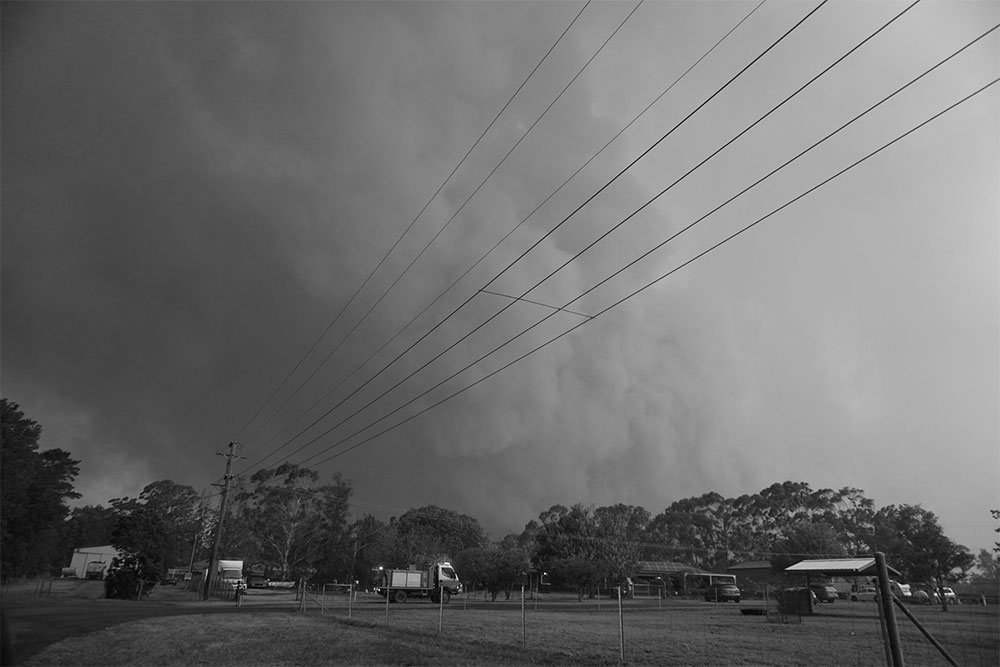
So Australia learned in 2019. On the last day of the decade, the country burned, as it had done more or less continuously since September. As the nation rang in the new year, more than 4,000 people huddled on a boat ramp in the coastal town of Mallacoota, in the state of Victoria, sheltering desperately from encroaching flames.
As of 5 January, the 2019–20 bushfires have killed twenty five people, destroyed more than 6.3 million hectares and razed more than a thousand homes. Scientists say nearly half a billion animals have died, including a third of the koalas in their main habitat in New South Wales. Some species probably face extinction; some ecosystems will never recover.
As David Bowman, from the University of Tasmania’s Fire Centre, explained to Science magazine, this year’s fires were hotter, came earlier and lasted much longer. And, at time of writing, they’re nowhere near over. “We’re seeing recurrent fires in tall, wet eucalypt forests, which normally only burn very rarely,” Bowman said. “We’ve seen swamps burning all around … In Tasmania, over the past few years we have seen environments burning that historically see fires very rarely, perhaps every 1000 years. What is happening is extraordinary.”
Extraordinary but not unexpected. Back in 2003, a government report made clear: “[C]limate change throughout the present century is predicted to lead to increased temperatures and, with them, a heightened risk of unplanned fire”. The following year, the National Inquiry on Bushfire Mitigation and Management gave the Council of Australian Governments, an intergovernmental body, the same message.
Four years later, the Intergovernmental Panel on Climate Change reinforced the message for Australia: “Heatwaves and fires are virtually certain to increase in intensity and frequency.”
Why, then, wasn’t anything done about this virtual certainty?
More from Mekong Review
-

A poem by Rory Harris
-

Shaping Australia’s print landscape
-

Rain on my farm
- Tags: Australia, Issue 18, Jeff Sparrow