


I am told, during my travels in the Philippines, that there’s a superstition where a chick is placed atop a coffin and fed with grains. It’s believed that, as the chick pecks at the food, it’s also nipping away at the conscience of the perpetrator responsible for the death of the person lying within. This was apparently a common practice at the funerals of the many victims shot down by faceless gunmen—or even by the police in alleged instances of “nanlaban”, where law enforcement officers justify their use of lethal force by claiming that the individuals had resisted arrest. Many of these bodies were left or dumped on the streets of Manila, their faces wrapped in plastic, cardboard signs hung around their necks branding them drug pushers or addicts.
Do the beaks of these chicks only peck at the consciences of the killers, or does this symbolic demand for accountability go further up the chain? Photojournalists who documented the almost nightly killings during Rodrigo Duterte’s six-year presidency describe the level of violence as “unprecedented”. It was, as Duterte willed it, a war. Now that he’s left office, the Philippines is taking stock of his legacy—and a body count numbering in the thousands.
In a series of congressional hearings, the ageing strongman confessed to providing funds for a ‘reward’ system for the killing of suspected drug pushers. He’s accused of having applied this “Davao model”—so named in reference to his time as mayor of the southern city—nationally to devastating effect. Duterte could now be charged under local Filipino law for crimes against humanity, but the International Criminal Court got there first. On 11 March, the former president was arrested upon arrival at the airport in Manila and whisked off to The Hague, where he’s facing a charge of “the crime against humanity of murder”.
Duterte was elected on a penal populist platform, with promises to wipe crime off Filipino streets. His primary targets were alleged drug dealers and users from some of the capital’s most impoverished communities. The effects of his war on drugs were immediately apparent: bodies were strewn throughout the streets of Metro Manila, Quezon City and even as far north as cities like Caloocan and Bulacan. Most victims were male, ranging from seventeen to over sixty, but there were also cases of ‘collateral damage’ where the deceased was as young as three. In one shocking case, seventeen-year-old Kian delos Santos was caught on camera being dragged away by police officers to the area where his body was later found, belying the police’s claim that he’d shot at them first and left them with no choice but to retaliate. His death sparked a wave of criticism against the Duterte regime—three police officers were later sentenced to up to forty years in prison for murdering the teenager—but the wider pattern of killings continued. Masked gunmen riding on motorcycles hunted down targets; they’d stop, shoot and ride off again, their vehicles easily navigating the narrow alleys and streets. Actual evidence of drug-related activity or crime was treated as optional, even unnecessary.
The neighbourhoods in which such extrajudicial killings (EJKs) took place are highly urbanised, densely populated areas where social relations are thick with communal intimacy. Living cheek to jowl, the residents of Phase 8 of Bagong Silang in the city of Caloocan inhabit an environment where the most intimate details of how they live are known to their neighbours—even the most private moments can be heard through the walls. This includes how one dies.
I make my way to Bagong Silang to meet Ampie, the mother of an EJK victim. We first met at a session for community coordinators of the Paghilom Program, an initiative that supports EJK victims and their communities. Coming from different affected neighbourhoods, the coordinators had converged at the AJ Kalinga Foundation—an organisation that works with the poor and homeless—where they could receive aid and counselling.
To get to Ampie’s home, I travel by car from the comfortable confines of the university belt to Caloocan. It’s a Sunday, but it still takes me an hour to get through the Manila traffic. As I head north, the landscape begins to change, bringing me to the confluence of two massive shopping malls facing each other. There’s nothing else in the vicinity other than these large edifices. Ampie meets me there, and we hop on a jeepney for another thirty minutes to get to the heart of the city. The streets converge as if forcing everything into a singularity from which outsiders can’t escape.
The jeepney isn’t the end of our journey. We have to go further on a trike—these sidecar motorcycles are the only forms of transportation small enough to navigate the cramped, low-rise neighbourhood. Ampie points out the many police stations dotting our route. “This is not a good police station,” she says. “That is also not a good police station.” She tells me that many suspected pushers and users were told to present themselves at these stations—when they did, they never came out again.
Ampie and I meet up with Laurie, who lives in a small shack right next to her sari-sari stall. Her uncle had been killed in a supposed drug bust. I ask her where it happened; she points to a nondescript spot in an alley not too far from her home. All the families I speak to that day tell me the same story: armed men in masks swooped in and opened fire. Shots rang out in the alleyways and victims were left where they’d fallen. Sometimes the gunmen murdered people in their own homes; one family shows me the bullet holes in the walls of their house. Violence is intimately felt, crashing into private realms. Another family tells me that, when they head home at the end of the day, they have no choice but to walk past the spots where their loved ones were killed, leaving their trauma a constant, festering wound in their lives. Everywhere I go in Bagong Silang, someone points at a spot and says, “This is where it happened.”
In one family’s home, an urn containing the remains of an EJK victim sits right above the stove. There’s no space for it anywhere else in their tiny abode. A forgotten candle placed next to the urn had accidentally set it on fire once. Had the fire not been put out quickly, they tell me jokingly, it’d have led to a “double kill”. Many of the families I speak to are Roman Catholic; it wasn’t easy to convince them to cremate, rather than bury, their loved ones. Ultimately, the deciding factor had been their fear of losing the remains forever.
When the strict Covid-19 lockdown ended in July 2023, some families visiting late relatives at the public ‘apartment-style’ cemeteries dotting Manila found empty niches where loved ones used to be. It costs about 5,000 pesos (about US$86) to rent a niche for five years but, for some struggling families, even that amount can seem like a king’s ransom. Failure to pay the fee leads to the eviction of the dead from the niche. If the family is fortunate, they’ll find the bones of their loved ones wrapped in sacks and placed on their doorstep. If not, the remains could end up in a pit, mixed with others in a mass grave.

To address this problem, Father Flavie Villenueva, a priest who runs the Paghilom Program, arranges for families in danger of losing their niches to have the bodies exhumed, cremated and blessed before being returned to them. It’s an extremely important job, returning dignity to the dead and providing comfort to the living. Most of these families had been hurried through the system in the first place, preyed upon by greedy funeral homes and denied justice by the authorities. Occupying the lowest rungs of the social and economic hierarchy in the Philippines, they’re usually seen and treated as undesirables; while the EJK victims are literally dead, the ones they’ve left behind endure social deaths.
Father Villenueva tries to dress these wounds, giving the dead an opportunity to come back to life in some way. After exhuming the remains, the Paghilom Program sends them to Raquel Fortun, a forensic pathologist who works to discover the real causes of death—as opposed to the “natural deaths” the police force and official coroners often claim. The families are given financial assistance and psychosocial support at every step.

Photo: Leong Kar Yen
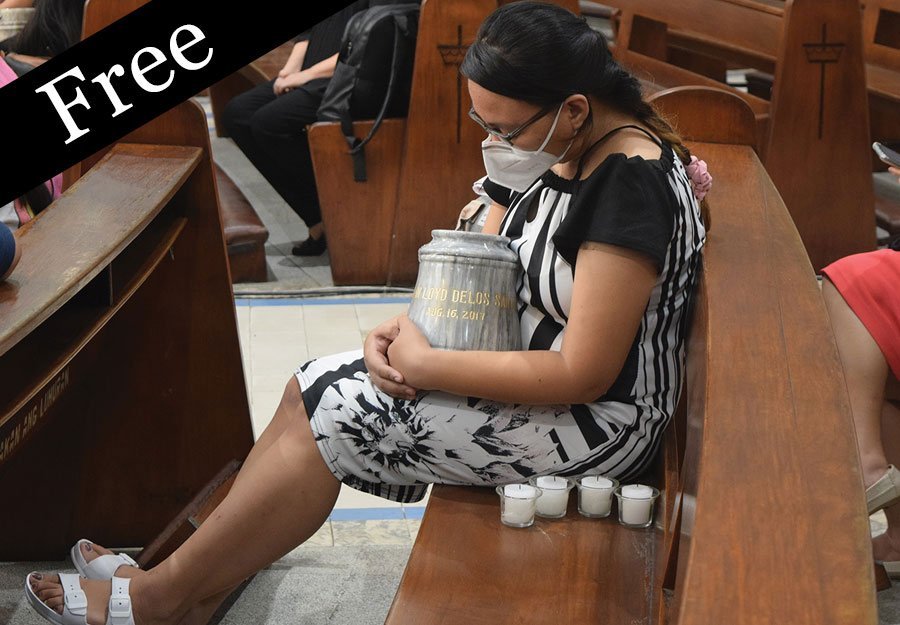
The next time I see some of the victims of Duterte’s drug war, I’m in one of the larger churches in Metro Manila. Their ashes have been placed into urns, waiting to be blessed before returning home. Families stand in a huddle, waiting patiently to claim their loved ones. This ritual is made as visible as possible: reporters and photographers are allowed to be present. Raffy Lerma and Vincent Goh, two photographers who’ve covered extrajudicial killings since Duterte’s inauguration in 2016, are present.
Each urn is labelled with the name and date of birth of the victim within. Father Villenueva, who’s presiding over the event, makes full use of the pulpit to excoriate the authorities for their involvement in these deaths. He blesses the urns. As the name of each victim is called out, their family approaches the table to take the container lovingly into their arms. Some cry as they sit down; as I watch, every family holding an urn whispers softly to it, as if the person within might emerge once again. This, of course, never happens. The bones remain silent, encased in heavy marble. But each family now knows that there’s recognition of their loss, of the violence they’ve experienced and of the consequences that’ll reverberate through the rest of their lives.
This is what Duterte has to reckon with now. He seems gaunt and tired as he sits before a set of congressional-level commissions in November 2024; it’s said that he’s suffering from diabetes and a host of other ailments. Nevertheless, he maintains his combative demeanour, even threatening to throw a microphone at a congressman. He looks uncomfortable, surrounded by political enemies seeking to indict him on charges of crimes against humanity. Perhaps he’s also discomfited by the presence of some of the families whose lives his policies had ripped apart.
Several families testify before the House, recounting to elected representatives the horror of the killings and the losses they’ve endured. It’s a rare moment for their suffering to be acknowledged on television. Sociologists have long pointed out that marginalised groups suffer from disenfranchised grief: given their low status in society, their plights are rarely properly recognised. Like the families of people on death row, the families of EJK victims are burdened with stigma and shame, forcing them to hide their pain away. Within small, tight-knit communities, even neighbours often look upon these victimised families with suspicion, accusing them of being drug pushers and peddlers themselves. Many have struggled for years for justice, facing numerous challenges. Police stations might burn down—like one did in Caloocan City in 2017—and files mysteriously disappear, leaving investigations at dead ends and perpetrators free. But now that Duterte’s the one facing judgement, these families have become a potent political force holding a mirror up to the Filipino establishment. The harms inflicted upon them are, at last, being widely witnessed and seen as injustice. When they speak and shed tears of sorrow and anger in front of legislators and flashing cameras, they’re finally able to transform shame into outrage.
There’s still a long way to go before true closure can be achieved. Human rights groups point to large numbers of unsolved EJK cases, leaving bereaved communities with no answers or accountability. But the pressure on the Filipino state to atone for its sins grows as more cases are investigated. Duterte’s rule was but one chapter in a long tradition of state violence in the country. The stories of the dead—as told by those who loved them best—accompanied by loud demands for justice might be an opportunity to redeem and heal the collective Filipino soul.
Postscript
After returning to Manila from a trip to Hong Kong in March, Duterte was served an arrest warrant and put on a flight to The Hague. Many political pundits have opined that this latest turn of events was triggered by Duterte’s recent fallout with Ferdinand “Bongbong” Marcos Jr, the current president. While this may certainly be true—the Philippines wouldn’t have been the first, or only, state to ignore charges brought by the International Criminal Court if they’d refused to facilitate Duterte’s arrest—we can’t discount the fact that human rights activists, organisations and, more importantly, families of EJK victims have campaigned long and hard for this outcome.
The journey from here remains a long and arduous one. The process is only at a pre-trial stage to ascertain whether prosecutors have a strong enough case for things to proceed. Even if things progress to a full trial, the whole thing might take several years. Meanwhile, Duterte’s army of supporters have begun to act, going as far as threatening EJK families. Despite this, my observations and conversations with friends and contacts indicate that these families and human rights defenders will continue to persevere. For them, Duterte’s arrest is an important milestone for the protection of human rights in the region—that this can happen to a “strongman” like him should send a chill down the spines of governments throughout the region. As it is, many of those previously associated with Duterte—Senator Ronald ‘Bato’ de la Rosa, a former police chief, being one of them—are beginning to feel nervous about being next on the list for a reckoning.
It feels, in many ways, like the tables have turned. There are glimmers of hope that, for those who have acted with impunity for so long, the time for atonement is now closer than it’s ever been.

More from Mekong Review
-

Poetry from Lawdenmarc Decamora
-

A poem by Alyza Taguilaso
-
Poetry from Tilde Acuña
- Tags: Free to read, Issue 39, Leong Kar Yen, Philippines
