


Landbridge: Life in Fragments
Y-Dang Troeung
Penguin: 2023
.
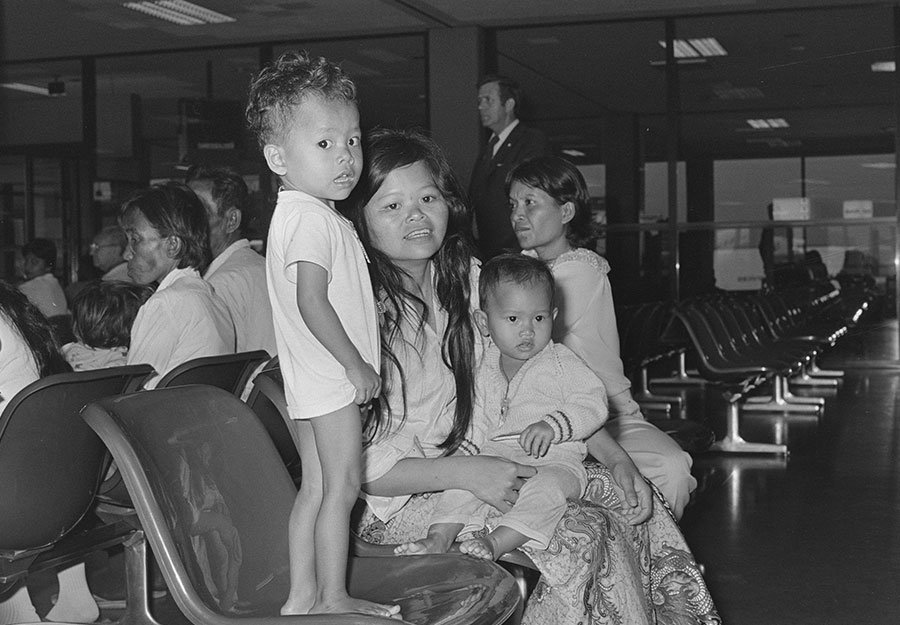
In the black-and-white photo, one has to squint to spot her, a baby not yet a year old held in her mother’s arms. In the foreground, Pierre Trudeau, the Canadian prime minister, hands joined in the Cambodian greeting gesture known as sampeah, welcomes the group of refugees she is part of. The year is 1980 and the picture immortalises her face as a tiny dot in history, a symbol of the 20,000 Cambodians who came to Canada to start a new life, fleeing the Khmer Rouge genocide which slaughtered a quarter of the country’s population.
Some forty years later, the little girl has grown. She has earned a PhD, moved to another country, fallen in love, become a mother and reclaimed her identity in her memoir, Landbridge: Life in Fragments. The book includes the photo of Trudeau and her as an infant, in a full circle move. “My public image as a refugee child rescued from Cambodia has been made and remade frequently throughout my life in ways that have been largely out of my control,” Y-Dang Troeung writes, longing to show “the cracks and fissures beneath the refugee’s smile of gratitude”.
Her book is an earnest and raw scrapbook of lingering trauma, peppered with family photos, newspaper clippings and artwork. A map shows the location of Khao-I-Dang, the Thai refugee camp where she was born and which inspired her name.
More from Mekong Review
-
Gordon Conochie’s book amounts to perhaps the most detailed autopsy yet of the death of Cambodia’s democracy.
-
The arts can remind us of our connections to home and nature as we are propelled forward by development projects that prioritise profit over nurturing rootedness and well-being.
-

Poetry from John Brixter Tino
- Tags: Agnès Bun, Cambodia, Issue 35, Y-Dang Troeung