

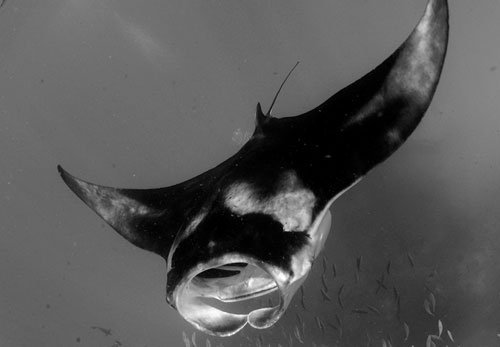
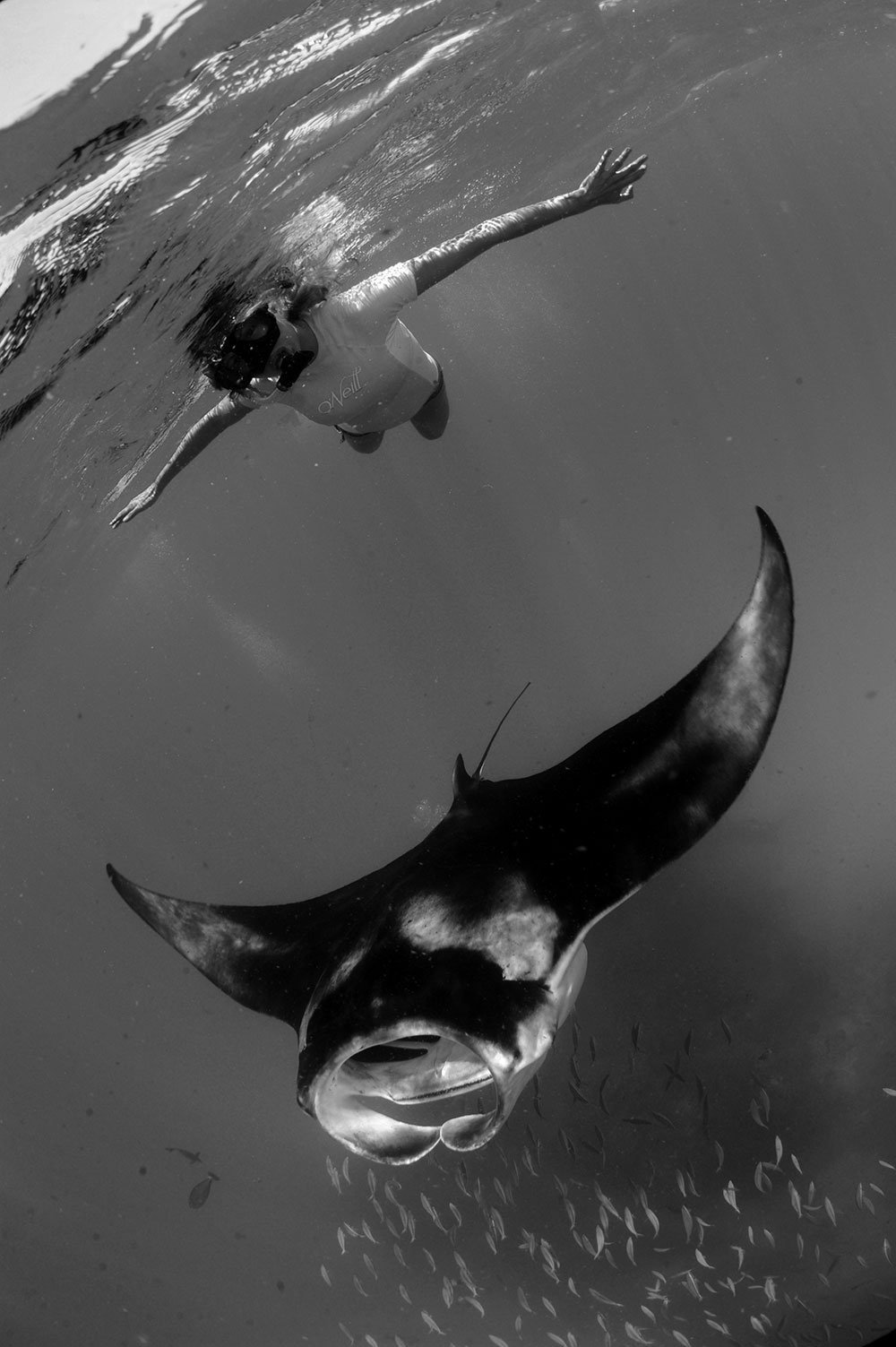
I am gazing in wonder at a flying carpet. Underwater. It’s a manta ray, winging along with the greatest of ease, keeping an eye on me. And I say “eye” singular because each manta eye is positioned to either side of its front lobes, spaced well apart.
Correction. Make that two flying carpets. Right over the top of the first one comes another manta, flying straight toward me. I wanted to get close to mantas, but not this close. The manta has a huge wingspan — some 500 kilograms of flying carpet is set on a head-on collision course — and I have nowhere to go. I am in panic mode. But at the last moment, the manta nose-dives into the depths. Is this the manta ray’s idea of a joke?
The mantas wheel back — both of them. There is no doubt in my mind now that the mantas are eyeballing me with curiosity. They know exactly where I am, and are avoiding any collision course, despite a three-metre wingspan. They show off with a stunning underwater ballet, winging along effortlessly, doing the occasional pirouette. This undulating choreography goes on for several minutes, the maximum time that I can hold breath underwater, but seems to last much longer. The mantas have let me into their world for a magical instant.
More marine encounters over the course of the next week convince me that manta rays are truly bizarre creatures: charismatic, graceful and gentle despite their size. I am on a vessel dedicated to tracking mantas — the Manta Trust research boat, patrolling Baa Atoll in the Maldives. In 2011, Baa Atoll was designated a UNESCO World Biosphere Reserve, largely due to its unique manta population, and to the efforts of Guy Stevens, who heads the manta research project here. The Maldives hosts the world’s largest known population of reef manta rays, which Stevens estimates at more than 6,000.
More from Mekong Review
-

One syllable brings the spice
-

What does it mean to be Chinese?
-

Poetry from Melinda Jane — The Poet Mj
- Tags: China, Issue 14, Michael Buckley