

I am ambivalent about hope.
This ambivalence is mostly due to the pernicious and successful co-opting of the vocabulary and gestures of hope by corporations, politicians, advertising, and wellness influencers. But it is also due to hope’s relationship to futurity, such that, at its worst, hope provides solace that anything is possible in the future, even—or especially—when it’s not. Indeed, the philosopher Eugene Thacker has described our era as being “haunted by the shadow of futurity, precisely because there is no future”. By which he means, ‘the future’ is a construct.
Each day, we are bombarded with endless (monetised) solutions to all conceivable problems. Don’t have any motivation? There are hundreds of self-help books, podcasts, and TikTok clips for you! Can’t sleep? Not sure what to eat? Can’t get out of bed? Have you tried yoga? Cold plunges? Mushroom powders? Infrared saunas? Probiotics? Eating more meat? Eating no meat? Biofeedback? The hyper solutions-oriented consumerist culture under late capitalism savvily individualises our collective struggles, commodifying self-help and spiritual practices, and standing in as an endless antidote to—or deferral of—suffering.
To use an obvious example: we might consider the way household recycling is sold as a solution to the problem of climate catastrophe but acts, more or less, as a defence against the grief and hopelessness that living with climate devastation brings. Particularly when we know that, however diligently we recycle, very often our items aren’t being properly recycled anyway. Not to mention the very idea that plastic can be recycled at all is a sort of sales pitch, given what we now know about microplastics.
Environmentally speaking, there would seem to be a phenomenal desire to live as if things are not as they are. In this picture, hope is used to defer the realities of the present to sell the promise of the future, where nothing has to change. Or better still, where we can return to the so-called golden era of the past. This, as the world’s leaders—along with the most powerful corporations and billionaires—have us wilfully hurtling towards greater devastation. Towards increased pollution, ocean acidification, and extinction, off the back of the dream of a technological solution to climate catastrophe. The promise being: life can continue as it is (or once was) and you can have everything you want, if you just click here and buy now (pay later).
I am reminded of philosopher Alenka Zupančič’s book, Disavowel, where she describes the logic of disavowal as “I know very well, but…” Knowledge in and of itself is not an antidote to denial, she argues. The book opens with a joke Sigmund Freud tells in his essay, Thoughts for the Times on War and Death: “A man says to his wife, ‘If one of us dies, I shall move to Paris.’” In other words, knowing we are mortal doesn’t stop us believing things could be otherwise. Indeed, as Zupančič reminds us, Freud uses this joke to “illustrate his argument that we do not believe in our own death”.
Under late capitalism, consumerism is quick to promise solutions. Such is the reach of consumerist culture that we increasingly see its logics entering politics. Much of the ideology of the political right—something the political left has mostly sought to avoid, sometimes to its detriment—being that it ‘knows’ all too well what the problem is and how to solve it. It’ll come as no surprise that this ‘problem’ is very often the marginalised Other. That same old, same old sleight of hand.
And yet, while hope can function to distort the reality of the present and defer the need for action—or change—to an eternal future, this is clearly not all that hope engenders. Arundhati Roy has argued that “hope lies in texts that can accommodate and keep alive our intricacy, our complexity, and our density against the onslaught of the terrifying, sweeping simplifications of fascism”. Rebecca Solnit similarly calls our attention to hope’s radical potential, insisting that to give up hope is to give in to the status quo. In Not Too Late: Changing the Climate Story from Despair to Possibility, Solnit writes: “A lot of stories in circulation endeavor to strip you of hope and power, to tell you it doesn’t matter or it’s too late or there’s nothing you can do or we can never win.”
In psychoanalytic terms, ambivalence is not simply about having mixed or opposing feelings. As writer and psychoanalyst Adam Phillips writes in ‘Against Self-Criticism’: “We are ambivalent, in Freud’s view, about anything and everything that matters to us.” In this sense, I am ambivalent about hope precisely because of what it means to me. Of what is at stake.
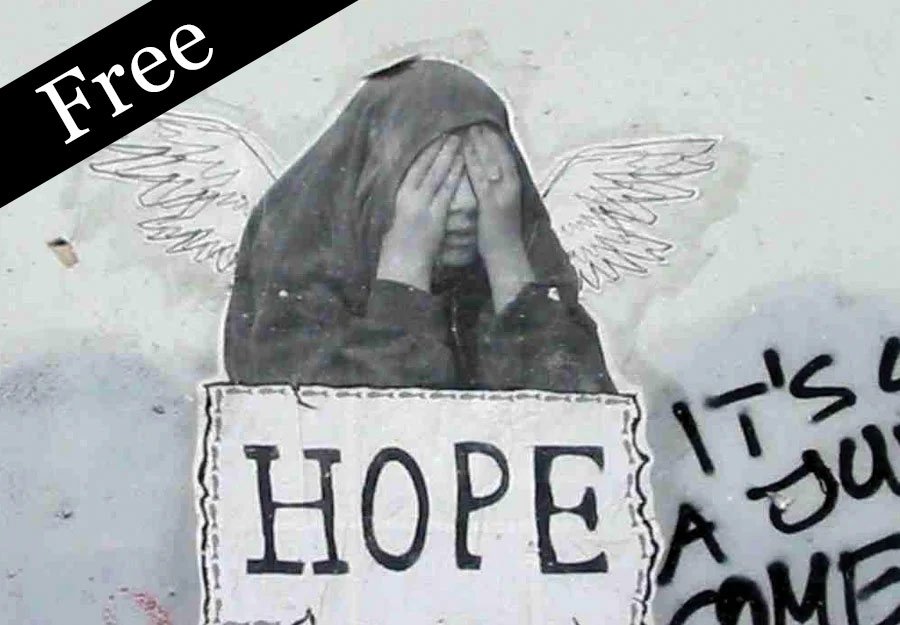
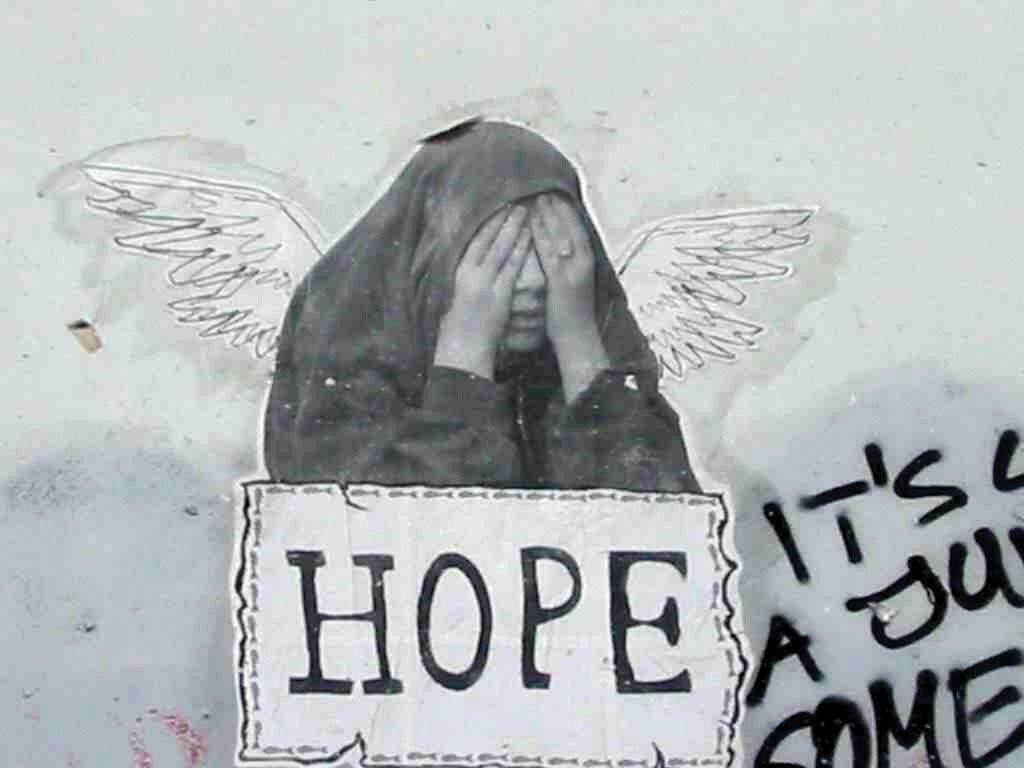
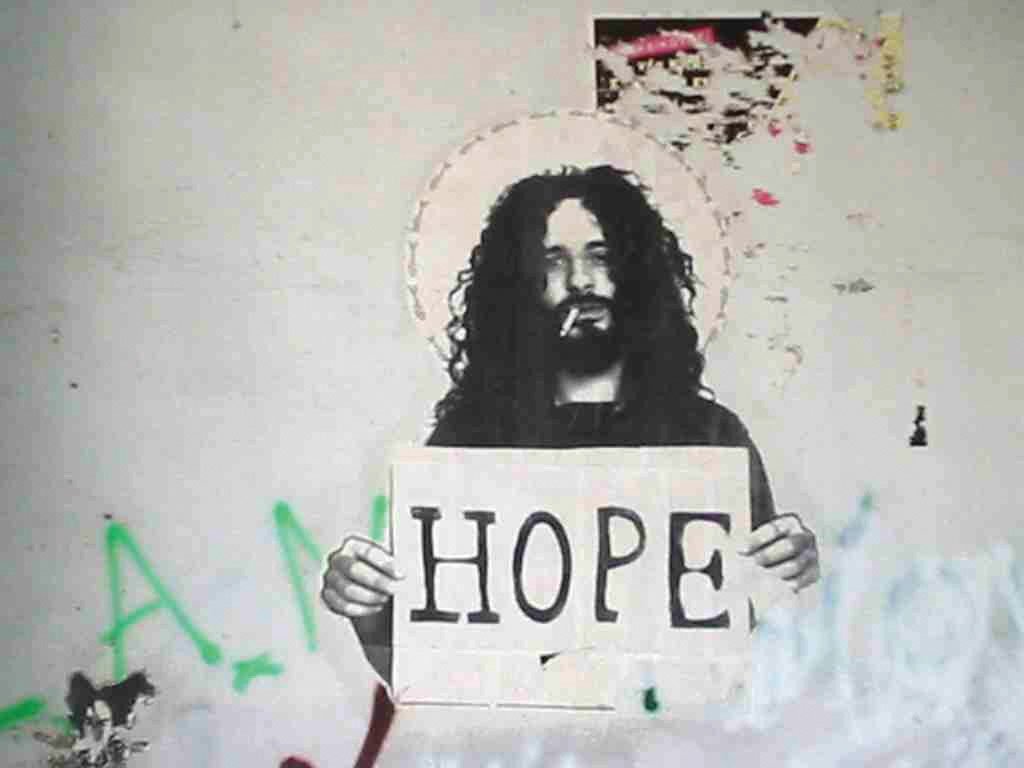
Hope has been showing up in my writing for at least a decade. During a trip to Greece in 2006, I kept coming across these paste-ups, around the inner neighbourhoods of Athens, of black-and-white portraits accompanied by the word “HOPE”. I photographed and wrote about them, telling anyone who’d listen how beautiful they were to me. I was in particular need of some hope at that time, so my encounter with these images were all the more moving for it. I later discovered that they were by Konstantinos Ntagkas, the Greek artist who goes by the alias “H.O.P.E”. After being introduced to Ntagkas by mutual friends, we began corresponding. Then, in 2009—during the early days of the Greek financial crisis, when a version of hope was being peddled by the European Union in return for harsh financial austerity measures—Ntagkas asked me to write the introduction to his first book, which I wrote as a prose poem. It opens:
I was half asleep with one eye open when Hope visited my bedside. He wore a felt hat and blew bubbles from a plastic pipe. He sat down beside me and smiled. I wondered for a moment if my imagination was playing tricks on me, until he placed his hand on my shoulder and I felt a great sense of sadness coupled with delight.
I was interested in the personification of hope in H.O.P.E’s work and employed a similar tactic by considering hope as an eccentric visitor or trickster.
The same year, I wrote a novella as part of my Honours degree in creative writing, entitled How Birds Live. The main character was a boy named Ümit (the Turkish word for ‘hope’) who lived in a public housing complex in the Australian capital city with his Turkish father and Greek mother. The story ends with Ümit’s death, followed by a series of accidental deaths and suicides of various tenants in the public housing complex. It drew from my own experience growing up in public housing in Canberra, a city where the median income is higher than the rest of the country due to the number of well-paid public service jobs, and which people don’t tend to associate with poverty or disadvantage. I tried to capture something of the complexity of the hope I grew up with. Hope, on the one hand tempered by the cynicism that comes from witnessing social services routinely punish and denigrate poor people, and, on the other hand, kept alive by my determination to live a different life when I grew up and moved out of home.
In Greek mythology, only hope remained when Pandora snapped closed the lid of the box Zeus had given her with the explicit instruction not to open it. Of course, if a protagonist in mythology or fairy tales is told not to do something—look back (Orpheus), open the door (Bluebeard’s wife)—we know they’ll invariably do so. And sure enough, when Pandora opens the box, out bursts pestilence, toil, suffering, death and all the so-called evils of the world for humanity to endure evermore. The consequences of Pandora opening the box has resonance with Eve’s bite of the apple in the garden of Eden. After all, let’s not forget that Eve and Pandora are both described as the ‘first woman’. The dominant interpretation is that desire, or lack of care, is the origin of the world’s worst aspects. Leaving aside for a moment—if it’s possible to do so—the implicitly gendered nature of their failures, we can see an important will to knowledge and independence, not to mention reality, in these women’s actions. In Gardens: An Essay on the Human Condition, literary scholar Robert Pogue Harrison argues that the fall from the garden represents an unequivocal blessing. It made life matter, he asserts. Nothing was at stake in the garden, Pogue Harrison writes, “until suddenly, in one decisive moment of self-revelation, everything was at stake”.
It occurs to me now that my stated ambivalence to hope is related to a bigger question of how to live. Of how to cultivate a ‘good enough’ life in the face of the overt and systemic violences, inequalities, and injustices of everyday life. Of how to rise to the challenges that the stakes of living demand, without losing the willingness to do so or unwittingly seeking comfort in denial.

More from Mekong Review
-

Rain on my farm
-

Cousin Merle’s abscission from the family tree didn’t elicit any great feeling on my part, but the fact that there was no Chinese blood in the family was a little more complicated.
-
Australia’s summer from hell
- Tags: Australia, Issue 42, Melody Ellis
