



The Party’s Interests Come First: The Life of Xi Zhongxun, Father of Xi Jinping
Joseph Torigian
Stanford University Press: 2025
.
Xi Zhongxun, the father of China’s current leader Xi Jinping, was a complex man. He preferred dialogue over confrontation, but didn’t shrink from violence when he felt the situation required it. More than once, he threw colleagues under the bus—albeit reluctantly—because it was politically expedient or necessary to preserve his interests. He was amiable and liked by many, but when he disapproved of someone, he was not above asking his underlings to “dig up problems”. He arguably reached a moral low in 1956 when he encouraged people to come out with criticism of the Chinese Communist Party (CCP) during the Hundred Flowers Campaign even after he knew a crackdown was coming.
Revolutions are notorious for devouring their own and, in 1962, Xi, too, became a victim. It began with a year under house arrest, during which he wrote constant self-criticism and avidly read Mao, Marx, and Lenin. Then his situation sharply deteriorated: beaten and humiliated publicly during the Cultural Revolution (1966-1976), he spent years in jail, often in solitary confinement. Close to despair, he wrote to his former boss, Premier Zhou Enlai, and even to Mao, but neither responded. It was eight years before he saw his wife or children again.
And yet, those travails notwithstanding, his loyalty to the Party—and even his “emotional attachment” to Mao—never wavered. In fact, whenever his conscience clashed with Party decisions, Xi consistently surrendered to the latter. Perhaps the most notorious example occurred in 1989, when Deng Xiaoping ordered the military to clear Tiananmen Square of protesting students. Hundreds, perhaps thousands, died in the ensuing violence.
More from Mekong Review
-

For English language readers outside China, these translations of The Running Flame and Soft Burial help to reframe Fang Fang as a writer of more than Wuhan Diary.
-
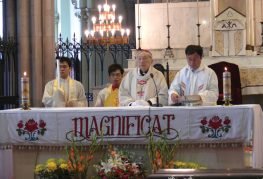
With both humanist insight and historical precision, Paul P. Mariani shows how Bishop Louis Jin Luxian was, above all, a Jesuit of his time.
-

As an attempt to preserve what is gone, Shen Fu’s writing endures as a reminder to treasure what we still have and what we will someday mourn.
- Tags: China, Issue 41, Joseph Torigian, Martin Laflamme, Xi Zhongxun