

Beyond Geopolitics: The Philippines in the New Marcos Era
Edited by Cleo Anne A. Calimbahim and Björn Dressel
ISEAS – Yusof Ishak Institute: 2026
.
When I need to explain the collapse of the ‘UniTeam’ alliance between President Ferdinand “Bongbong” Marcos Jr and his vice-president, Sara Duterte, I like to use a—ahem—highly sophisticated political paradigm of ‘Team Kadiliman (Darkness) versus Team Kasamaan (Evil)’. The reference is to a video of a hapless Harry Roque, the former Rodrigo Duterte spokesperson and current fugitive, rallying his former boss’s supporters outside Congress. In the clip, he says, in Filipino, that the battle is no longer between the Dutertes and the Marcoses. Instead, he goes, “it’s a fight between the forces of darkness versus the forces of…?” He pauses expectantly.
“Evil!” the crowd shouts innocently.
“The forces of good!” he corrects them.
To my delight, Carmel V. Abao references the same viral video in her chapter, ‘The Marcos Jr. Administration: From Populism to Reformism?’, in , edited by Cleo Anne A. Calimbahin and Björn Dressel. Abao recounts the twists and turns of Marcos Jr’s presidency until the midterms in 2025, helping readers navigate the workings of these fractious elite coalitions.
Being a Singapore government think tank, the tends to publish on relatively timely issues, quickly. For example, they published Games, Changes and Fears: The Philippines from Duterte to Marcos Jr.—on the transition from Duterte to Marcos Jr—in 2024, just two years after the presidential election. Drawing on the expertise of mainly academics, Beyond Geopolitics serves a middle audience sandwiched between the needs of political operators, who need analysis fresh out of the news cycle, and historians, who are utterly unhurried and probably wouldn’t mind waiting a few decades for proper perspective. Taken together, the book helps make sense of developments in the past years and months across different fields, helpful for watchers of Philippine politics to fill gaps in their knowledge of major issues. It’s a hefty eighteen-chapter collection, so there’s practically something for everyone.
Jan Carlo Punongbayan tells us about the economy at midterm: plummeting growth, weak consumption, inflationary pressure on food and energy, slow investment. He’d written a book dispelling economic myths about the administration of Ferdinand Marcos Sr—the ousted dictator and father of the current president—so he also shows us signs of “Marcosian” rehabilitation like Kadiwa stores, Masagana rice self-sufficiency, and, crucially, the Maharlika Investment Fund, evoking programmes and ideas from the dictatorship. His chapter ties in with others that do deep dives into subjects like agriculture and infrastructure. There’s a chapter on development challenges in the Bangsamoro Autonomous Region in Muslim Mindanao (BARMM) written by Acram Latiph, a good reference on the region as it goes into a long-awaited election this September. Weena Gera, meanwhile, writes an illuminating chapter on the Mandanas-Garcia ruling of the Supreme Court that expanded the base for local governments’ share of revenues to include all national taxes. She argues that decentralisation, including Marcos’s current inclinations, fails to follow the maxim “finance follows function” and risks further dysfunction in providing local services. Many of these chapters offer policy recommendations that are evidence-based and well reasoned.
I enjoyed the cluster of chapters around the notion of Philippine politics being oligarchic in nature. What better way to enjoy the national soap opera than tales of cutthroat sibling rivalry? Athena Charanne Presto’s chapter on Marcos and his sister, Senator Imee Marcos, lays out the differences in their temperaments, talents, and strategies. Not enough is written about the Marcoses in their father’s bailiwick of Ilocos Norte, and this is where her work is quite revelatory. For example, the absenteeism and party boy image of Marcos Jr as president was already evident in abundance when he was the provincial governor. Snide remarks about the son not having the political acumen of the father were already being made about Junior when he was in local politics. As their father lamented in his private diaries, Imee inherited his intellect and—foreshadowing sentiments of Bongbong’s failings—he’d even written, “I wish she had been a boy.”[1]
The Philippine political lexicon is endlessly amusing. “Cha Cha”, in this vernacular, means “charter change”, shorthand for repeated attempts since the fall of dictatorship in 1986 to revise the 1987 Constitution, promulgated under President Corazon Aquino. Thereafter, any president whose surname wasn’t Aquino (her son, Benigno “Noynoy” Aquino III, was president from 2010 to 2016) has tried to do things like remove term limits that ensure elected officials—especially the president—don’t overstay their welcome. The Cha Cha chapter in the oligarchy section, written by Cristina Regina Bonoan and Dressel, sifts through these various attempts to show how oligarchic competition helps explain this stasis: one side pushes away hurdles for them to remain in power while the other keeps them firmly in place in order to gain office. It’s a dance that repeats itself every election.
Beyond Geopolitics is chock-full of horrifying facts about the country. Kristian Karlo Saguin’s chapter on energy transition, for instance, tells us that the country was less reliant on fossil fuels for energy in 2003 than it was in 2023! Given the socioeconomic conditions in the Philippines, the development of renewable energy has been marred by cases of land conflict, land grabs, and negative impacts on the environment. He notes the encroachment of solar and wind power installations on ancestral domains of indigenous peoples in Ilocos Norte and on arable land in Aklan, as well as on fishing in Laguna Lake. He writes that “the energy transition, therefore, creates new conflicts within existing agrarian and rural configurations”.
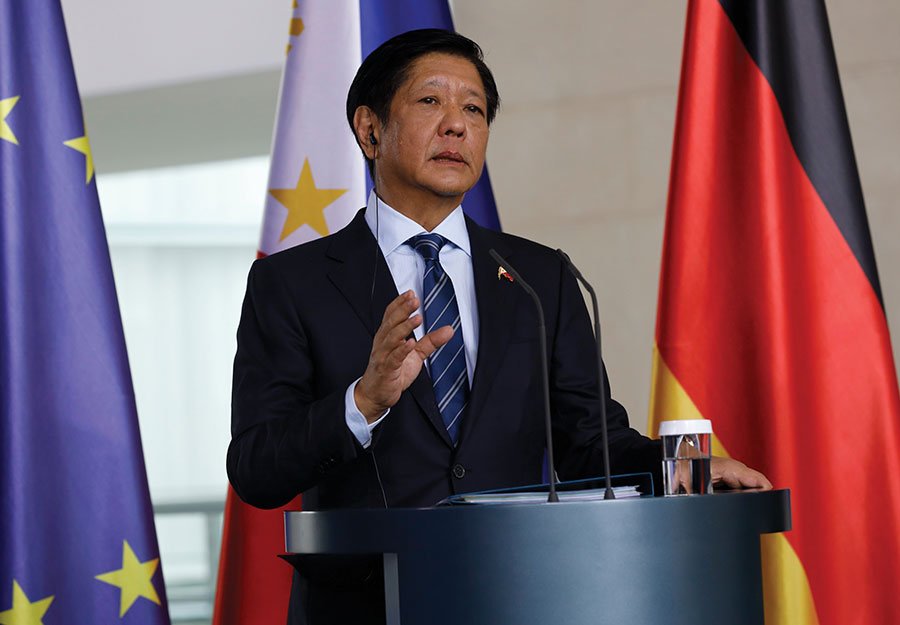
The journalist Marites Dañguilan Vitug, who co-wrote the book Unrequited Love: Duterte’s China Embrace, extends the tongue-in-cheek romance metaphor in the chapter ‘Love in the Time of Geopolitics: After Duterte, Marcos Gets Out of China’s Embrace’. She writes that Russia’s invasion of Ukraine influenced Marcos Jr’s “pro-Western” stance. The Philippines has since granted the US access to four military bases. Marcos Jr has also presided over the largest joint military exercises with the Americans, and expanded bilateral security arrangements with countries like Canada, France, New Zealand, and South Korea.
As a political violence scholar working with Michael D. Pante and others advocating for a renewed peace process, I read his chapter on historical distortion, fake news, and red-tagging with interest. ‘Red-tagging’ refers to the vilification of individuals or groups with accusations of being communists. It’s perfectly legal to be a communist in the Philippines, but the implication is that communists are part of the New People’s Army (NPA), the armed wing of the Communist Party of the Philippines—or are, at the very least, sympathisers of their cause—and should therefore be treated like enemies of the state. As Pante notes, red-tagging has had lethal consequences: red-tagged activists, students, teachers, community organisers, and others have been victims of extrajudicial killings and forced disappearances. Pante argues that such tactics of vilification, as well as the spread of disinformation, have continued from the Duterte government to the Marcos Jr administration. He also shows how the present government, seeking to distinguish itself, has created myths of non-violence—a narrative of being “bloodless” in its anti-crime or security policies, despite the reality of persistent violence.
Beyond Geopolitics is a good guide to the first half of the Marcos Jr administration. The crazy second half—just Google the terms “Senate”, “shooting”, and “Philippines”—could not really have been predicted by the authors. Still, much of what is contained in this volume on corruption, political dynasties, elite competition, and debilitated institutions helps to explain present circumstances.
[1] https://opinion.inquirer.net/149137/bbm-through-his-fathers-eyes

More from Mekong Review
-

Poetry from Lawdenmarc Decamora
-

A poem by Alyza Taguilaso
-
Poetry from Tilde Acuña