

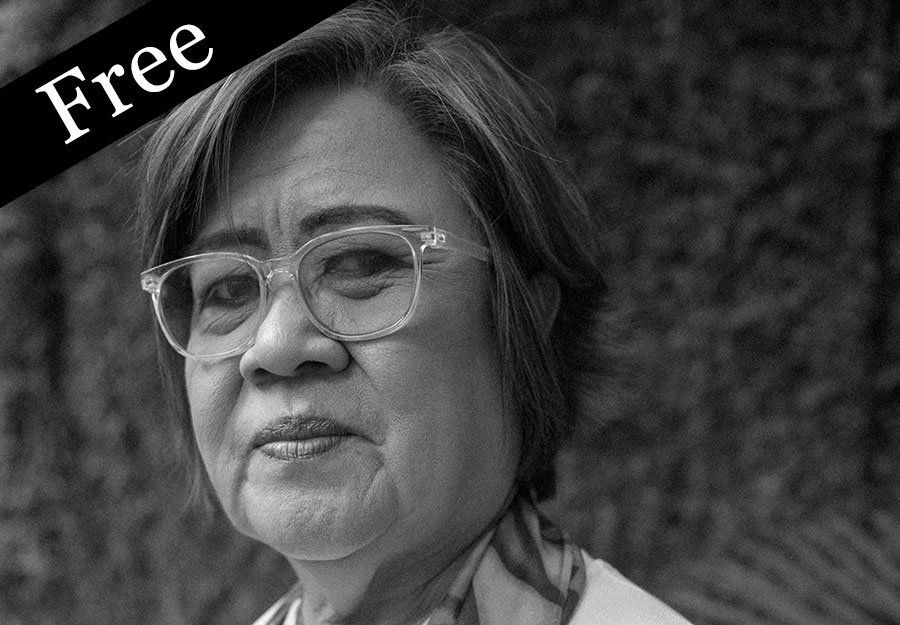

In the world of politics she never dreamt of entering, there seems to be an invisible pull that always draws Leila de Lima back in. After seven years in jail—on drug charges widely condemned as fabricated under former president Rodrigo Duterte—the sixty-five-year-old came forward as the lead nominee of the new Mamamayang Liberal (ML) party-list and won a seat in the Philippine Congress in the May elections.
Once an election lawyer handling technical voting disputes, De Lima has been repeatedly propelled into roles she’d never sought: chair of the Commission on Human Rights, Justice Secretary, and senator. From those posts, she became one of Duterte’s fiercest critics, probing his so-called Davao Death Squad and denouncing his bloody war on drugs, which left thousands dead during his presidency. Her outspokenness landed her on the strongman’s bad side… and in prison.
Now, barely two years after reclaiming her freedom, De Lima is again right back in the thick of things, being trolled and targeted, but unwavering in her resolve. Despite the political sensitivity, she agreed to join the prosecution panel to impeach Vice-President Sara Duterte for allegedly misusing public funds and threatening to assassinate President Ferdinand “Bongbong” Marcos Jr. “No one is supposed to be above the law and no one is supposed to be exempt from accountability,” she told Mekong Review in June.
The impeachment trial was ultimately blocked by the Philippine Supreme Court in July, but there’s still plenty to keep De Lima busy. Returning to politics, she says, is the only choice if she wants to keep fighting for justice, the rule of law, and truth.
How has life been since the House of Representatives elections, and what was the journey like leading your new party-list?
It was very exhausting. It was challenging. Initially, our party-list, Mamamayang Liberal (Liberal Citizen), was actually struggling because it’s the first time that we’d participated as a party-list organisation. Since it’s a new party, there was very little awareness about it. In fact, we were always at the fringes of the surveys; it was always less than 1 per cent in the pre-election surveys. We went along for the ninety-day campaign period [and] the awareness gradually increased.
My colleagues in the Liberal Party convinced me to be [ML’s] lead nominee. But one other challenge was how to connect me, my name, to ML. Because some people thought I was running for the Senate. They would probably look for my name on the ballot [instead of ML].
It was really an uphill battle for us. We had very meagre resources. We [couldn’t] even afford TV ads; just a few radio ads. And then… we made it! Although I’m still a little sad because we were aiming for three seats, because I would have wanted my two other co-nominees to also have obtained seats. Still, for a first-timer party-list, it was already a good showing.
Did you hesitate before saying yes? Why did you ultimately return to politics?
When I was released, my plan was really just to go back to [legal] practice and also to teaching, so there was hesitance on my part. Would I again be living a public life? Where you’re the centre of everything—including the bashing, all of the bashing? I’ve been vilified, extremely vilified, especially by trolls. If I returned to public life, then I was sure I’d be targeted again.
My attitude has always been to ignore [the trolls]. Never to engage with them. It’s not worth my time, my effort, and my energy. And then I’m also thinking that no matter what you say or no matter what you do, you’ll always be a target. They’re unreasonable and they’re just closed‑minded already. They’ve been brainwashed and they’re paid—the trolls are paid. So what’s the point of dealing with them when I could focus on the more essential matters?
First, [people] were encouraging me to run for the Senate. I immediately said no. I wasn’t prepared to run for the Senate because I don’t have the resources. And I just didn’t feel like joining the Senate [again]. But when ML was accredited, my fellow Liberal Party colleagues talked to me again, and I asked for time to reflect on it. After consultations and mulling over it, I finally decided to say yes. Because this could be a platform.
You can always, of course, push for your advocacies even if you’re just a citizen. But then your platform or exposure will be very limited. I needed a platform to continue fighting for the causes that I’ve been fighting all these years—which landed me in jail. You know, especially human rights, justice, rule of law, democracy, and sovereignty. I thought that this would be a good platform. Especially since we’d be representing marginalised sectors. There are so many issues affecting marginalised sectors: women, youth, farmers, fisherfolks, labourers or workers, Indigenous people, the urban poor, LGBTQ+, persons with disabilities, and senior citizens.
What kind of politician do you intend to be?
I don’t make compromises. No matter what the cost. That’s just who I am.
My father knew that about me. I remember quite clearly when my father was about to die. He had colon cancer and, two weeks before he passed away [in 2012], he told me, “If you have other plans to join public service, to stay in public service after your stint at the Department of Justice—please, if you can avoid it, avoid entering politics.” That’s what he said. Because he told me, “I know you. You might get hurt in politics.”
What he meant was that he knew I see very clearly what’s black and what’s white. He knew that I don’t play games, especially in politics. I don’t do wheeling and dealing.
That’s exactly how I intend to be as a politician. To stay true to what’s right, to keep fighting for human rights and justice, and to hold on to those values even if politics often pushes you to bend. I’ll still be the same in my resolve and in my determination to always fight for the right causes. But because this is a party-list, I also have to prioritise the legislative agenda of these sectors [that we pledged to represent].
In terms of fighting disinformation, I’m thinking of a bill where we can sanction or penalise troll farms. It’s a tricky thing. If you target individual fake news peddlers, sometimes there’s a blurred line as to what falls within protected free speech—the constitutional protection of free speech—and then also asserting your rights as a victim of disinformation. It requires more study, actually, on how to regulate when it comes to individual fake news purveyors. But the troll farms, these are actually business entities; they have clients that they cater to, who pay them to do all the ‘black propaganda’. So that can easily be subjected to regulation and sanctions.
While I’m still uncertain about the exact level of regulation for individual fake news purveyors, like bloggers, right now they’re covered by cyber libel [laws]. I want something stronger than that, but will not infringe on the constitutional right to free expression.
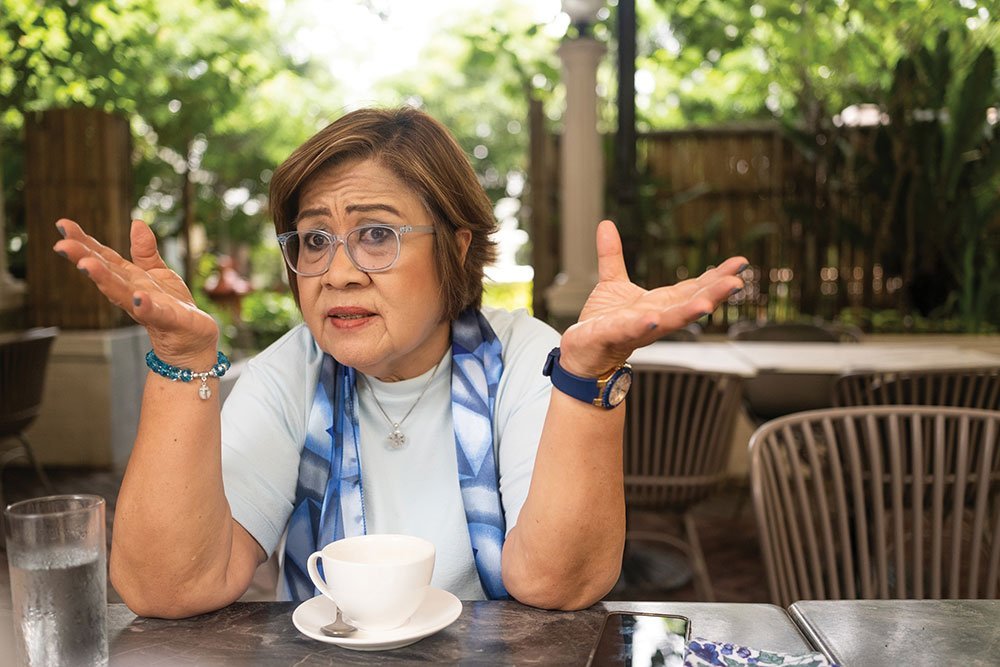
Let’s walk down memory lane: How did you go from being an election lawyer to chair of the Commission on Human Rights (CHR), Department of Justice (DOJ) secretary, senator, and now back in Congress?
I never planned my career trajectory. I was an election law practitioner. In fact, before, I was the only female election law practitioner. But then former president Gloria Macapagal-Arroyo offered me to become the CHR chairperson. I even questioned her motive, because I didn’t know her, really—only as the president. And I used to criticise her even when I was an election law practitioner!
But she convinced me to be the chairperson. We had a one-on-one before I accepted it. I asked her straight, “Why me? You know that I’m not into human rights. You know that I’m an election law practitioner.” I had a very limited exposure to human rights; I knew only what I’d read from the newspaper.
And then she said something… actually, these were her exact words: “I want you to be the face of human rights in the country. I know that you would be a good chairperson of the Commission on Human Rights. Because, you see, our country now suffers internationally from image. We have a negative image internationally because of two issues: corruption and human rights.”
Even with some doubts about the real motivation of President Macapagal-Arroyo, I said yes after I consulted my father. But he was also in disbelief that that was being offered to me by the president.
When I became the CHR chairperson, I immediately learnt to love it. I learnt fast about human rights, and I learnt to appreciate it and love human rights. It was such a fulfilling task.
After about only two years as chairperson—my term was supposed to be for seven years, from 2008 to 2015—that was the time when the Maguindanao Massacre [where fifty-eight victims, including more than thirty journalists, were killed on the way to file a certificate of candidacy for the upcoming Maguindanao gubernatorial election] happened. So we had to investigate that.
Then there was our investigation into the Davao Death Squad. That’s where I and the former president [Duterte] started—because I dared investigate the death squad killings right there in his territory. The CHR went there for a series of public inquiries.
In 2010, when President Benigno Aquino III became president, he offered me [the justice secretary position]. I never applied for it; I never applied for CHR, I never applied for the DOJ secretary. Again, he summoned me. Again, we had a one-on-one. I thought I was just part of a shortlist and that was just an interview. And then, all of a sudden, he was talking about my security: “You know, next to mine, your position as DOJ secretary would have the most security risk.”
So I said, “Are you telling me I’m now your choice?”
“Yes, didn’t anybody tell you that? You’re my choice.”
You’ve had a long and bitter history with Rodrigo Duterte, from confronting him as CHR chair to spending seven years in jail because of him. Did you ever expect things to go that far?
Yes and no. Yes, of course, he couldn’t forget and forgive me, because I incurred his ire. But no, because I thought it was just going to be regular vilification, you know, smear campaigns. You know how it was then. Every opportunity—even his public speeches—he would always inject me [into them], calling me names and all. There was even this “you will rot in jail” or something like that. But I never thought that he would go to that extent, filing those manufactured cases and jailing me.
I thought it was just going to be regular vilification, demonisation, so when the charges were filed, I was in disbelief and I was actually enraged. How could he do this? He knows that I have nothing to do with the illegal drug trade. But he used people, he coerced witnesses, they manufactured those. They were all testimonial evidence, no corroborative evidence. I didn’t expect him to go to that extent.
Although, two months before I was arrested—I was arrested in February 2017—in December 2016, I was a senator already. I went to the US first, it was a short trip, and then I went to Berlin and spoke at a human rights forum. And on the sidelines were two foreign groups. I won’t tell you who they were, what countries. Two foreign groups talked to me separately, and they were telling me that they had information that I was going to be arrested and charges would be filed against me.
I graciously declined [offers of asylum]. Because I was thinking, oh no… First, I can’t imagine myself being in a foreign country indefinitely. And second, would people say I’m guilty? There’s a saying that flight is indicative of guilt. I wanted to confront those charges. But I was still in disbelief. I didn’t really expect that I would be arrested… until it happened.
Why is accountability and justice still at the heart of everything you do?
I’m just being consistent with what I’ve been fighting for. You can trace my life as CHR chair, DOJ secretary, and then ultimately as senator. I’ve always been fighting for truth, justice, and accountability. So any issue that centres on those, that involves those values of truth, justice, and accountability—I cannot help myself. Because I know that I have a voice. Even if I tend to be controversial at times, I know that, deep within me, I’m fighting for what is right and just.
I feel that our society now really needs voices, because of the proliferation of fake news and disinformation. It’s really massive. If you don’t counter those false narratives about issues—not about me personally, because I don’t care what they think about me—about national issues, for example, the arrest of the former president… you know how it is. The trolls, the disinformation were on hyper mode. Saying that [Duterte, who was arrested in March 2025 under an International Criminal Court (ICC) warrant] was kidnapped, that the arrest was illegal. They were even targeting the judges of the pre-trial chamber of the ICC.
I actually said in a previous interview: How come the [Ferdinand Marcos Jr] administration did not prepare on the communication side and try to counter all the false narratives about the validity or invalidity of the arrest? They should have prepared for that. They were prepared to arrest the former president when he arrived from Hong Kong. But how come they left out the communication side?
What keeps you going—through prison, vilification, and loss?
Inside prison, I was already doing a lot of reflection and introspection. There was moral and spiritual strengthening on my part. So, in a way, I was already thinking about a lot of things. I was also observing the situation, the national situation.
I had no cell phone for almost seven years—no cell phone, no access to the internet, no electronic gadgets whatsoever, no TV, no radio. But at least they supplied daily newspapers: the Philippine Daily Inquirer and the Philippine Star. So I was updated. I was monitoring those. From time to time, I’d issue handwritten dispatches.
There were also books: a combination of political novels, spiritual things, and even romance. My visitors would either bring me food, books, or rosaries. That was before the pandemic. After the pandemic, it became stricter.
Prison actually made me more prayerful. That was one of the blessings of detention. It became part of my strict daily routine: to pray the Holy Rosary, to read the Bible, to make reflections. Every single day. That grounded me. Even now, I carry those routines. I still pray every day. I include everything in my daily prayers now—for protection, for guidance, for strength.
Physically, I try to walk. When I was first released, I would do morning walks in the subdivision. The campaign disrupted that, but I still tried.
I have two grandchildren now. I remind myself I have to stay strong for them. And maybe because of what I went through, I have enough strength to confront further challenges.
I’m sixty-five. I’m a grandmother. And still, I feel strong enough to face what comes next.

More from Mekong Review
-

Poetry from Lawdenmarc Decamora
-

A poem by Alyza Taguilaso
-
Poetry from Tilde Acuña
- Tags: Aie Balagtas See, Issue 41, Leila de Lima, Philippines
