

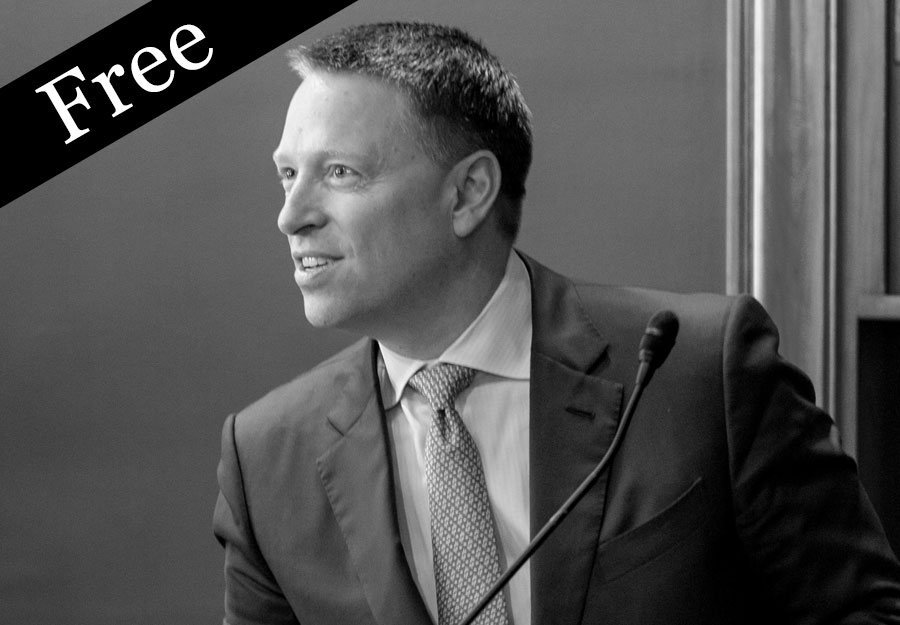
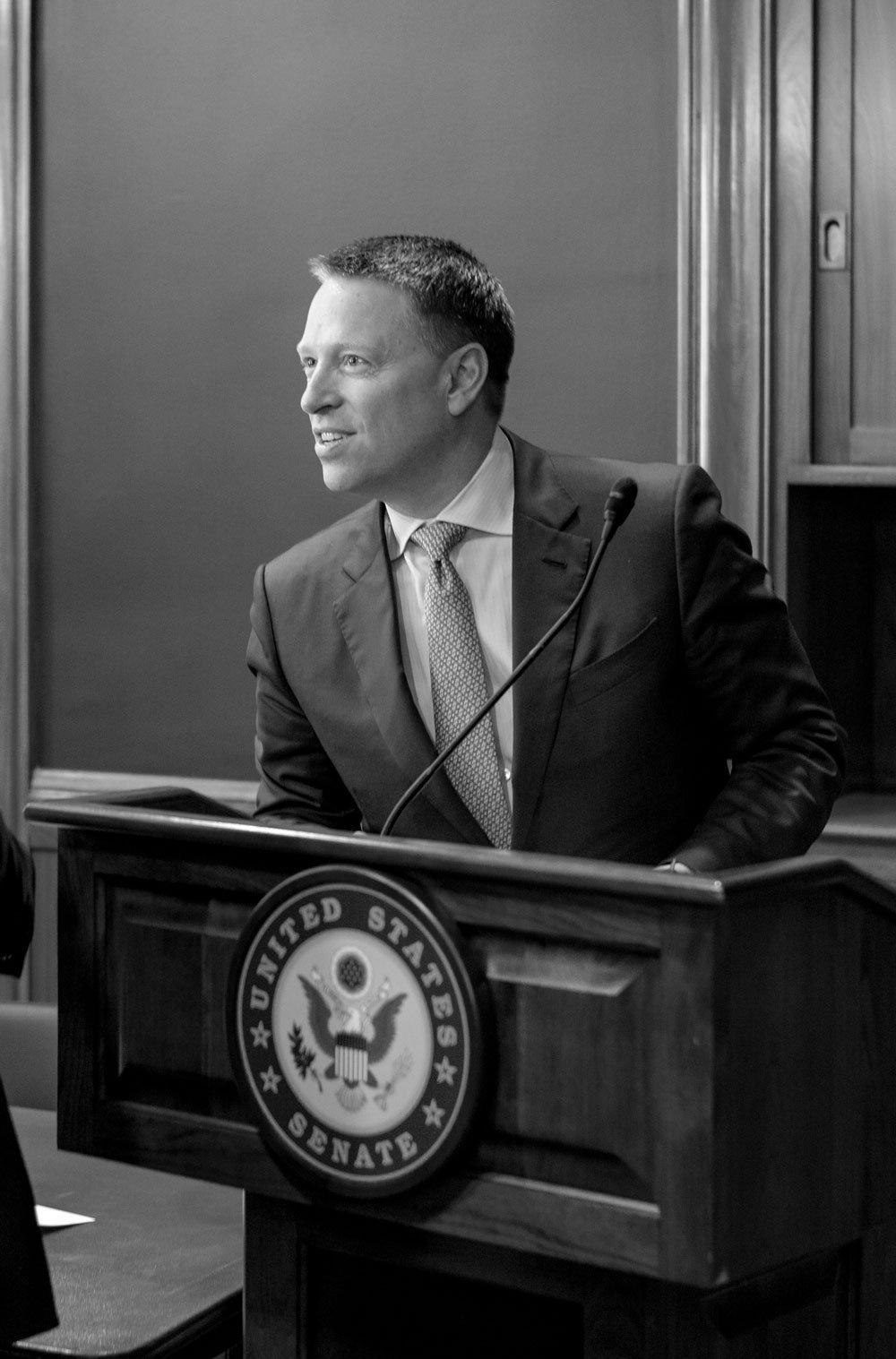
Matt Pottinger doesn’t much like the term “China hawk”. Even so, he’s become one of the most prominent voices in the United States associated with the term, pushing for a tougher line against Beijing, both inside its government and in the public square.
Under President Donald Trump, Pottinger held a series of influential roles as a White House advisor on Asia policy and was widely credited with pushing forward a range of measures to bolster the US military and push back against the rising power of China’s President Xi Jinping. Amid the tumult of Trump’s period in office, he won respect as a steadying, competent influence—helped along by his decision to resign in disgust in the aftermath of the rioting that hit the US Capitol building on 6 January 2021.
Unlike many in the US who criticise China, Pottinger’s hardline views are informed by a deep knowledge of the country. A fluent Mandarin speaker, he worked in China as a journalist for Reuters and the Wall Street Journal from 1993 to 2001. Living variously in Beijing, Shanghai and Hong Kong, his time there began during a period of optimism about Sino-American ties, albeit one that dimmed rapidly over the decades that followed.
In the aftermath of the attacks on 11 September 2001, at the late age of thirty-two, Pottinger signed up to join the US Marines, serving several tours as an intelligence officer in both Iraq and Afghanistan. After leaving the military, he returned to focus on China, both as a business advisor and think tank researcher, and signed on with Trump’s team after the 2016 election.
Pottinger worked mostly behind the scenes during his time in government. He made only occasional public appearances, most notably at a 4 May 2020 virtual symposium where he delivered, in Mandarin, a controversial public address to the Chinese people. The date was provocative: the anniversary of China’s May Fourth Movement, an anti-imperialist campaign in 1919 often cited by Chinese advocates for greater democracy. Pottinger in effect encouraged China’s population to revolt against their own government once again. His video was viewed more than a million times, angering authorities in Beijing.
In Washington, there’s now plenty of speculation that Pottinger might seek to re-enter government if Trump prevails in November’s election—a prospect upon which he declines to comment.
In the meantime, he has written and edited his first book, The Boiling Moat: Urgent Steps to Defend Taiwan. The title comes from a quote in The Book of Han, a work of classical Chinese history covering the period from 206 BC to 25 AD: “Cities along the frontier must resolutely fortify their defenses; protected by metal ramparts and boiling moats, they become impregnable.” As Pottinger argues in his own book’s introduction: “Taiwan, the United States, and key US allies should embrace a ‘boiling moat strategy.’ The Chinese military’s center of gravity in a Taiwan war would be its naval forces. The Taiwan Strait would be its graveyard.”
Let’s start at the beginning. How did you end up in China in the first place?
I was at one of the rare high schools in the 1980s in the US that taught Chinese, so I got to study the language in the late 1980s. I had even planned on doing a summer exchange programme in Beijing at a high school but our trip got cancelled because of the Tiananmen Square massacre. I subscribed to my first newspaper as a high school student because of those events in the spring of 1989. That probably planted the seeds of interest in journalism at the same time.
When did you arrive in Beijing? And did you have fluent Mandarin by then?
I had serviceable Mandarin when I showed up in Beijing to study as an exchange student in college in 1993. I later studied in Taiwan for an academic year, after I finished college, and I got hired by Reuters news agency in Beijing.
Did you start out then as a fan of engagement with China?
I would have counted myself as an optimist in the 1990s. President Bill Clinton had just visited Beijing in the summer of 1998. The economy was liberalising. People had more basic freedoms to travel where they wanted, to marry whoever they wanted and also to travel abroad. It felt like a very optimistic period for China and for the Chinese people. The US relationship with China was never horrific, but it was definitely much more cooperative in the late 1990s than it would end up being in the years that followed.
I don’t think there was a specific moment when all that changed. But I do recall that during my reporting, all the way through 2005, it looked to me as though some of the reforms that had preceded China’s entry into the World Trade Organization were stalling out. In other words, a lot of what it had promised did not come to fruition after Beijing acquired access to Europe and the US and other major economies around the world. The party was showing dogged determination to maintain its monopoly on control in ways that were sometimes stark and bracing. Sometimes I saw this from my own run-ins with the security apparatus because of the stories I was writing, covering corruption stories out in the hinterland. I had more than one run-in; it was usually corrupt local officials who were able to use the police to rough up local people, jail local people and intimidate journalists who were coming to look [at what they were doing].
Were there any books that influenced your thinking?
One that really grabbed me was James Mann’s book, The China Fantasy. I read it in Okinawa as a Marine preparing to go on a combat deployment and it was the most prescient set of insights about how China was not going to liberalise in the way the US hoped. He was criticised for the book, but I can’t imagine anyone would dare criticise that book today.
I thought Prisoner of the State: The Secret Journal of Premier Zhao Ziyang was quite revealing too. It showed that the party’s determination to maintain its monopoly on power was ironclad even through the Deng Xiaoping and Hu Jintao years. I also read books by Perry Link. His Evening Chats in Beijing I read as a student and then reread again as a journalist. He wrote a terrific book on the Chinese language as well. I’ve stayed in touch with Perry after he ran one of the language programmes that I had the privilege of attending as a college student one summer in Beijing in 1994. There were both foreign and Chinese writers, some of whom you might call dissidents or independent-minded thinkers who had an impact.
You now are often described as a China “hawk”. Is that a title that you’re comfortable with?
The only problem with the term ‘hawk’ is that it seems to imply sort of a warlike inclination. I fought in two wars on three combat deployments. I’m the last person who would want to increase the odds of the US having to engage in a war again. I think it’s a much more realistic position that believes that peace comes through strength and that you’re less likely to fight wars when you’re strong. I don’t mind the term ‘hardliner’. I don’t think that appeasing the Chinese Communist Party is serving us well. I think détente is exactly the wrong kind of policy to pursue right now vis-à-vis the Chinese Communist Party.
When did your views on China begin to change?
While I was in the Marine Corps, I wasn’t really dealing with the China problem. I was in Afghanistan twice. When I came back I started a business, when I moved to New York City, that was doing investigative research about China. I started to travel back to China again. And I was struck by how it was a much less optimistic place. There was a sense that it was more corrupt, that security forces could be used by local business interests and by local officials to go after their personal enemies or to seek retribution against journalists or against people doing research. And that was before Xi Jinping stepped into the role of what would eventually become a dictator.
Tell us about The Boiling Moat. You’ve written policy reports before, but this is your first book?
It describes the urgent steps that I believe Taiwan, Japan, the US, Australia and Europe need to take to maximise our odds of deterring what would be a catastrophic conflict. It describes Xi Jinping’s own statements about Taiwan. When you see them in aggregate, it gets a lot harder to think that he’s simply reacting to events. It’s much clearer that he’s the protagonist driving events not only in the Taiwan Strait but also in places far from Taiwan, like Ukraine and the Middle East and Venezuela.
The book deals with what the consequences would be if Taiwan were to be coercively annexed and addresses, maybe quite provocatively, what I believe history has shown to be myths around what provokes wars. It takes a pointed view that our fear of provoking a war is, paradoxically, making war more likely because it’s signalling weakness. I also have co-authors who contributed to the book, who contributed chapters which I edited, about what Taiwan needs to do, as well as what Japan and Australia and Europe need to do.
Ultimately, it’s very much military focused. We don’t go into the diplomatic and economic measures that we should be taking to deter China, not because they’re not important, but because we don’t think they have any chance of succeeding if they’re not built on the strong foundation of hard power.
In Asia, there’s a sense that the US has become much more hardline on China. How do you find your argument being received domestically?
I think that there are some interesting cross-currents right now in US politics. One is a sense of defeatism that has creeped into parts of the Democratic Party and even parts of the Republican party. I don’t think these are always mainstream views, but they say we can’t possibly increase our defence spending anymore because Americans are tired and that we simply must aim for a modus vivendi with Beijing. But that doesn’t take into account Beijing’s strategy and its stated goals, which have nothing to do with a nice comfortable balance of power. They are seeking to really remake the globe in a way that is amenable to autocracy and more dangerous for democracy. I do address some of those views in this book; it’s one of the reasons I wrote the book.
If the US does nothing, what’s your central scenario? Do you think China is going to invade Taiwan?
I don’t pretend to know when Xi Jinping would push the situation to a boiling point. What I do know is that he is overseeing the largest peacetime military buildup since the Nazis in the 1930s. He has said repeatedly that he intends to solve the Taiwan question. He told President Biden last fall that peace is all well and good but, at some point, this needs to be solved. And he says that the United States must support Beijing’s decision in effectively overturning the peaceful status quo and forcing Taiwan to submit to communist party rule. When discussing the dynamics surrounding Taiwan today, Beijing is already waging what it would call the “three warfares”: legal warfare, psychological warfare and public discourse warfare, which is information warfare that’s designed to create a sense of futility, a sense of cynicism about democracy, a sense that resistance is futile.
So the war, from Beijing’s perspective, has already started. They’re not yet using kinetic warfare. There are several more steps they could take short of that, including a quarantine of the island. They are building up to doing what I would call a “flash quarantine”, which would be a short-term quarantine to prove or demonstrate that they can exert jurisdiction over Taiwan’s near shore waters. Then they could, over time, decide to impose a much broader quarantine or even a blockade, which is technically an act of war. That said, I don’t think a full-blown blockade is likely until Beijing is ready to wage a full-blown war.

You’ve said that your view on the current balance of power in East Asia is informed by US military history. Can you say why?
I think it came from reading the history of World War II. You’ll notice that in the second chapter of The Boiling Moat, I quote General Douglas MacArthur, who commanded the Southwest Pacific Theatre in World War II. He had strong views about the island that was then called Formosa, now Taiwan, and its importance in the chain of islands off the coast of China.
MacArthur’s view was that a hostile government controlling those islands would basically render America’s defensive posture untenable in places like the Japanese island of Okinawa and in the Philippines. So geography matters. It matters still today. But, on Taiwan, it’s also about the future of democracy in that region and it’s about Taiwan as a major source of our economic wealth, given its role in producing semiconductors.
It’s at least possible that former President Trump will be reelected in November. You worked for him. What are his instincts on China? What could we expect from a second Trump administration?
I can’t speak for him or his campaign. What I can say is that, over the course of his first term in office, he became much more concerned about the consequences of a coerced annexation of Taiwan. I think he understands that this is a serious risk not only to US national security, but also to our prosperity. And so I’m hopeful that his policy, if he gets reelected, reflects what an important priority deterrence of Beijing is.
You wrote an article earlier this year which called for the US to seek “victory” over China. Many people viewed this as, in effect, a call for regime change in Beijing. Can you explain that?
This is not an argument for regime change or subversion. What we did say was that success or victory would be, first and foremost, persuading Beijing that there’s no way Beijing can win a hot war or a cold war against the United States and our allies. That’s the main theme of what would constitute victory.
We also say that if the Chinese people themselves are inspired to seek new forms of governance that are not wholly repressive at home and not compulsively hostile abroad, that should be something that the US should welcome and not fear. That’s the same view that George Kennan had at the outset of the Cold War against the Soviets. It’s the same view that the Truman doctrine held. It’s the same view, if you draw a line, all the way to the Reagan administration. It’s the same view that President Reagan personally held and that his advisors, who wrote his Cold War winning strategies, held. So claims that this is a call for regime change are an effort to divert attention from our core arguments.
What do you say to people, in regions like Southeast Asia, who might view these as bellicose arguments that risk dragging the region into a war with China?
I’d say I’m not bellicose. My views are designed to prevent war, not to invite miscalculation by Beijing. I want Beijing to be crystal clear on where the US stands. I want them to be crystal clear that we have the capacity to win a war over Taiwan and that we have, well within our grasp, the means to improve our capacity relative to Beijing in terms of the military balance.
When I talk to friends in Southeast Asia, none of them view the US as the actor that’s trying to change the status quo in dangerous ways. The thing that Southeast Asians worry about most is whether the US is going to abandon Southeast Asia. The US is a status quo power that wants to maintain peace. Beijing is a dynamic, non-status quo power that wants to remake the region under a new Chinese hegemony.

More from Mekong Review
-

Creating Feeding Ghosts, a graphic memoir, was the only way Tessa Hulls could think of to repair her relationship with her mother and make sense of the responsibilities borne by each generation.
-

A poem from Eileen Chong
-
Poetry by Ghojimuhemmed Muhemmed
