

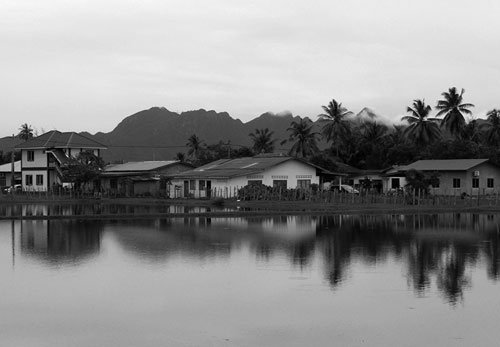
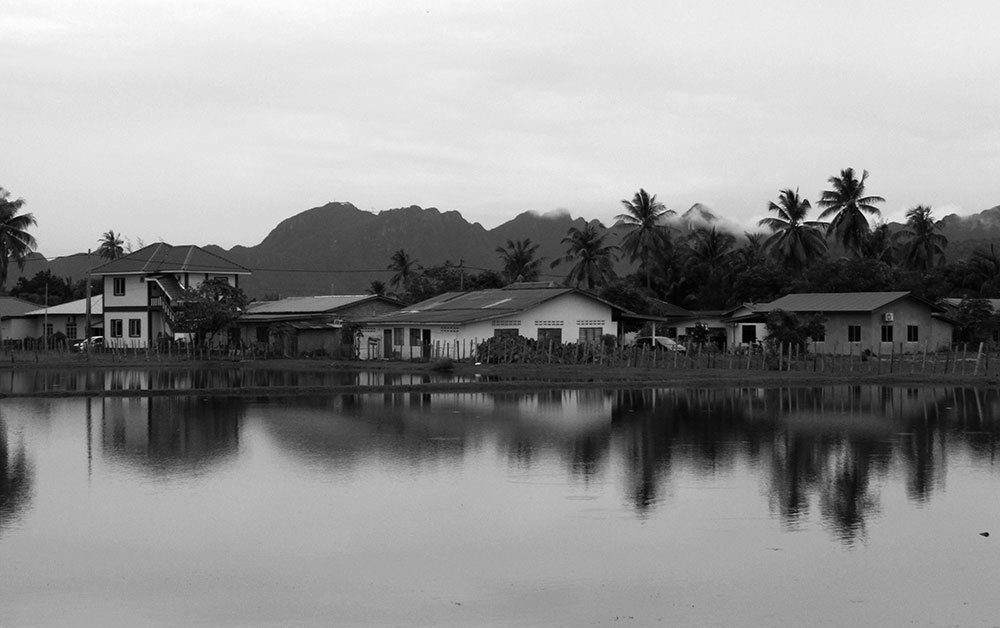
You know you’ve been in the kampung a long time when you think, Oh, she’s pregnant again, when looking at one of the neighbour’s buffaloes. I live on the eponymous main island of the Langkawi archipelago, an hour and a half’s boat ride off the northwestern coast of peninsular Malaysia. My neighbourhood is resolutely rural, the poorly maintained roads barely wide enough for a single car. Not that there’s much traffic. Hours can go by with only a few motorcycles buzzing past. When they do, practically none of the drivers wear helmets. More often than not they carry multiple passengers. As in many places in Asia, it’s not unusual to see a family of four or five improbably perched on the same motorbike. The women wear headscarves, almost without exception. Increasingly the younger women cover their faces as well. Some of the men still wear the traditional sarongs, but the international uniform of jeans and a T-shirt is more common.
There are barely a dozen houses along the road where I live. Animals outnumber people, by far. One neighbour keeps goats, their cloven hooves clomping against the planked floor of a stilted ramshackle wooden structure, the ground below it pungent and generously fertilised. The goats seem to subsist entirely on the sugar cane harvested from the small plot of land behind the goat shed. I wonder if this diet imparts a unique flavour to the meat, something similar to the manner in which Spaniards feed certain pigs uniquely on acorns, or ancient Romans once force-fed geese with sweet ripened figs. I can’t help considering heightened insulin levels, the incidence of diabetes in goats.
Free-range chickens roam the neighbourhood, singly or in small gangs. If the roosters weren’t so common, the shimmering copper and purples and blues of their proud feathers catching the morning light would draw gasps from the hordes of khaki-clad birdwatchers who flock to Langkawi with their massive telephoto lenses. In the fields by my house there are herons and egrets and red-wattled lapwings. Brahminy kites wheel high overhead. Beady-eyed kingfishers perch on fence posts, then dart away cackling in electric-blue flashes. Wintering whistling ducks haunt the flooded paddy fields. Spooked, they rise flapping, issuing the call that gives them their name, circling the field before settling down again. There are rusty-winged, red-eyed coucals; green-tinged, long-beaked bee-eaters; bright-yellow orioles wearing black bandit masks; and near-invisible koels screaming their melancholic two-tone tune. A few weeks ago I spent an hour, perhaps longer, watching baya weavers busily braiding and sewing strands of grass together with their beaks, constructing the complicated tubes of their inverted, dangling nests.
More from Mekong Review
-

A poem by Aiden Heung
-
A towel for all times
-

Navigating language in Malaysian fiction
- Tags: Issue 16, Langkawi, Malaysia, Marc de Faoite