

Angkor: Exploring Cambodia’s Sacred City
Theresa McCullough, Stephen A. Murphy, Pierre Baptiste and Thierry Zephir (eds)
Asian Civilisations Museum: 2018
.
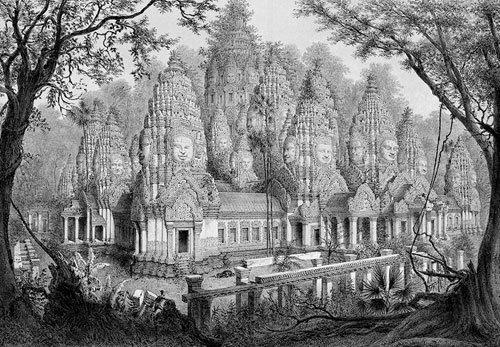
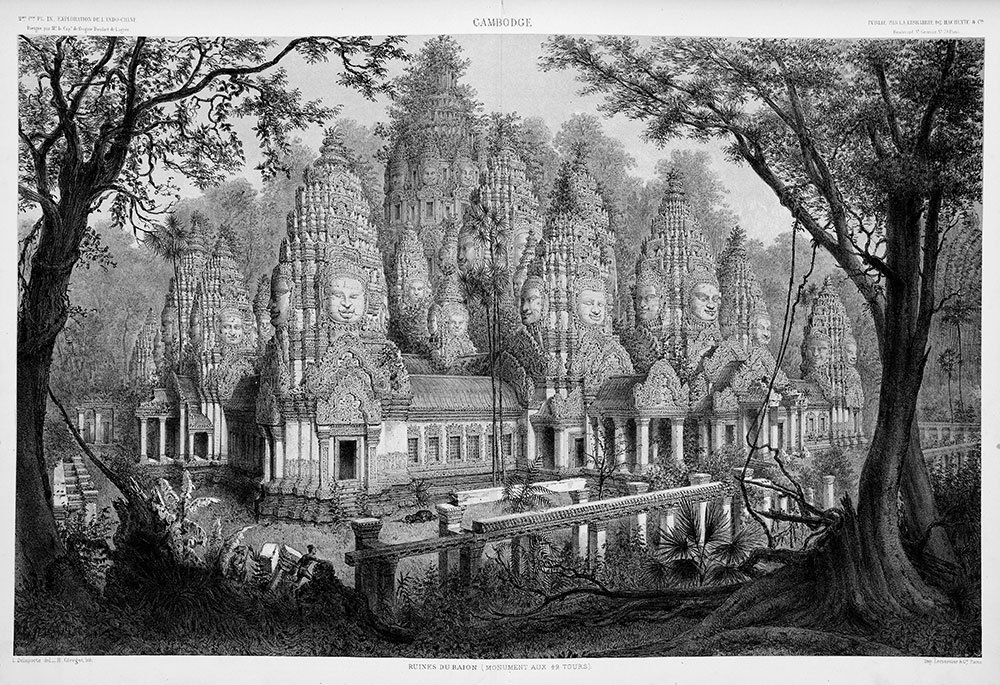
In the nineteenth century, the whole French nation fell in love with the image of a lost city. The image was that of Angkor as the climax of a glorious civilisation, now entombed in jungle. It resonated powerfully with the myth of Sleeping Beauty, who will waken when the right man reaches her. She is fatal to others and men did die in their quest: the naturalist Henri Mouhot in 1861, Commander Doudart de Lagree in 1868, the attache Louis de Carne in 1870. The man who didn’t die, Louis Delaporte, spent the rest of his long life cherishing Angkor. A naval officer, artist and musician, he had been with Lagree on the scientific mission to chart the Mekong when he first saw Khmer art in 1866 and felt the urge to bring back to France the work of “a great and vanished people”.
There was of course an overt colonial agenda, for Cambodia was part of the Indo bit of Indochina — a concept conveniently invented in the 1860s by the geographer Malte-Brun, Vietnam being the China bit. Exposing Angkor would show the world how wonderful Khmer civilisation had been and, by extension, how much it would flourish under colonial tutelage, an idea brilliantly explored in Penny Edwards’ Cambodge: The Cultivation of a Nation 1860–1945. France had at the time little to congratulate itself on; it had been humiliatingly invaded by Germany in 1870–71 and had lost Alsace. Angkor Wat may well have seemed a proxy for Strasbourg Cathedral, which happens to be more or less contemporary.
Delaporte returned several times to Cambodia, by then a French Protectorate, to study and remove art works, with permission from King Norodom — a convivial man more interested in European science than in ancient ruins. Fortunately, Angkor was off-limits, as it was still technically part of Siam but, through bribery and deceit, Delaporte managed in 1873 to take away part of the huge Preah Khan balustrade and have moulds made of Bayon and Angkor Wat carvings.
More from Mekong Review
-

Poetry from Clarity Lim
-
Poetry from Richard Milazzo
-
Poetry from Maung Day